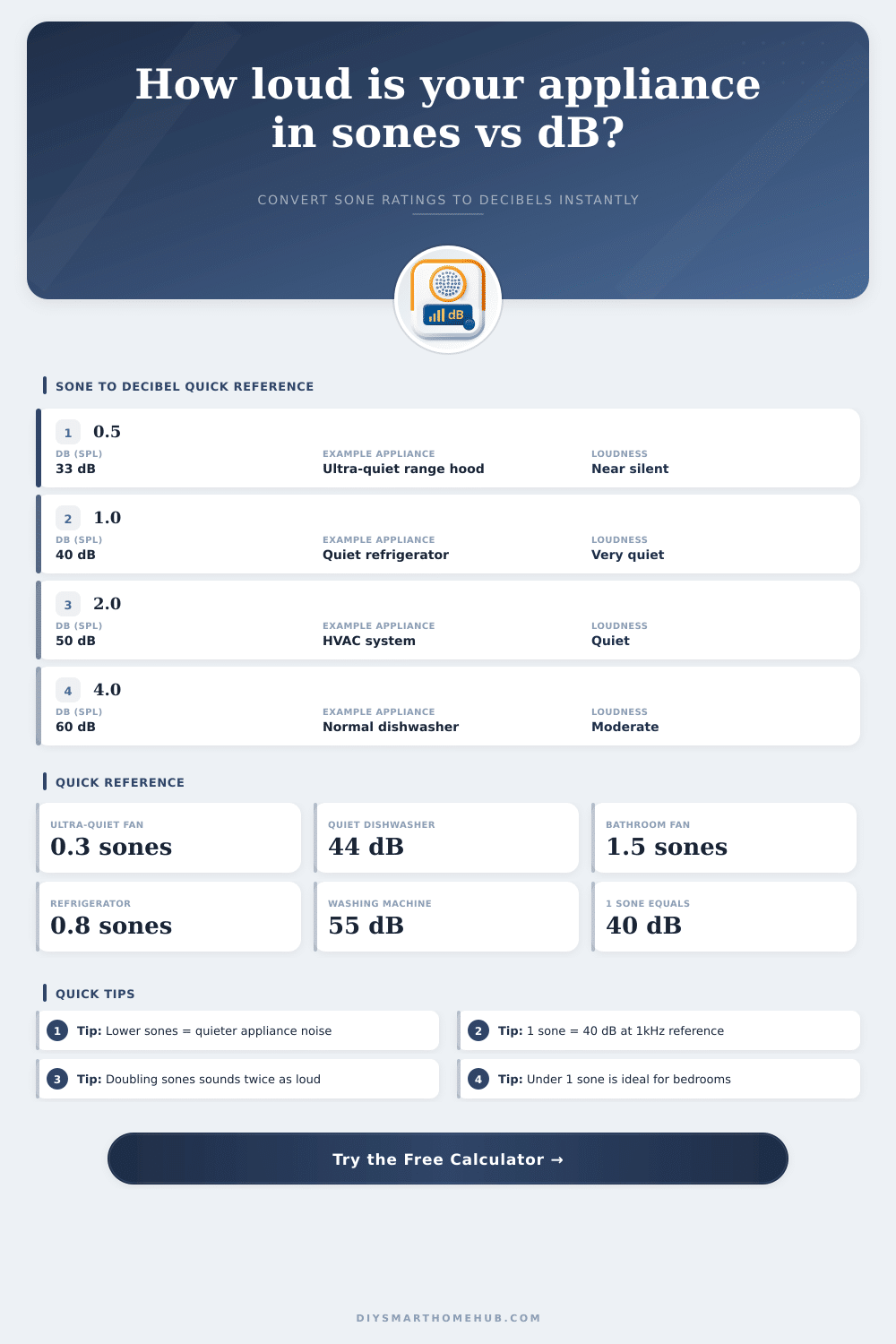
🔊 Sone to Decibel Converter
Convert between sones and decibels for smart home appliance and HVAC noise planning
| Sones | dB (SPL) | Example Appliance | Perceived Loudness |
|---|---|---|---|
| 0.25 | 30 dB | Barely audible hum | Near silent |
| 0.5 | 33 dB | Ultra-quiet range hood | Very quiet |
| 0.8 | 37 dB | Quiet refrigerator | Very quiet |
| 1.0 | 40 dB | Quiet room / fan at low | Quiet (reference) |
| 1.5 | 44 dB | Bathroom exhaust fan | Quiet |
| 2.0 | 50 dB | HVAC / dishwasher quiet | Moderate |
| 3.0 | 55 dB | Washing machine (gentle) | Moderate |
| 4.0 | 60 dB | Normal dishwasher / TV | Moderate-loud |
| 6.0 | 65 dB | Loud range hood | Loud |
| 8.0 | 70 dB | Vacuum on carpet | Loud |
| 12.0 | 75 dB | Very loud appliance | Very loud |
| 16.0 | 80 dB | Industrial blower / loud vacuum | Very loud |
| Appliance | Typical Sones | dB Equiv. | Quiet Threshold | Category |
|---|---|---|---|---|
| HVAC / Range Hood | 0.3 – 6.5 | 30 – 66 dB | < 1.5 sones | Quiet < 45 dB |
| Dishwasher | 1.5 – 4.0 | 44 – 60 dB | < 2.0 sones | Quiet < 50 dB |
| Washing Machine | 2.5 – 5.0 | 52 – 63 dB | < 3.0 sones | Quiet < 55 dB |
| Refrigerator | 0.5 – 1.5 | 33 – 44 dB | < 1.0 sone | Quiet < 40 dB |
| Smart Speaker | 0.8 – 3.0 | 37 – 55 dB | < 1.0 sone | Quiet < 40 dB |
| Bathroom Fan | 0.5 – 4.0 | 33 – 60 dB | < 1.5 sones | Quiet < 44 dB |
| Vacuum Cleaner | 4.0 – 10.0 | 60 – 73 dB | < 4.0 sones | Moderate 55–65 dB |
| White Noise Machine | 1.0 – 2.5 | 40 – 52 dB | < 1.5 sones | Quiet < 45 dB |
Sone to decibel converter is a tool that changes between sones (perceived loudness) and decibels (dB) for exact measurements of sound levels. You use sones to estimate noise of devices like kitchen fans, bathroom fans and range hood fans. One sone matches sound in around 1 000 Hz with level of 40 decibels above the standard benchmark level.
The sone shows subjective loudness as it feels in human ear where 1 sone corresponds to 40 dB in 1 kHz
How to Convert Sones to Decibels
Decibel measures loudness or more exactly pressure. The dBA-scale deals with noises in the hearing range of people. Above 82 dBA hearing protection is needed if you are inside 5 feet.
Hence it matters to know how loud something really is.
In books you separate loudness level with units phon and loudness with units sones. 40 phon match to 1 sone. Sound in 20 decibels has around 20 phon depending on the measurement.
Convert of phon to dB is not simple or pure becuase.
Sone units make more sense for how people actually hear. 10 sones sound twice as loud as 5 sones. 20 sones are four times louder than 5 sones.
Sones consider human perception rather than decibels that started from electrical measurement. Sone is unit of perceived loudness that includes pitch and volume so direct course to dB not always makes sense.
Even so charts and calculators help. For instance, 1 sone matches 28 dB. In 2 sones it reaches around 38 dB.
In 5 sones roughly 51 dB. In 10 sones around 60 dB. In 30 sones around 77 dB.
In 50 sones roughly 84 dB. You cannot convert frequency to decibels. Frequency and loudness are two different things.
Bathroom fan with 1 sone matches to 28 dB. Someone estimated in 0.3 sone showed after online conversion only around 11 dB. Other source pointed 0.3 sone at 22.5 dBA.
There are converters that handle 25 or more sound and acoustic units including dB SPL, dBA and dBC, as well as sound pressure units as pascal and micropascal, sound intensity and psychoacoustic units as phon and sone.
Computer fan estimated in 0.9 sone compared to stock in 4.9 sones show big difference. Convert between these units is useful for picking quiet hardware or home devices. Free online calculators simplify immediate change of decibels to sones, and they work for HVAC, fan noise rating and acoustic measures.