CFM to MPH Calculator
Convert fan or duct airflow (CFM) to wind speed (MPH), FPM, m/s, and km/h for smart home ventilation systems.
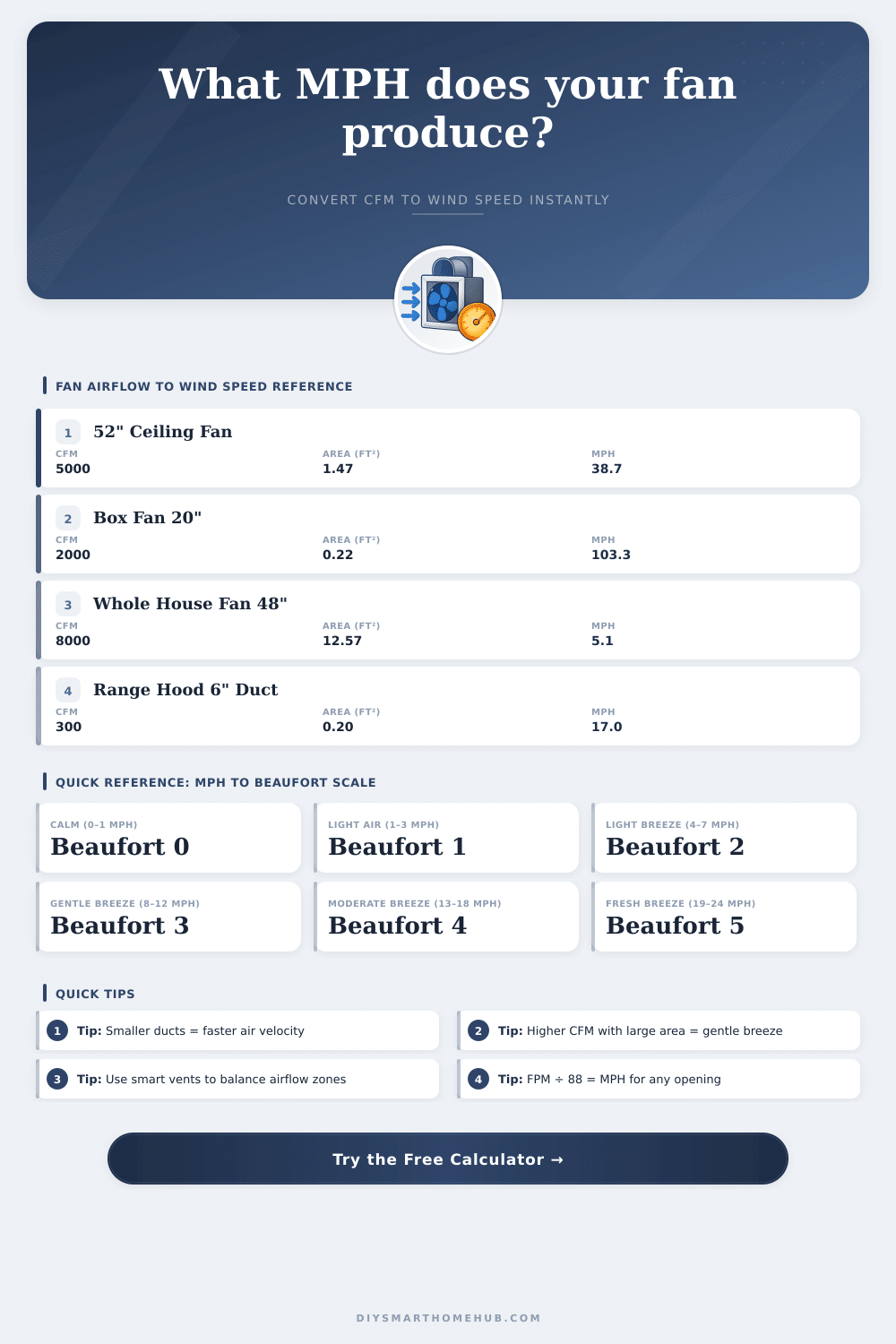
Air velocity (MPH) depends on both CFM and the opening size. A small duct at 300 CFM creates faster air than a large ceiling fan at the same CFM.
Use FPM to size ducts — ASHRAE recommends 600–900 FPM for supply ducts. Convert to MPH to understand perceived comfort and wind-chill effect.
Calculator
Quick Presets
Fan & Duct Airflow Spec Grid
| Fan / Duct | Size | CFM | Area (ft²) | FPM | MPH | m/s |
|---|---|---|---|---|---|---|
| 52" Ceiling Fan | 52" dia | 5,000 | 1.47 | 3,401 | 38.7 | 17.3 |
| Box Fan 20" | 20" dia | 2,000 | 0.22 | 9,095 | 103.4 | 46.2 |
| Whole House Fan 48" | 48" dia | 8,000 | 12.57 | 636 | 7.2 | 3.2 |
| Range Hood 6" Duct | 6" dia | 300 | 0.196 | 1,531 | 17.4 | 7.8 |
| HVAC Supply 6" Duct | 6" dia | 100 | 0.196 | 510 | 5.8 | 2.6 |
| Attic Fan 24" | 24" dia | 3,000 | 3.14 | 955 | 10.9 | 4.9 |
| Smart Vent 6×10 | 6"×10" | 150 | 0.417 | 360 | 4.1 | 1.8 |
| Bathroom Fan 4" | 4" dia | 80 | 0.087 | 920 | 10.5 | 4.7 |
Beaufort Scale – Fan Wind Speed Reference
| Beaufort | MPH | m/s | Description | Equivalent Fan Scenario |
|---|---|---|---|---|
| 0 | 0–1 | 0–0.5 | Calm | Smart vent at low setting |
| 1 | 1–3 | 0.5–1.5 | Light Air | HVAC supply vent, large area |
| 2 | 4–7 | 1.6–3.3 | Light Breeze | Whole house fan, large grille |
| 3 | 8–12 | 3.4–5.5 | Gentle Breeze | Attic fan 24", bathroom fan 4" |
| 4 | 13–18 | 5.5–8.0 | Moderate Breeze | Range hood 6" duct at 300 CFM |
| 5 | 19–24 | 8.0–10.7 | Fresh Breeze | 52" ceiling fan at 5000 CFM |
| 6 | 25–31 | 10.7–13.8 | Strong Breeze | High-velocity duct output |
| 7+ | 32+ | 13.8+ | Near Gale+ | Box fan 20" at 2000 CFM |
Fan Opening Size – CFM at Various Velocities
| Diameter / Size | Area (ft²) | CFM @ 5 MPH | CFM @ 10 MPH | CFM @ 15 MPH |
|---|---|---|---|---|
| 4" round | 0.087 | 38 | 77 | 115 |
| 6" round | 0.196 | 86 | 173 | 259 |
| 8" round | 0.349 | 154 | 307 | 461 |
| 12" round | 0.785 | 346 | 691 | 1,037 |
| 20" round | 2.182 | 960 | 1,920 | 2,880 |
| 24" round | 3.14 | 1,382 | 2,765 | 4,147 |
| 48" round | 12.57 | 5,531 | 11,062 | 16,594 |
| 6×10" rect | 0.417 | 183 | 367 | 550 |
CFM means cubic feet per minute and it describes the volume flow of gas through a pipe or vent. This volume flow shows how much gas goes through the system, but it does not always help to imagine how quickly it moves. MPH, instead, is miles per hour and says the actual speed the air moves.
You often need to convert between these two values, whether talking about pipes, engines or leaf blowers.
What CFM and MPH Mean for Leaf Blowers
Air speed is usually expressed in linear feet per minute. If you multiply the air speed by the cross area of a pipe, it is possible to count the air volume that passes a spot in the pipe during one unit of time. That volume flow you usually measure by CFM.
So, to go from CFM to MPH, the cross area is very important. When the area is known, the math stays quite simple: for instance, 1000 CFM through 1 square foot gives 1000 feet per minute, which is roughly 1000 divided by 88, or around 11,36 MPH.
A smaller opening or nozzle with the same CFM will give higher air speeed. There are online calculators that let folk play with that and see the difference between big and small openings according to air speed. The speed adjusts depending on what nozzle is used.
CFM helps you understand how much air can flow through a narrow nozzle to create fast air, while MPH does not really show how that could change with different sized attachments.
This really matters for leaf blowers. CFM measures the amount of air that the blower moves during a minute. High CFM rating means that more leaves can be removed immediately.
MPH shows the speed of the air exiting from the nozzle of the blower. Higher MPH gives stronger push to move wet, heavy or stuck garbage. With high CFM you can quickly clean a big pile of leaves, but maybe do not blow them far.
With high MPH, leaves can be pushed very far, but the pile will be smaller.
Good CFM for most yards is between 400 and 700, depending on the size of the area. For smaller yards, 150 to 400 CFM usually suffices. For most uses, good MPH is around 110 to 200.
Simply said: the higher the CFM, the more leaves and garbage you can move in one minute. MPH is a more direct measure that most folks are already used to.
A good way to compare the force of blowers is to multiply the CFM by the MPH. That is a bit like asking whether torque or RPM matters more, one without the other does not say much. When you multiply the two numbers, you receive a clearer image of the real performance.