Air Compressor CFM Calculator
Find the exact CFM and tank size your workshop needs — smart garage & automation ready.
Quick Presets
Tool Configuration
Compressor Settings
Results
Compressor Specifications
Compressor Analysis
Air Tool CFM Spec Grid @ 90 PSI
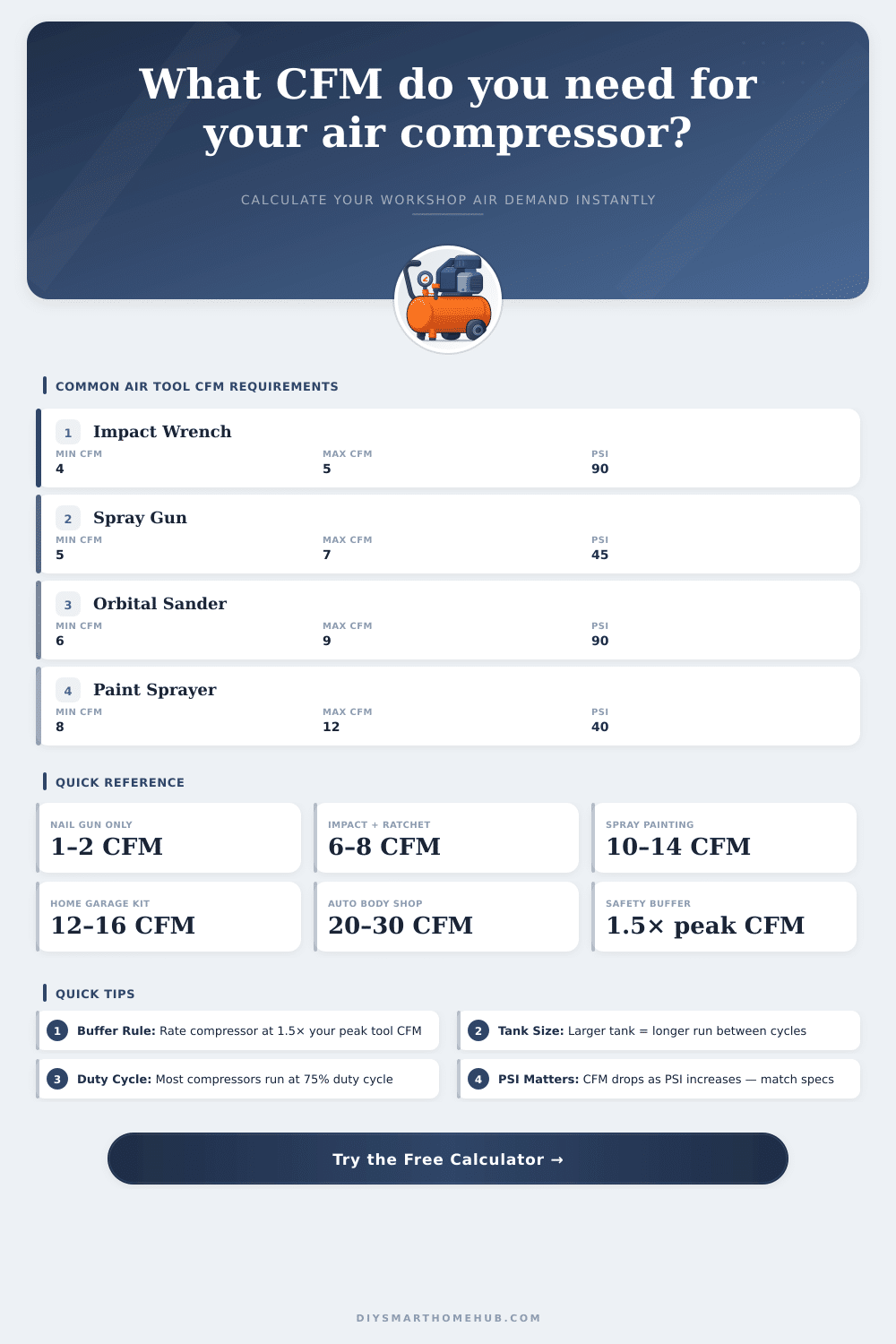
Tool CFM Requirements Reference
| Tool | Min CFM | Max CFM | Operating PSI | Duty Cycle |
|---|---|---|---|---|
| Impact Wrench (1/2") | 4 | 5 | 90 | Intermittent |
| Air Ratchet (3/8") | 3 | 4 | 90 | Intermittent |
| Nail Gun / Nailer | 1 | 2 | 70–90 | Low |
| Spray Gun | 5 | 7 | 40–50 | Continuous |
| Angle Grinder | 4 | 5 | 90 | Moderate |
| Orbital Sander | 6 | 9 | 90 | Continuous |
| Blow Gun | 1 | 2 | 90 | Low |
| Tire Inflator | 1 | 2 | 150–175 | Low |
| Paint Sprayer (HVLP) | 8 | 12 | 40 | Continuous |
Compressor Size Selection Guide
| CFM Output | HP | Tank Size | Suitable Applications |
|---|---|---|---|
| 1–3 CFM | 1–1.5 HP | 6 gal | Nail guns, tire inflation, blow guns |
| 3–5 CFM | 1.5–2 HP | 20 gal | Air ratchet, small impact wrench |
| 5–8 CFM | 2–3 HP | 30–60 gal | Impact wrench, grinder, spray gun |
| 8–12 CFM | 3–5 HP | 60 gal | Spray painting, continuous sanding |
| 12–20 CFM | 5–7.5 HP | 80 gal | Home garage full kit, auto body |
| 20+ CFM | 7.5+ HP | 120+ gal | Commercial shop, multiple users |
CFM measures how many cubic feet of air flow in minute. That shows the speed of airflow inside or outside space For compressed air it shows the flow or output, how much air exits from the compressor. So, CFM says how much volume of air the compressor delivers in a set pressure level.
PSI and CFM are different ways to estimate the power of a compressor. PSI measures the pressure, while CFM the volume. Imagine CFM as gallons in minute in a water system, and PSI as pounds in square inch, that is pressure.
CFM, PSI and SCFM: How to Choose the Right Air Compressor
CFM estimates amount of moving air, PSI its force.
There is also SCFM, which is standard cubic feet in minute. The difference: SCFM always calcualtes in standard conditions, 14.7 psi atmospheric pressure, 68 degrees Fahrenheit and 36% relative humidity. Because of that SCFM values usually surpass average CFM numbers.
The calculation for CFM is really easy. It is volume in cubic feet divided by minutes. You estimate compressor according to CFM in fixed pressure.
Those ratings best help for long use, not for short needs. Big tank only helps moments, but the motor power causes the continuous output.
Compressors with high flow, for instance 200 CFM, work for big tasks as HVAC systems. It depends on what you will use the air for, that CFM you require. If tools require 16 CFM in 100 psi, then compressor of 24 to 30 CFM avoids running permanently.
For three mechanics with total 12, 15 CFM, multiply by 1.25 for 15; 19 CFM, so 5 to 7.5 HP compressor would work.
For long usage of tools choose compressor with 100% duty cycle, so that tools operate without stop. Spray guns consume much air, just as some tools and paintrs. Sum the whole consumption for estimate involved CFM.
Most folks have only 120V with 15 amp circuits, which gives around 2 HP engine and 6 CFM pump. Take the biggest tank possible. Oiled compressors last more than oil-less.
When air compacts, it makes moisture, that builds below in the tank and cause rust up, so drain regular the moisture.
Common mistake is bad piping, that stops air reaching the usepoint. Reducers in the line steal volume. Nice swivels, little pipe diameters and pipe reducers commonly fault.
Many folks successfully paint with 5 CFM compressors and 20 gallon tanks, but biggerwould help.