Duct Plenum Size Calculator
Size supply and return plenums by airflow, velocity, and shape
Unit System
Quick Presets
Calculator Inputs
Plenum Sizing Results
Supply Plenum — Rectangular
Calculation Breakdown
Velocity Recommendations by Application
| Application | Min FPM | Recommended FPM | Max FPM |
|---|---|---|---|
| Residential Return Plenum | 200 | 300–400 | 500 |
| Residential Supply Plenum | 400 | 500–700 | 800 |
| Commercial Return Plenum | 300 | 400–500 | 600 |
| Commercial Supply Plenum | 500 | 600–800 | 1000 |
| Industrial Supply Plenum | 600 | 800–1000 | 1200 |
| Quiet / Noise-Sensitive Area | 150 | 200–300 | 400 |
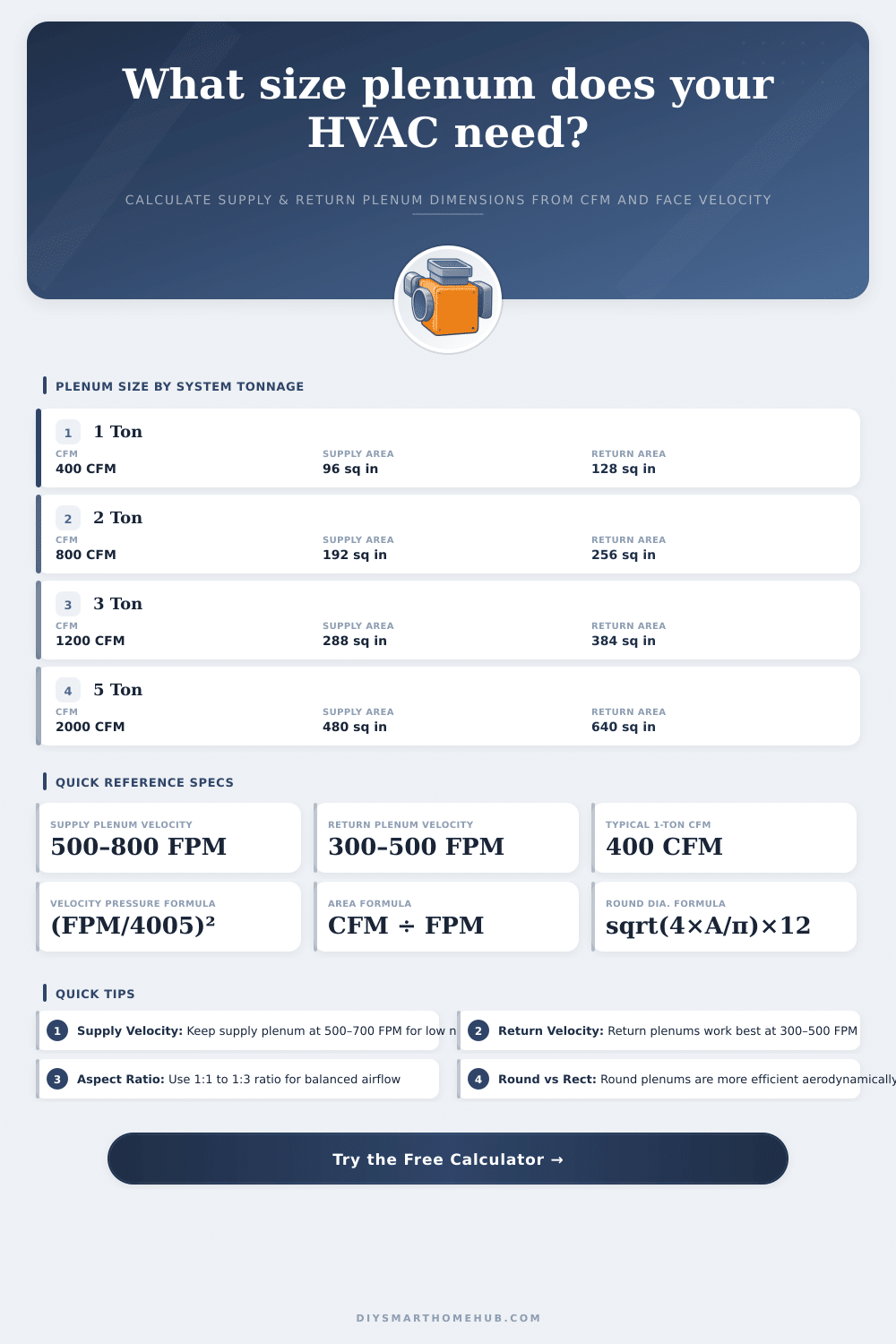
Plenum Sizing by System Tonnage
| System Tons | Typical CFM | Supply Area (sq in) | Return Area (sq in) |
|---|---|---|---|
| 1 Ton | 400 CFM | ~80–96 | ~100–128 |
| 1.5 Ton | 600 CFM | ~96–120 | ~128–180 |
| 2 Ton | 800 CFM | ~128–160 | ~160–256 |
| 2.5 Ton | 1000 CFM | ~160–200 | ~200–300 |
| 3 Ton | 1200 CFM | ~192–240 | ~240–384 |
| 4 Ton | 1600 CFM | ~256–320 | ~320–512 |
| 5 Ton | 2000 CFM | ~320–400 | ~400–640 |
| 7.5 Ton (Comm.) | 3000 CFM | ~480–600 | ~600–960 |
Common Air Handler Specifications
| Air Handler Model Size | Rated CFM | Supply Opening | Return Opening |
|---|---|---|---|
| AH-018 (1.5 Ton) | 600 CFM | 10 x 12 in | 14 x 14 in |
| AH-024 (2 Ton) | 800 CFM | 12 x 12 in | 14 x 16 in |
| AH-036 (3 Ton) | 1200 CFM | 14 x 14 in | 16 x 20 in |
| AH-048 (4 Ton) | 1600 CFM | 16 x 16 in | 20 x 20 in |
| AH-060 (5 Ton) | 2000 CFM | 18 x 18 in | 20 x 24 in |
| AH-090 (7.5 Ton) | 3000 CFM | 20 x 24 in | 24 x 30 in |
The supply plenum is basically that box that sits directly on the air handler or the furnace and it pushes conditioned air through the ducts to every room One can consider it as the heart of the HVAC system. You must choose the right size because too small a size causes noise, loss of pressure and bad distribution of air.
Good rule for the plenum depth is to make it about 2.5 times bigger than the diameter of the fan for good flow. The area of the plenum should match or be more than the outlet of the fan or the air handler. Usually, the plenum box has the same size as the supply side of the furnace, and the size of the ducts depend on the need of every zone.
How to Size a Supply Plenum
Every job is different, but when you do that correctly, the result is equal flow of air.
Regarding the proporitons of the box, the width should be around 2 to 3 times bigger than the connecting supply trunk. The best length is twice the width, but it can range between one and three times. A plenum with length of at least 2 feet works well, but 4 feet are even better.
The branch ducts are measured according to the amount of air required in the various rooms; that measurement is key so that each place receive enough air.
Normal supply plenum measures about three feet long if it is on slab coil, and four feet on box coil or air handler. Ceiling return plenums most commonly are three feet high. Plenums can be installed at every end of the furnace or cooling coil, and they are measured to match that opening, usually no longer than 20 or 25 inches.
Out of the plenum exits the trunk duct, and usually there is only one such duct on the return side.
If the supply plenum is too short, that can create problems, depending on how quickly the ducts get smaller later. For instance, you had a supply plenum of 22x19x19, connected to a 5-foot trunk duct of 26×9, that later got smaller to an 18-foot duct of 20×9 to provide seven vents.
The return air commonly is too small, which creates its own problems. In systems with two return ways, every way should not be longer than 30 feet from the return plenum to the filter grille. When you need to bend the duct, metal elbows are better than flex.
Every return way can have up to 180 degrees of total curve, but no more than 90 degrees from that must be flexible duct.
Before you decide the size, you must first count the load needs of the house. Only then you choose the unit size to satisfy that load. Later, you design the supply and return ducts to deliver the air required for the various areas.
Custom plenums can be made in any size to fit the dimensions. The smallest duct used on runs should be six inches. If you use a calculator for ducts, 700 feet each minute at.08 are good for a silent system.