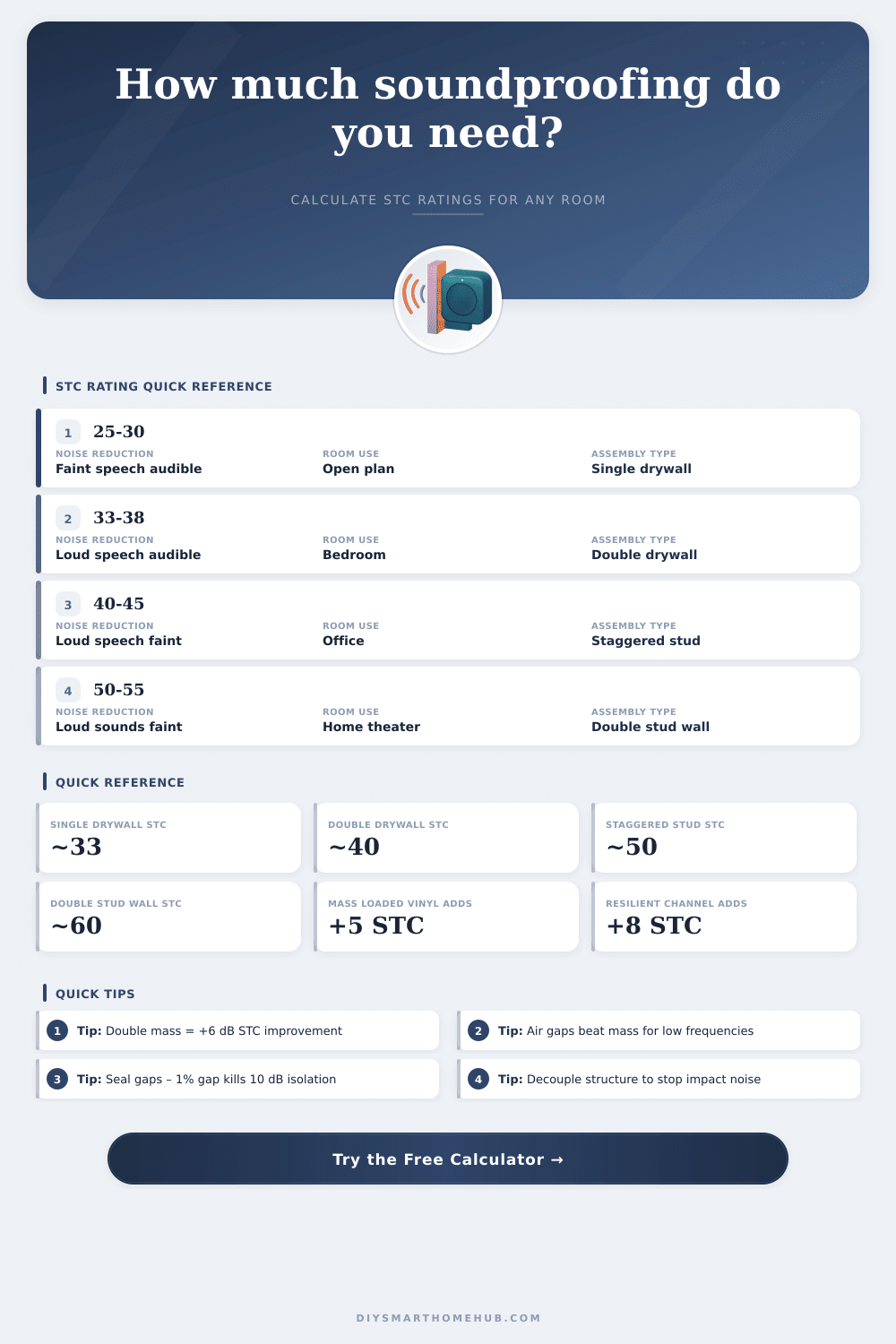
🔇 Soundproofing Calculator
Calculate the STC rating and wall assembly needed to achieve your target noise reduction for any smart home room.
| Noise Source | Source dB | Room Use | Required STC | Recommended Assembly |
|---|---|---|---|---|
| City Traffic | 70–80 dB | Bedroom | 45–55 | Double drywall + resilient channel |
| Highway | 80–90 dB | Bedroom | 55–65 | Double stud + MLV + RC |
| Living Room TV | 60–70 dB | Home Office | 25–35 | Single or double drywall |
| Living Room TV | 60–70 dB | Home Theater | 40–50 | Staggered stud + green glue |
| Hallway Conversation | 55–65 dB | Office | 20–30 | Single drywall + solid door |
| Music / Band | 95–110 dB | Neighbor Room | 60–75 | Double stud + MLV + RC + damping |
| HVAC / Mechanical | 70–85 dB | Sleep Room | 45–60 | Double drywall + MLV |
| Party / Bass | 85–100 dB | Apartment Neighbor | 55–70 | Double stud + full decoupling |
| Server Fan Noise | 50–65 dB | Adjacent Room | 25–40 | Double drywall + door seal |
| Podcast Recording | 40–55 dB | Quiet Room | 20–35 | Single drywall + acoustic door |
| Construction Type | Base STC | Mass (kg/m²) | Typical Application |
|---|---|---|---|
| Single Layer Drywall (12mm) | 33 | 9.8 | Interior partitions, closets |
| Double Layer Drywall (2x12mm) | 40 | 19.5 | Bedrooms, offices |
| Double Layer + Green Glue | 45 | 19.5 | Home office, study rooms |
| Double Layer + Resilient Channel | 48 | 19.5 | Bedrooms near noise |
| Staggered Stud Wall | 50 | 22 | Apartment party walls, theaters |
| Staggered Stud + RC + Glue | 56 | 22 | Home theaters, music rooms |
| Double Stud Wall (50mm air gap) | 60 | 25 | Recording, broadcast studios |
| Double Stud + MLV + RC + Glue | 68 | 35 | Professional isolation rooms |
| Mass Loaded Vinyl (add-on) | +5 | +6 | Any assembly upgrade |
| Resilient Channel / Clips (add-on) | +8 | 0 | Decoupling upgrade |
| Green Glue / Damping (add-on) | +5 | 0 | Viscoelastic damping upgrade |
Soundproofing is any method for reducing sound between a source and the person or device that hears it. There are several basic ways for reducing noise: you can expand the distance between the source and receiver, use noise barriers to reflect or absorb the energy of sound, or use damping structures so that the sound disappears. Basically, soundproofing means adding mass and density to a building to seize or block sound
Soundproofing operates in three main ways. First, it blocks noise by adding mass to a structure, so that the sound energy is reflected or converted to heat. Second, it separates one structure from another, which stops the vibration waves from travelling through the materials.
Easy Ways to Soundproof Rooms and RVs
The main target of soundproofing is reducing the leak of sound in or out of a room.
Open windows let air in the room, but they also let in sound, because the air carries sounds. Even so, closing the window does not entirely remove the noise, because sound also travels through the glass and the wooden frame. Hence, sealing the room against air is a good first step to reach better soundprofoing.
For walls, there are various ways to improve the soundblocking. A very efficient method for reducing sound through a wall or ceiling is to use two layers of drywall assembled with a product called Green Glue. Green Glue is a non-hardening damping material; if you strike a wall with it, it sounds as if you would strike brick.
Other options include viscoelastic glue, soundproofing drywall, soundproof putty, thick channels or sound clips. Because air at the base of walls and doors lets through much sound, special attention to the airtight joint will be very useful.
Techniques for ceilings can include adding a second layer of drywall with damping material, installation of thick channels or insulating clips, or use of dense acoustic insulation above the ceiling tiles. Quiet Batt is an excellent product for soundproofing and thermal insulation, created for internal and exterior walls, ceilings and attics. You can install it by means of a tight hold between wooden or metal studs.
Even so, actually full soundproofing solutions are very costly. Many folks simply lay pads or panels to reduce the reverberation in a room, but actually there do not exist such things as “soundproof panels“. Soundproof rooms are best planned and built from the start.
Some rooms it is possible to convert, if they already have enough space. Using a machine for “white noise” or even just a fan is a cheap and simple way to help against usual household noise. That solution probably will be more efficient than many other attempts.
RVs are known as noisy. The motor noise in a motorhome can become stressful, especially in old models. The cover of the engine-box between the front seats commonly is only a bit of plastic with very little insulation.
Applying insulation under or above the floor and adding little carpets can help reduce the noise.