🌙 Melanopic Lux Calculator
Calculate circadian stimulus (CS) and melanopic lux for smart home lighting automation
✨ Circadian Lighting Results
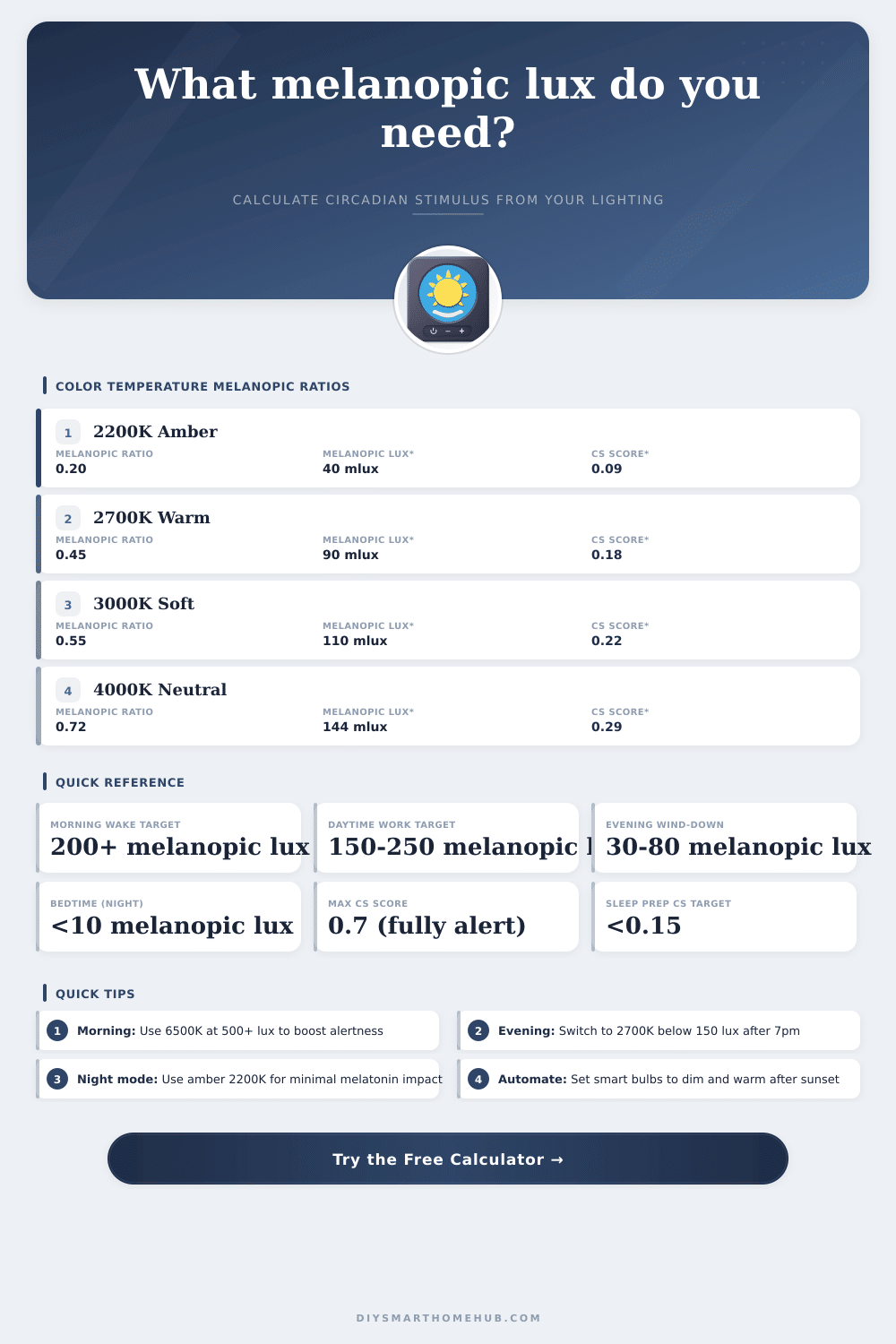
| Time / Activity | Target Melanopic Lux | CS Target | Photopic @ 3000K | Photopic @ 5000K |
|---|---|---|---|---|
| Morning Wake-Up | 200–400 mlux | 0.35–0.55 | 364–727 lux | 222–444 lux |
| Daytime Work / Focus | 150–300 mlux | 0.29–0.45 | 273–545 lux | 167–333 lux |
| Neutral Maintenance | 80–150 mlux | 0.18–0.29 | 145–273 lux | 89–167 lux |
| Evening Wind-Down | 30–80 mlux | 0.09–0.18 | 55–145 lux | 33–89 lux |
| Sleep Preparation | 10–30 mlux | 0.04–0.09 | 18–55 lux | 11–33 lux |
| Night / Bedtime | <10 mlux | <0.04 | <18 lux | <11 lux |
| Kitchen Cooking | 150–220 mlux | 0.29–0.38 | 273–400 lux | 167–244 lux |
| Reading / Desk | 120–180 mlux | 0.25–0.34 | 218–327 lux | 133–200 lux |
| CS Score | Melanopic Lux Equiv. | Circadian Impact | Typical Context |
|---|---|---|---|
| 0.00 – 0.05 | <15 mlux | Negligible | Very dim night light |
| 0.05 – 0.15 | 15–55 mlux | Minimal | Low-level bedroom lamp |
| 0.15 – 0.30 | 55–130 mlux | Moderate | Evening living room |
| 0.30 – 0.45 | 130–250 mlux | Strong | Bright office / kitchen |
| 0.45 – 0.55 | 250–400 mlux | Very Strong | Morning wake-up routine |
| 0.55 – 0.70 | >400 mlux | Maximum | Outdoor / skylight level |
Light does more than only help us see. It also affects the internal clock of the body, called the circadian rhythm For measure how strongly light works on the receptors controlling that biological rhythm, you use the unit “melanopic lux”. Rather than traditional lux, that only measures brightness for the eye, melanopic lux considers also the color spectrum and how it regulates our internal clock.
Traditional lux measures how much area is lit, which shows the perceived brightness. Because the lux curve reaches its peak around green, it is not a good measure even for blue lights, because here important is the setting of melanopsin, that corresponds most strongly to cyan. Hence, melanopic lux is described as a better way to measure the biological impacts of light on people.
Melanopic Lux and the Body Clock
The core of circadian lighting is called the melanopic response. Blue waves in daylight stop the production of melatonin in the body until after the dusk. By means of special cells, called ipRGCs, light with high frequency and intensity increases our vigour.
When that stimulus lacks, the body receives a signal to reduce energy expense and prepare for rest. Equivalent Melanopic Lux (EML) is a consitnent measure, that is weighed according to the ipRGCs instead of the cones, that traditional lux uses.
The WELL Building Standard used EML as a measure to find the biological impacts of light on people. Its recommendation for daytime melanopic EDI is 250 lux, measured vertically at the eye at a height of 1.2 metres. This hint bases on data of healthy adults between 18 and 55 years with regular daytime schedules.
If light has a low melanopic ratio, it requires higher photopic light intensity to reach that target.
Research proved that melanopic lux is the best predictor for changes of the focus of melatonin, although it does knot explain subjective sleepiness. Approximately 500 lux of daylight or 1000 lux of office lighting can pack the phase-shifting answer during a six-hour period.
Not all light sources give the same amount of melanopic lux. For instance, for every 100 lux of certain sources, only 39 melanopic lux are produced. Some makers now start to include melanopic ratios in their technical information.
To count EML, you multiply the illuminance on the vertical plane of the observer by a coefficient based on the spectrum of the light source. By means of software as spectral raytracing, you can foresee how much light is absorbed by non-visual photoreceptors, depending on the place and direction of the look. Also the system f.luxometer allows you to measure light and automatically count circadian metrics, as melanopic irradiance and the ratio between melanopic and photopic lightsource.