☀ Lux to Irradiance Calculator
Convert lux to irradiance (W/m²) for solar panels, grow lights, UV therapy, and smart home sensors. Supports bidirectional conversion across multiple light spectrums.
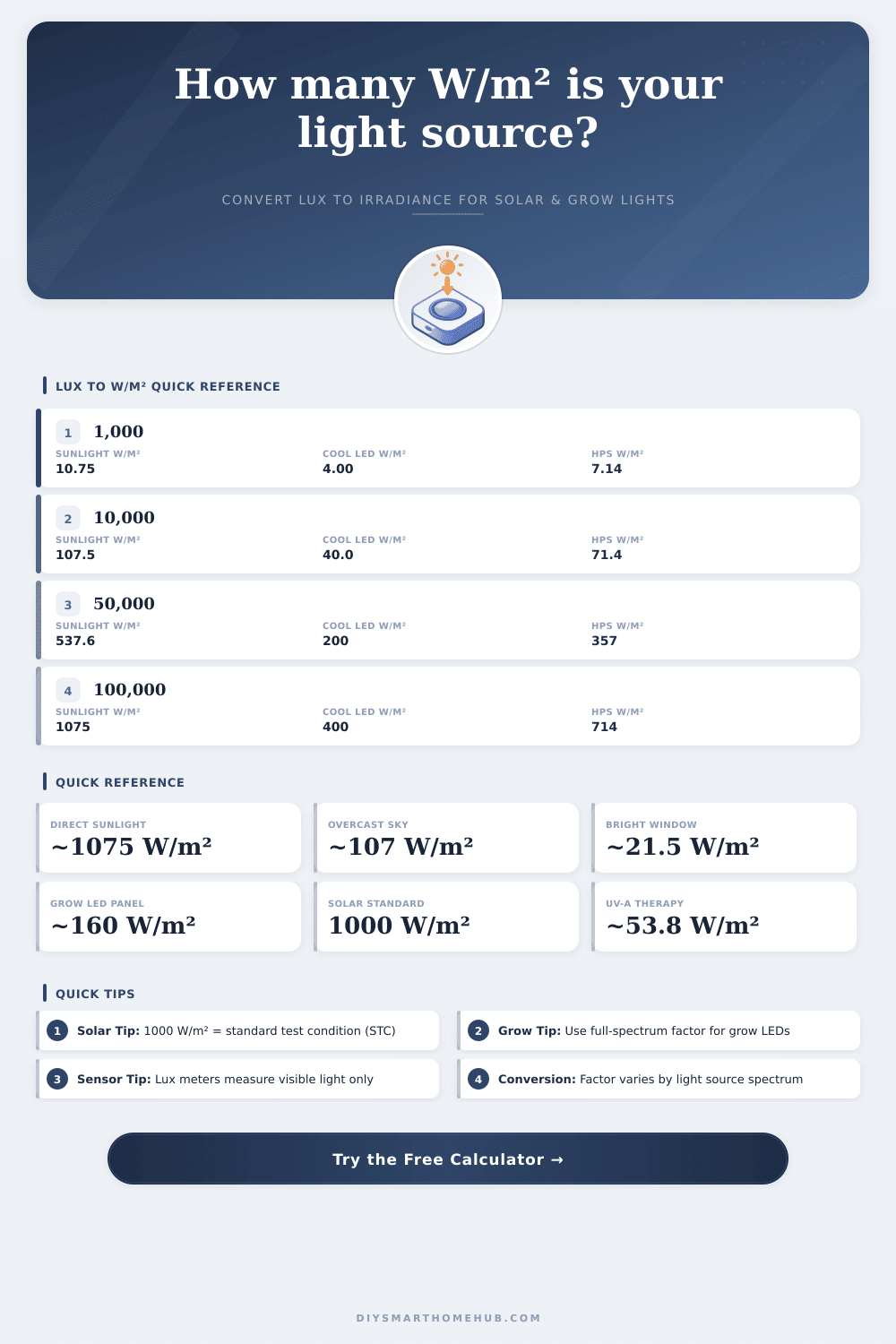
| Illuminance (lux) | Sunlight W/m² | Cool LED W/m² | HPS W/m² | Solar Context |
|---|---|---|---|---|
| 500 | 5.38 | 2.00 | 3.57 | Deep shade / dusk |
| 1,000 | 10.75 | 4.00 | 7.14 | Dawn / heavy overcast |
| 5,000 | 53.8 | 20.0 | 35.7 | Thick cloud cover |
| 10,000 | 107.5 | 40.0 | 71.4 | Overcast sky |
| 25,000 | 268.8 | 100 | 178.6 | Partly cloudy |
| 50,000 | 537.6 | 200 | 357.1 | Hazy sun / light cloud |
| 75,000 | 806.5 | 300 | 535.7 | Slightly hazy sun |
| 100,000 | 1075.3 | 400 | 714.3 | Direct full sunlight |
| 120,000 | 1290.3 | 480 | 857.1 | High altitude bright sun |
| Application | Typical Lux | Typical W/m² | Recommended Source Factor |
|---|---|---|---|
| Outdoor solar panel (peak) | 100,000 lux | ~1,075 W/m² | Sunlight (93 lm/W) |
| Outdoor solar panel (overcast) | 10,000 lux | ~108 W/m² | Sunlight (93 lm/W) |
| Indoor window (bright) | 2,000 lux | ~21.5 W/m² | Sunlight (93 lm/W) |
| Grow light (veg stage) | 20,000–40,000 lux | 100–200 W/m² | Full Spectrum LED (200 lm/W) |
| Grow light (flower stage) | 40,000–80,000 lux | 200–400 W/m² | Full Spectrum LED (200 lm/W) |
| UV-A therapy lamp | 5,000 lux | ~62.5 W/m² | Fluorescent (80 lm/W) |
| Office / task lighting | 500–1,000 lux | 2–4 W/m² | Cool White LED (250 lm/W) |
| Smart blinds / sensor target | 500 lux | ~2 W/m² | Cool White LED (250 lm/W) |
| Weather station pyranometer | ~93,000 lux equiv. | ~1,000 W/m² | Sunlight (93 lm/W) |
Solar irradiance is measured in watts per square meter, that is W/m² What is the problem? Irradiance meters cost a lot of money and struggle to pick up weak light signals. Light meters, on the contrary, do not cost much and they are quite good at finding dim conditions.
They measure luminous flux per unit area, which you call illuminance, and express it in lux (lumens per square meter). Hence, folks always ask how to convert lux into irradiance.
How to Convert Lux to Watts per Square Meter
Here where it becomes complicated: lux and W/m² do not measure the same thing. W/m² tells you the total irradiance. The total energy that hits a surface.
But lux is a photometric unit for illuminance, which means only the visible part of the light that hits that same surface. Because of that basic differece, the conversion is not simple.
The definition of a lumen relates specifically to green light: it is 1/683 watts of green light at 555 nanometers. Lux, so, equals one lumen spread on a square meter. At 555 nanometers, the wavelength where human eyes are most sensitive, the conversion reaches a maximum at roughly 683 lux per watt per square meter.
Otherwise said, around 1.464 milliwatts per square meter produce only 1 lux at that wavelength. If you shift to red or blue light, where our eyes are less sensitive, you receive fewer lux from the same irradiance. And at wavelengths that we cannot see?
Even less.
Solar light follows another pattern. For solar light exists an approximate rule of around 0.0079 W/m² per lux. One Sun…
Defined as 1,000 W/m², converts to roughly 120,000 lux. Even so, on the net you find various figures that range from 21,000 until 688,449 lux for that same 1,000 W/m² of solar irradiance. Studies checked by peers show values of luminous efficiency between 21 and 131 lumens per watt, which explains why there are so many various values.
Light meters are calibrated according to the CIE photopic luminosity function. Basically, they are set to match how the human eye perceives brightness. To convert it correctly, the math uses a thing called “maximum spectral luminous efficiency“, and that value is 683 lumens per watt.
We do that with a sample. Assume that you measure direct irradiance of 0.76 kilowatts per square meter. That means 760 W/m² if you multiply by 1,000.
From here, dividing by 0.0079, you reach roughly 96,202 lux.
Makers of lamps usually list their products in lumens, that is only the visible spectrum. Even so, many lighting engineers prefer to think in lux or foot-candles. Irradiance uses another way: it is an objective measure that shows exactly how much light energy plants can use for photosynthesis.
Because solar panels operate inside the visible spectrum, lux surprisingly are relevant alsohere.