🌱 Lux to PPFD Calculator
Convert grow light lux readings to PPFD (µmol/m²/s) for smart home gardening automation
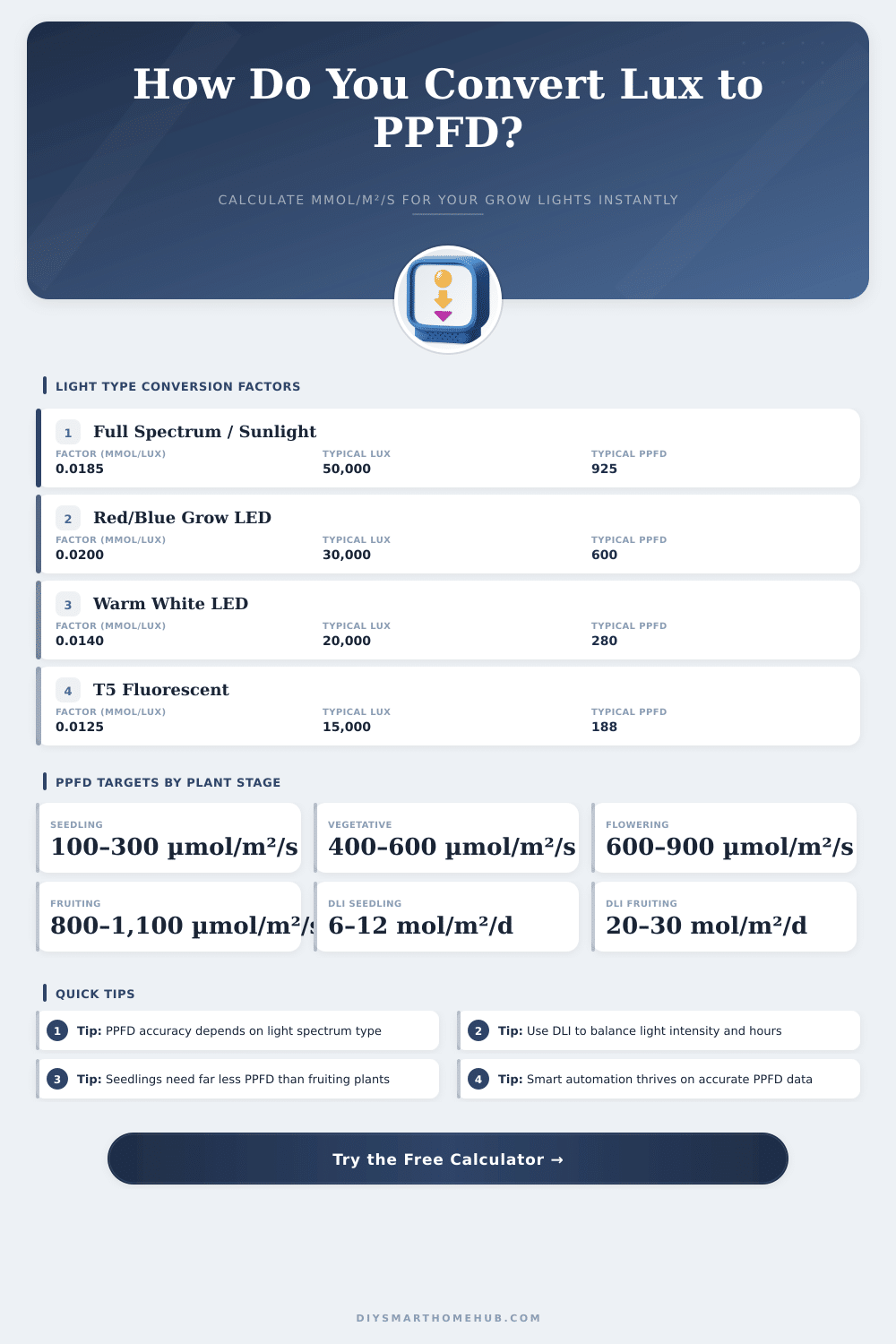
| Light Type | Conversion Factor | Typical Lux Range | Typical PPFD (µmol/m²/s) |
|---|---|---|---|
| Full Spectrum / Sunlight | 0.0185 | 40,000–100,000 | 740–1,850 |
| Cool White LED | 0.0130 | 10,000–50,000 | 130–650 |
| Warm White LED | 0.0140 | 10,000–40,000 | 140–560 |
| Red/Blue Grow LED | 0.0200 | 15,000–60,000 | 300–1,200 |
| HPS (High Pressure Sodium) | 0.0130 | 30,000–80,000 | 390–1,040 |
| T5 Fluorescent | 0.0125 | 5,000–25,000 | 63–313 |
| CMH / LEC | 0.0160 | 20,000–60,000 | 320–960 |
| Plant | Seedling PPFD | Vegetative PPFD | Flower/Fruit PPFD | DLI Target |
|---|---|---|---|---|
| Tomato | 150–250 | 400–600 | 800–1,000 | 20–30 mol/m²/d |
| Lettuce / Greens | 100–200 | 200–400 | 200–400 | 12–17 mol/m²/d |
| Cannabis | 200–300 | 400–600 | 800–1,000 | 25–40 mol/m²/d |
| Basil / Herbs | 100–200 | 250–450 | 300–500 | 12–20 mol/m²/d |
| Microgreens | 100–250 | 200–400 | N/A | 6–12 mol/m²/d |
| Succulents / Cacti | 150–250 | 300–600 | 400–700 | 12–22 mol/m²/d |
| Strawberry | 200–300 | 400–600 | 700–900 | 18–26 mol/m²/d |
| Pepper | 150–250 | 400–600 | 700–1,000 | 20–30 mol/m²/d |
Lux and PPFD are two different ways to measure light, but they are not the same thing Lux is based on how people see light, not on what plants actually use. For plants, PPFD is much more useful, because it measures the number of photosynthetically active photons that hit a surface. When you use lighting in greenhouses, lux or foot-candles do not exactly represent the real light intensity needed for photosynthesis.
If you want the best lighting (PAR), measuring PPFD is the right way.
Lux and PPFD: Simple Guide for Growing Plants
The problem is, that PAR meters can cost anywhere between 500 dollars or even more. Lux meters are cheap and relatively precise for comparison. Every modern phone has a lux sensor, although the results between various phones range a lto.
With a lux meter app, you can check if the light spreads well across the crown and get a rating of lux. Still, for higher accuracy, a calibrated lux meter is the best choice.
To convert lux to PPFD, you simply multiply the lux value by the proper factor of the used light source. This conversion factor usually ranges from 0.017 to 0.02, depending on the source. For instance, for white LEDs with a CRI of 80, a factor of 70 lux matches 1 PPFD, which gives a result inside 10% of the real value.
High CRI LED at 3000K have a number of around 52.554, while low CRI LED at 3500K have a number of about 62.3558. Just divide the lux value by the ratio of lumen-to-PPF to find the PPFD value.
Lux and PPFD are not perfectly convertible. Still, if you measure curves at the same time with a PAR meter and a specific lux meter, they can overlap enough to give a useful linear factor. You cannot use a universal conversion, unless you use a universal spectrum.
To find the conversion of a specific lamp, divide the PPF by the lumens.
When you use non-white sources, like “blurple” or red-blue grow lights, a lux meter will work as a precise PAR meter if the conversion value of that specific light is known. Online calculators exist that convert lux to PPFD for sunlight, fluorescent lamps, HPS and metal halide lamps. Full sunlight gives about 2000 µmol per meter squared per second, which corresponds to around 108,000 lux.
For growers, PPFD is a much more precise and reliable method to estimate grow lights for horticulture. It is also useful to know that using lower PPFD for a longer time usually works better for most species to reach the same DLI. Some plants will die if they receive more than 16 hours of light per day, but others, like sphagnum-mosses, grow best with 24hour of light.