Water Heater BTU Calculator
Calculate BTU/hr, kW, and recovery rate for any water heater — gas, electric, or heat pump
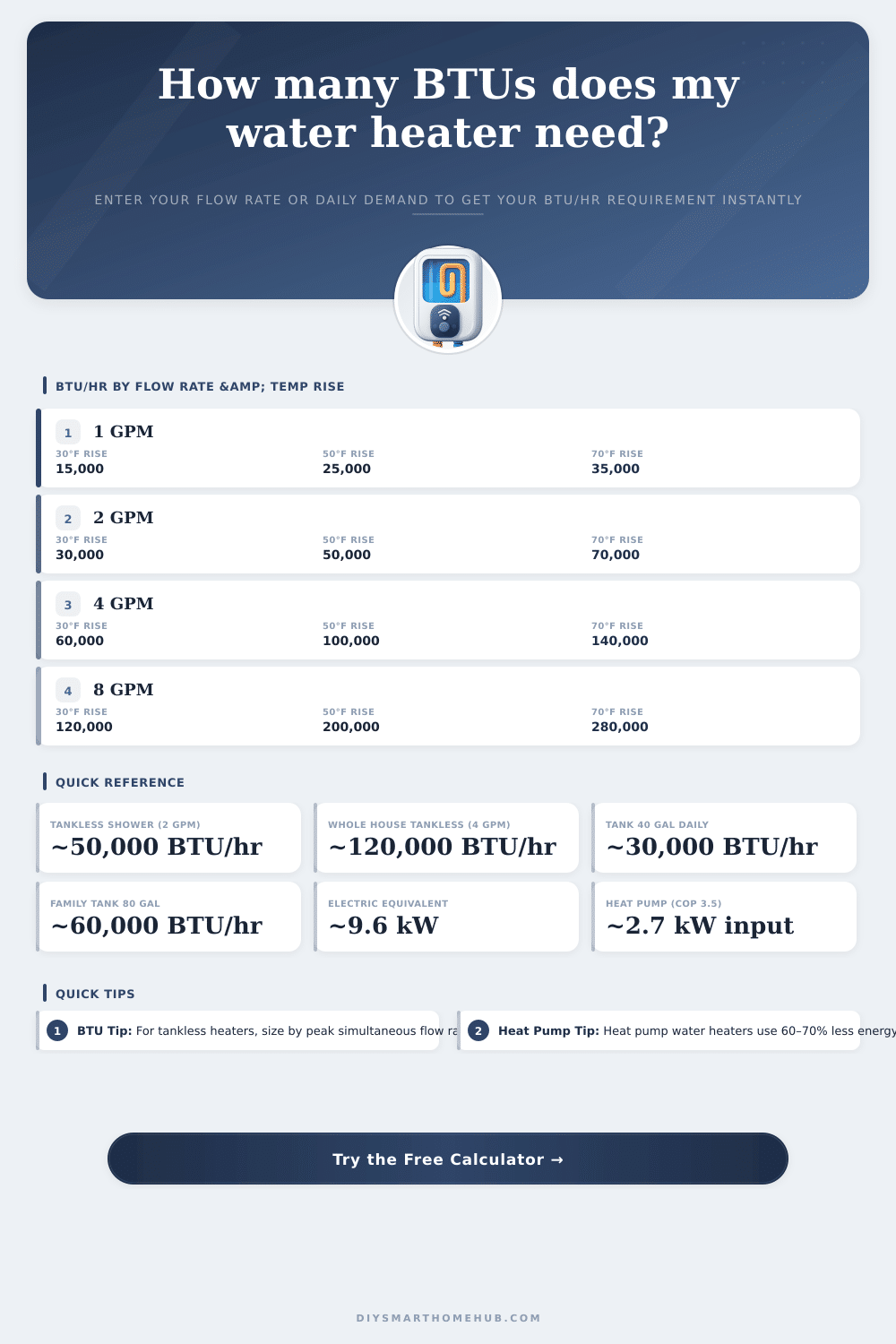
| Flow Rate | 30°F Rise | 50°F Rise | 70°F Rise | 90°F Rise |
|---|---|---|---|---|
| 1 GPM | 15,000 | 25,000 | 35,000 | 45,000 |
| 2 GPM | 30,000 | 50,000 | 70,000 | 90,000 |
| 4 GPM | 60,000 | 100,000 | 140,000 | 180,000 |
| 8 GPM | 120,000 | 200,000 | 280,000 | 360,000 |
| Fuel Type | Input BTU/hr | kW Equivalent | Efficiency | Recovery (GPH) |
|---|---|---|---|---|
| Natural Gas | 40,000 | 11.7 kW | 82% | ~40 GPH |
| Propane | 40,000 | 11.7 kW | 82% | ~40 GPH |
| Electric | 32,755 BTU | 9.6 kW | ~100% | ~37 GPH |
| Heat Pump (COP 3.5) | 9,357 BTU | 2.7 kW | 350% | ~37 GPH |
BTU is abbreviation for British Thermal Unit. It represents the amount of heat needed to raise the temperature of one pound of water by one degree Fahrenheit Regarding water heaters, the BTU rating shows the power of the device. Higher is that number, more quickly the heater can heat the water.
Usually, home gas water heaters have rating between 30,000 and 40,000 BTU each hour. For instance, a Professional Classic 50 gallon tall natural gas water heater operates at 40,000 BTU each hour. If you search for a 50-gallon device, 38,000 BTU is considered good, 40,000 is better, and 42,000 BTU is the highest level.
What BTU Means for Water Heaters
Some stores sell models of 36,000 or 40,000 BTU, but no 38,000. For families that do not shower too long, even 36,000 BTU will sufficy.
Less costly models with same capacity but lower BTU mean that you must wait longer for the tank to fill again. Hence, if household members shower one after another, choose high BTU. Otherwise, there is no real difference.
BTU is the number that indeed produces the warm water. A higher number can mean more warm water, what explains the high first hour number. High BTU water heaters are useful when family uses much warm water with medium or low flow.
Modern heaters have better insulation and efficient burners, so they require fewer BTU for heat water than models 20 years ago. You will find the BTU value on the ID plate of the maker on the side of the device. That plate is not the big yellow sticker about energy, but a smaller plate with the gallons, serial number and BTU.
Tankless water heaters are a different story. A plumber could advocate 199,000 BTU for a whole house tankless system. The flame in such a heater can produce only a certain amount of heat.
Colder is the entering water, less the flame can raise its temperature. Such systems are also less efficient than tank models, because the water passes quickly by the flame. For a smaller tankless heater, 30,000 BTU is typical.
Between 100,000 and 150,000 BTU can be a big difference, and low water pressure from a well also can create problems.
Low BTU value can mean fewer problems with the vent, fewer burner heat and simpler gas flow in tight places like basements. Too much BTU and combustion can create humidity, if the vent is not perfect. To size a water heater, you must count the flow rate and the needed temperature rise for the use.
Heat pump water heaters usually deliver around 15,000 BTU each hour, where about two third of the heat comes from the surrounding air.