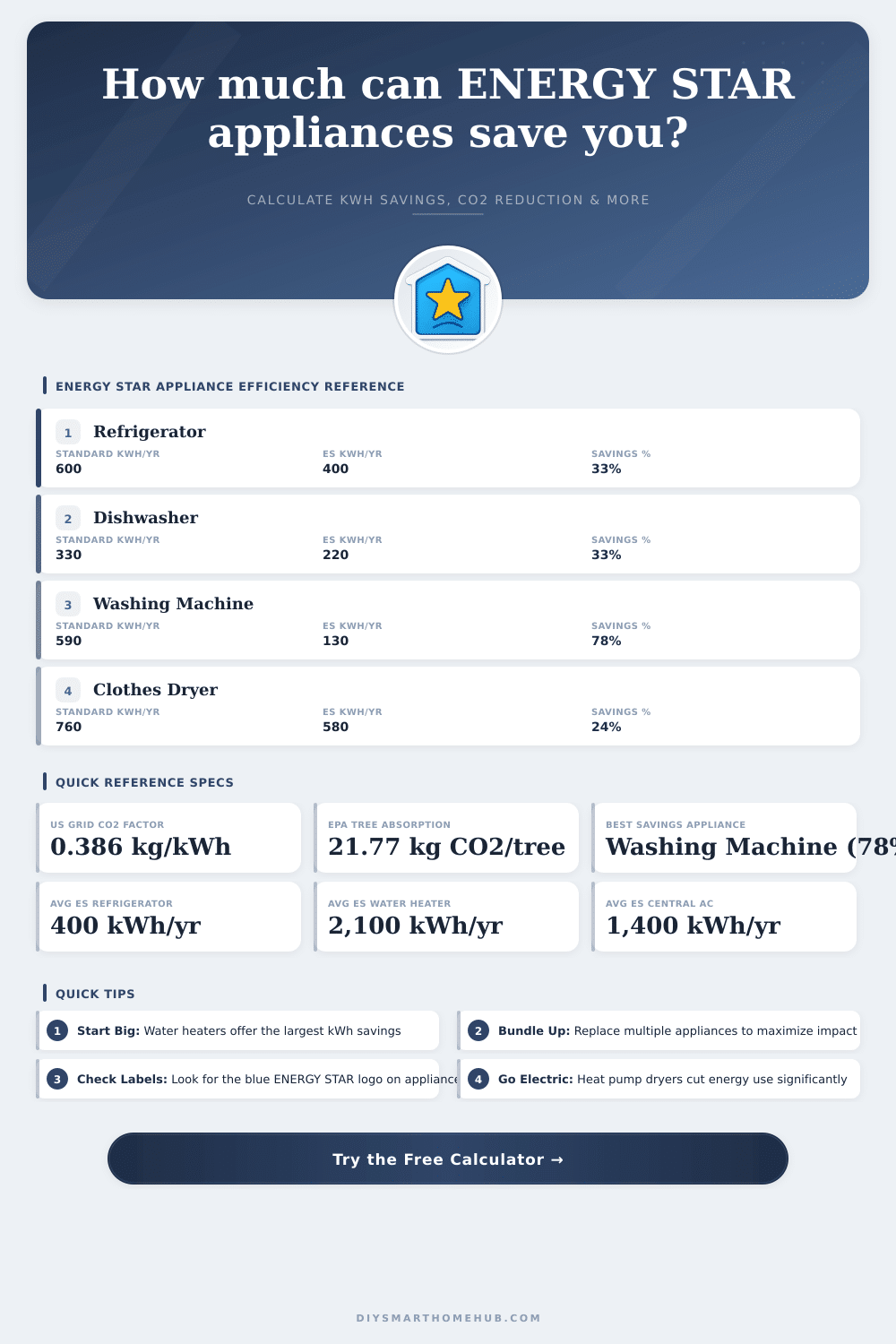
⭐ ENERGY STAR Savings Calculator
Compare certified vs. standard appliances — see annual kWh savings and CO2 impact instantly
⚡ Select Appliance & Calculate Savings
📊 Your Savings Results
📋 Calculation Breakdown
| Appliance Type | Standard kWh/yr | ENERGY STAR kWh/yr | Savings % |
|---|---|---|---|
| Refrigerator | 600 | 400 | 33% |
| Dishwasher | 330 | 220 | 33% |
| Washing Machine | 590 | 130 | 78% |
| Clothes Dryer | 760 | 580 | 24% |
| Room Air Conditioner | 1,200 | 900 | 25% |
| Central Air Conditioner | 2,000 | 1,400 | 30% |
| Water Heater (Electric) | 4,800 | 2,100 | 56% |
| Freezer (Chest/Upright) | 400 | 280 | 30% |
| Annual kWh Saved | CO2 Reduced (kg) | Equiv. Trees Planted | Miles Not Driven |
|---|---|---|---|
| 100 kWh | 38.6 kg | ~1.8 trees | ~158 miles |
| 500 kWh | 193 kg | ~8.9 trees | ~792 miles |
| 1,000 kWh | 386 kg | ~17.7 trees | ~1,584 miles |
| 2,700 kWh | 1,042 kg | ~47.9 trees | ~4,276 miles |
| 4,700 kWh | 1,814 kg | ~83.3 trees | ~7,443 miles |
| Household Size | Refrigerators | AC Units | Major Appliances |
|---|---|---|---|
| Studio / 1-Bed | 1 | 1 Room AC | 2–3 |
| 2–3 Bedroom | 1 | Central AC or 2 Room | 4–6 |
| 4+ Bedroom | 1–2 | Central AC | 6–9 |
| Large Home / Multi-unit | 2+ | Multi-zone Central AC | 9–12+ |
Want to know how much you could save by switching to ENERGY STAR certified products? There is a calculator for that, actually, there are two. Those online tools help you estimate the real numbers: energy savings, cost cuts, and the amount of emissions you could reduce by upgrading to certified gear
The Simple Savings Calculator is about as simple as it sounds. You enter some basic info, and it gives back your energy use, operating costs and the environmental impact of the change. Better yet, the calculator adapts to your place, so the numbers reflect what you actually would pay in your area.
Simple Calculators to Find Energy, Money, and Pollution Savings
There is also an Excel spreadsheet that you can download, if you want to dig into the numbers or shrae them with someone else.
About HVAC systems, gear certified by ENERGY STAR was independently tested and showed reduced energy consumption, while it lowers your utility bills. The calculator leads you through your current setup, whether that is a forced-air system with central cooling or heating, or a boiler with radiators and baseboard heating. Even so, the calculator for that second category is still being developed; so if you have a boiler system, you maybe will not receive full results.
Refrigerators and freezers certified by ENERGY STAR also are independently confirmed for energy savings, and depending on where you live, maybe there are special deals available. The Flip Your Fridge calculator specifically estimates what you would save if you substitute an old refrigerator or freezer with a new ENERGY STAR model. The certification itself bases on quite simple math, comparing how many kilowatt-hours the device uses regarding its size and how it is built.
Models with freezer on top usually are the most efficient, while french door styles appear as the least efficient. Every setup has a threshold, and the device either clears it or it doesn’t.
For bigger buildings, Target Finder gives you a real check on how your design compares with alike buildings across the country. You enter your approximate energy consumption and details about how the building will be used, and you receive an ENERGY STAR score somewhere between 1 and 100 (for eligible property types), compared with the national median, plus a breakdown of emissions. The scoring system considers factors like square feet, place, how many folks work there and the number of computers; then it estimates energy use across every performance level before comparing it with actual data.
There is also the SEER Energy Savings Calculator, a free tool that immediately shows energy reductions when you upgrade to a higher SEER or SEER2 rating for air conditioning. It translates those savings into real dollars, so that you clearly see the financial impact of efficiency improvements. And there is the Baseline Calculator, that converts usual energy measures like kilowatt-hours and therms to source MMBTUs, and establishes your annual standard of energy intensity for the ENERGY STAR Challenge for Industry participation.