EER to COP Calculator
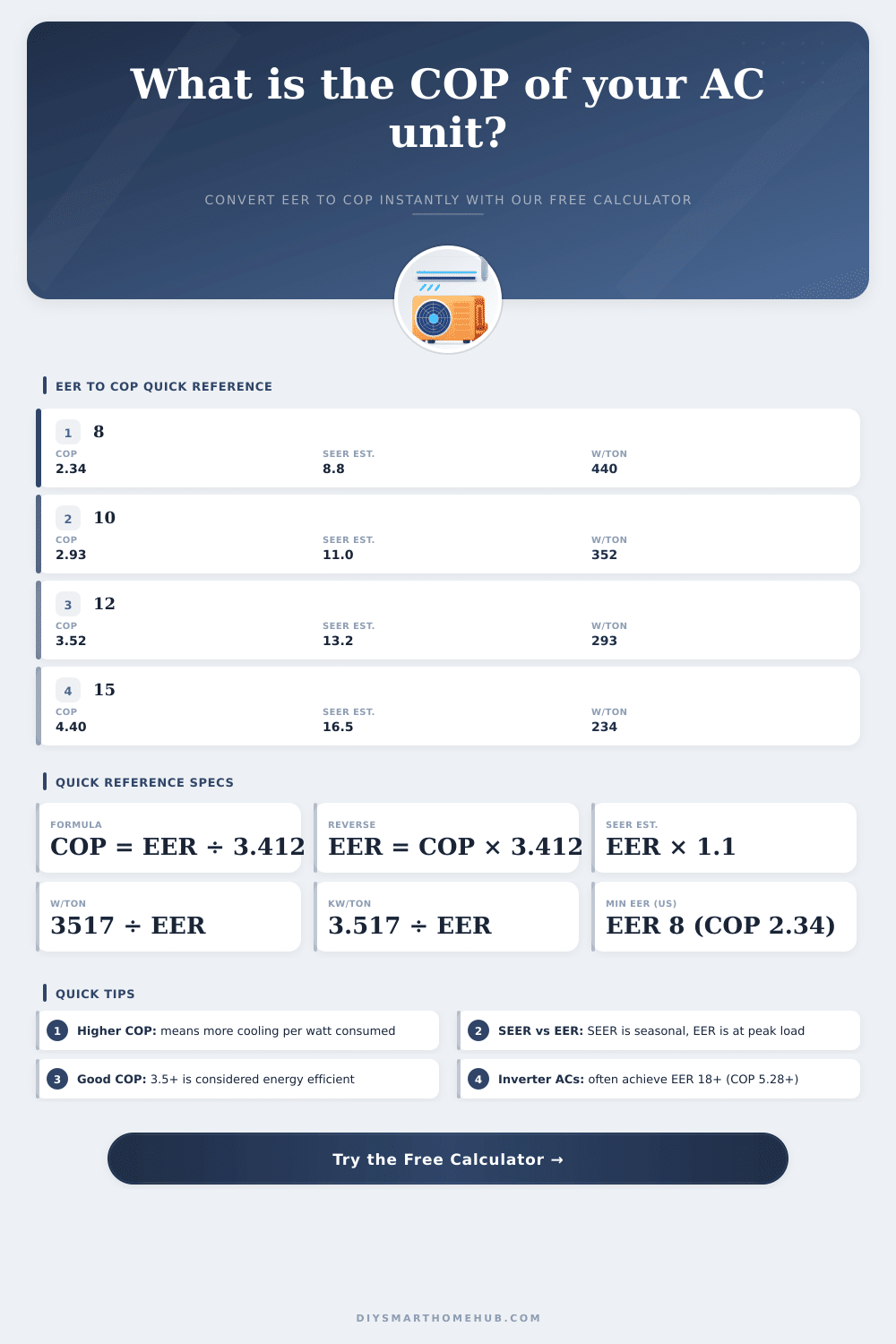
Convert Energy Efficiency Ratio to Coefficient of Performance instantly. Get SEER estimates and watts-per-ton values.
| EER Range | COP Range | Efficiency Class | Typical Application |
|---|---|---|---|
| Below 8 | Below 2.34 | Poor | Older window units |
| 8 – 10 | 2.34 – 2.93 | Standard | Basic window AC |
| 10 – 12 | 2.93 – 3.52 | Fair | Mid-range central AC |
| 12 – 15 | 3.52 – 4.40 | Good | Mini-split, heat pumps |
| 15 – 18 | 4.40 – 5.28 | Excellent | Inverter mini-splits |
| 18+ | 5.28+ | Premium | High-efficiency inverter AC |
| EER | COP | SEER Est. | W / Ton |
|---|
| Equipment Type | Typical EER | COP | SEER Est. |
|---|---|---|---|
| Window AC (basic) | 8 – 10 | 2.34 – 2.93 | 8.8 – 11.0 |
| Window AC (Energy Star) | 10 – 12 | 2.93 – 3.52 | 11.0 – 13.2 |
| Central AC (standard) | 11 – 13 | 3.22 – 3.81 | 12.1 – 14.3 |
| Mini-Split (non-inverter) | 12 – 14 | 3.52 – 4.10 | 13.2 – 15.4 |
| Mini-Split (inverter) | 15 – 18 | 4.40 – 5.28 | 16.5 – 19.8 |
| Heat Pump (air source) | 12 – 15 | 3.52 – 4.40 | 13.2 – 16.5 |
| High-Eff Inverter AC | 18 – 22 | 5.28 – 6.45 | 19.8 – 24.2 |
| Commercial Chiller | 14 – 17 | 4.10 – 4.98 | 15.4 – 18.7 |
EER stands for Energy Efficiency Ratio. You use that ratio to check the efficiency of cooling systems. COP stands for Coefficient of Performance.
You use EER and COP for geothermal heat pumps and other air conditioning devices. There are several HVAC metrics for energy efficiency, and often the EER appears on the technical sheets however the COP is not always listed. Luckily, converting between them is quite easy.
What EER and COP Mean and How to Convert Them
The link between EER and COP is direct: EER equals COP multiplied by 3.41. The number 3.412 is simply a conversion factor, because 3,412 BTU/h equals 1 watt. So to change EER to COP, you only divide the EER by 3.41.
For instance, if the efficiency of a chiller is rated at 1 kW/ton, its COP would be 3.5 and its EER would be 12.
COP basically shows the watts output for the watts input, at set conditions. EER is BTU/hr per watt. COP equals the amount of heat absorbed or dumped by the system, divided by the power needed to move that heat through the system.
Both these measures change based on indoor and outdoor temperatures, so each value of COP or EER is only valid for specific condtions. To compare two heat pumps, you would need to know the COP under the same condition.
The standard condition for calculating EER is outdoor temperature of 95°F and inside temperature of 80°F with 50% humidity. Gear with higher EER uses less energy and helps to reduce carbon emissions.
There are also other related conversions worth knowing. If you start with kW/ton, EER equals 12 divided by kW/ton. COP equals 3.516 divided by kW/ton.
You can also find COP by dividing EER by 3.41214. IPLV is calculated using a formula that counts COP or EER values at different load levels, for example 100%, 75%, 50% and 25%, and every value is weighed in the calculation.
SEER is another metric. To convert SEER to EER using a simple method, you multiply SEER by 0.875. A more detailed formula is: EER equals -0.02 times SEER squared plus 1.12 times SEER.
That multiplier of 0.875 depends on climate. SEER is basically EER, but changed to be more accurate by counting the start and stop of the unit.
CEER is yet another rating. CEER is just EER, but with a fix for the energy usage when the unit is powered on but not actively heating or cooling. For instance, a CEER of 12 could be an EER of 9, and a CEER of 7 could be an EER of 4, as a rough example.
Energy modeling software like eQUEST allows you to enter EER values, that are then converted to COP for calculations behindthe scenes.