📸 Lux to F-Stop Calculator
Convert lux illuminance to aperture f-stop for photography and smart home camera systems
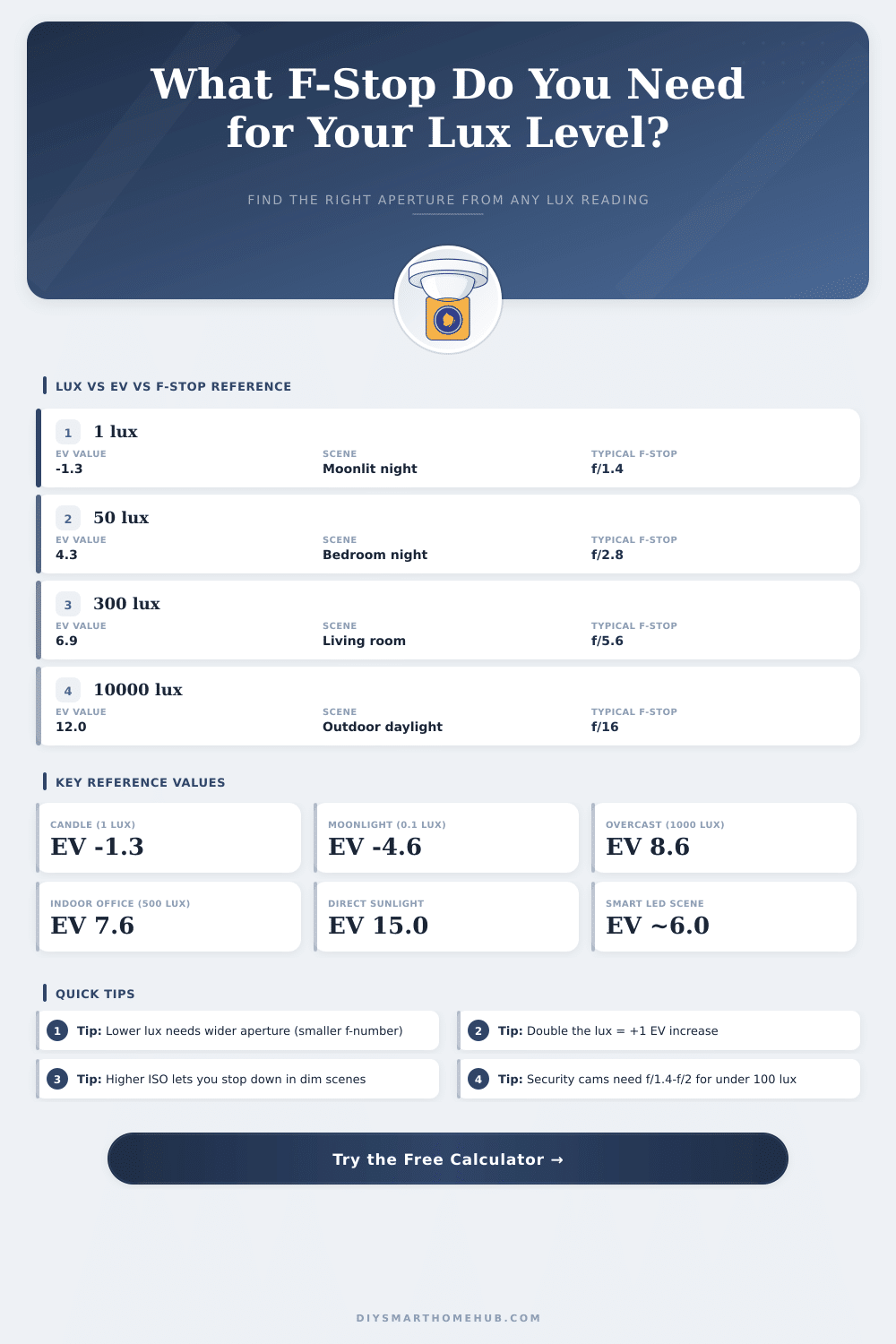
| Lux Level | EV Value | Scene Description | Typical F-Stop (ISO 100, 1/60s) |
|---|---|---|---|
| 0.1 lux | –4.6 | Moonlit outdoor, no clouds | f/0.5 (very wide needed) |
| 1 lux | –1.3 | Candle, emergency lighting | f/1.0 |
| 5 lux | 1.0 | Very dim corridor | f/1.8 |
| 10 lux | 2.0 | Street lamp / security perimeter | f/2.0 |
| 50 lux | 4.3 | Bedroom night, dim lounge | f/2.8 – f/4 |
| 100 lux | 5.3 | Security camera zone, stairwell | f/4 |
| 200 lux | 6.3 | Smart LED scene, accent lighting | f/5.6 |
| 300 lux | 6.9 | Living room, home studio | f/5.6 – f/6.3 |
| 500 lux | 7.6 | Office lighting, kitchen | f/8 |
| 1,000 lux | 8.6 | Overcast outdoor, bright shop | f/11 |
| 5,000 lux | 11.0 | Hazy sunshine, grow light peak | f/16 – f/22 |
| 10,000 lux | 12.0 | Full outdoor daylight | f/22 |
| 50,000 lux | 14.3 | Bright summer day | f/45+ |
| 100,000 lux | 15.3 | Direct sunlight, equatorial noon | f/64+ |
| ISO | 1/30s | 1/60s | 1/125s | 1/250s | 1/500s |
|---|---|---|---|---|---|
| ISO 100 | f/8.0 | f/5.6 | f/4.0 | f/2.8 | f/2.0 |
| ISO 200 | f/11 | f/8.0 | f/5.6 | f/4.0 | f/2.8 |
| ISO 400 | f/16 | f/11 | f/8.0 | f/5.6 | f/4.0 |
| ISO 800 | f/22 | f/16 | f/11 | f/8.0 | f/5.6 |
| ISO 1600 | f/32 | f/22 | f/16 | f/11 | f/8.0 |
| ISO 3200 | f/45 | f/32 | f/22 | f/16 | f/11 |
Understanding the relation between lux and f-stop can be a bit difficult but everything bases on some simple ideas about light and camera settings. For a “working” f-stop of f/5.6 at ISO 800, you need around 500 lux (exactly 538.2). That gives a good starting point to count other values.
Lux and f-stop both measure light, but differently. The sensor of a camera reacts to lux, not to lumens. Lumens measure the total light exiting from a source; lights are round, but frames are rectangular.
Simple Guide to Lux, F-Stops and Exposure
Because it is not possible to photograph the whole lit area, the relation between f-stop and lumens is a bit complex.
F-stop and lux-seconds both are logarithmic units. F-stop use base 2, while lux-seconds use base 10. With a calculator, you can convert base 10 to base 2 and back.
Even so, f-stop are not absolute values, which you must recall.
Here is how the doubling of light works in prcatice. If you increase the light to 4000 lux (400 fc), the difference is 2 f-stop more light. It works like this: 1000 lux (100 fc) double to 2000 lux (200 fc), which is one stop brighter.
Double any value of ISO, exposure time or footcandles results in the same change of f-stop, because that doubles the light. For instance, at 100 ASA, 24fps, 180 shutter and 100 footcandles, the result is f/2.8.
EV is a number that represents a combination of aperture and shutter. EV 0 matches to 1 second at f/1.0, and each plus-one EV halves the light by one stop. Using a conversion table, 2100 lux become about 9.5 to 10 EV.
Knowing that, those figures help to find the right settings for the gear when you use a set distance.
It is important to know the difference between incident light and reflected light. Incident light measures the light that hits a certain surface. Reflected light is the light that bounces off the surface and is measured.
Hence, to determine EV or lux-values, it is better to measure the incident light.
Every change of EV matches to 1 f-stop, so a difference of -2 EV means minus 2 stops, or a quarter of the light. For ISO 200 and exposure value of 12, an aperture of f/5.6 (three stops under f/16, which allows three times more light) would mean a shutter of 1/200, because EV 12 is three steps under EV 15. Only 3,125 lux would reach the sensor at f/5.6, which is a dramatic decrease compared with wider aperture.
If the near EV is 11, and it is 1 stop overexposed based on the needed lux, you must close the aperture to f/8.0 or increase the shutter to 1/125 to compensate that.