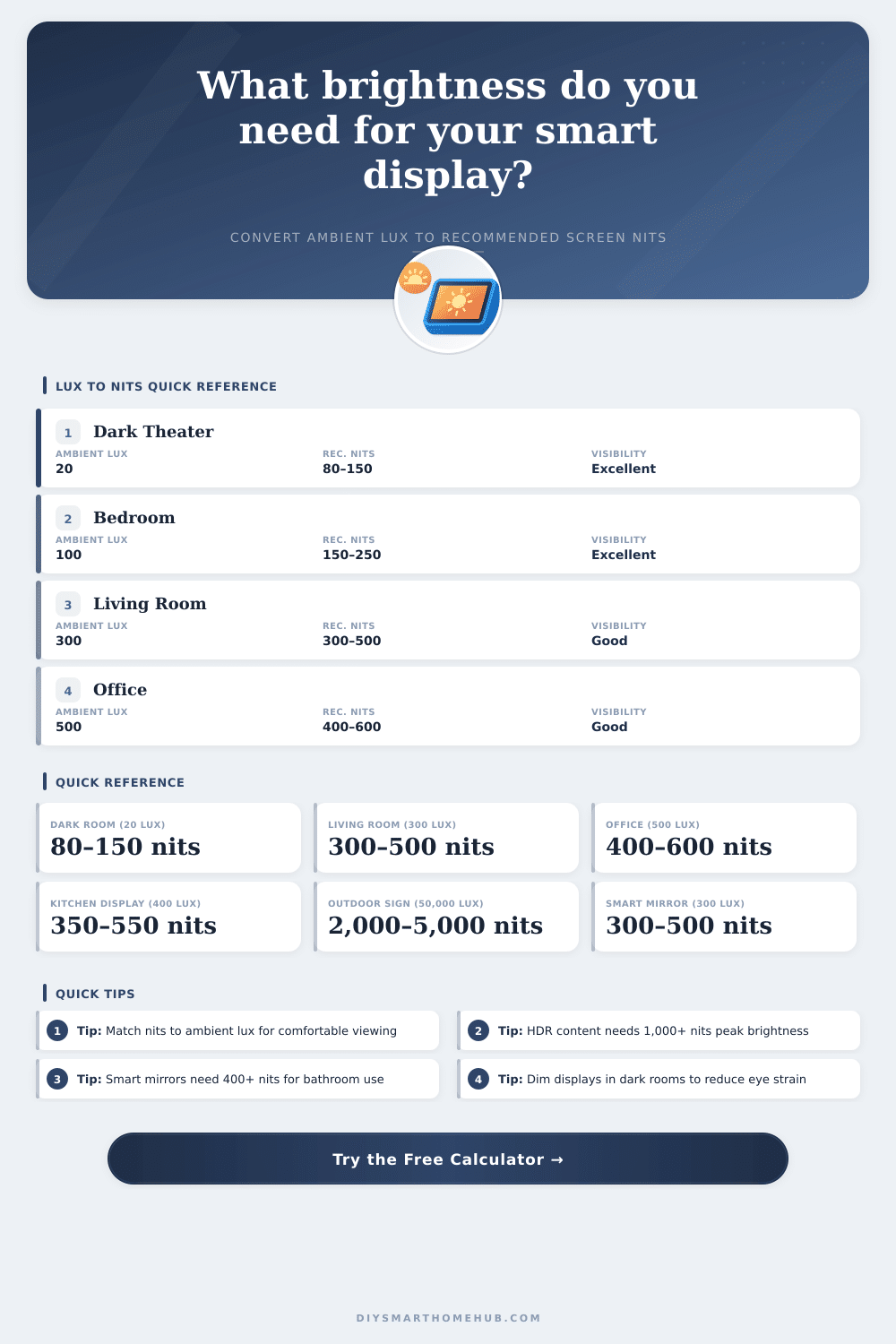
📺 Lux to Nits Calculator
Convert ambient lux to recommended display brightness (nits / cd/m²) for smart home screens, TVs, tablets, and digital signage.
| Environment | Ambient Lux | Rec. Nits | Display Suitability | HDR Tier |
|---|---|---|---|---|
| Dark Home Theater | 20 | 80–150 | All displays | HDR10 (400 nits) |
| Bedroom / Dim Room | 100 | 150–250 | All displays | HDR10 (400 nits) |
| Living Room | 300 | 300–500 | TV, tablet, hub | HDR10+ / HLG |
| Kitchen / Office | 500 | 400–600 | Monitor, hub | HDR10+ |
| Bright Office | 1,000 | 600–1,000 | High-brightness monitor | Dolby Vision |
| Outdoor Shade | 5,000 | 1,000–2,000 | Signage, rugged tablet | Dolby Vision |
| Overcast Outdoors | 10,000 | 1,500–3,000 | Signage only | N/A (ambient) |
| Direct Sunlight | 50,000 | 2,000–5,000 | High-bright signage | N/A (ambient) |
| Device | Typical Nits Range | Ideal Ambient Lux | Use Case |
|---|---|---|---|
| TV | 250–1,000 nits | 50–500 lux | Living room, home theater |
| Monitor | 250–600 nits | 200–800 lux | Office, desk, workstation |
| Smartphone | 500–2,000 nits | 0–50,000 lux | Indoor and outdoor use |
| Tablet | 350–800 nits | 50–2,000 lux | Bedside, kitchen, travel |
| Smart Display / Hub | 300–600 nits | 100–800 lux | Kitchen, hallway, desk |
| Digital Signage | 700–5,000 nits | 500–80,000 lux | Retail, outdoor, venue |
| Smart Mirror | 300–700 nits | 200–600 lux | Bathroom, bedroom, hallway |
Lux and nits both measure light, but they focus on different things. Lux measures illuminance which is the total amount of light that hits a surface in a set area. We can imagine that as weight, like a pound for square meter, only here we deal with light.
One lux equals one lumen spread over one square meter
What are lux and nits?
Nits measure something entirely different. It is another name for luminance, and one nit equals one candela per square meter. While lux deals with light hitting a surface, nits relate to the light that comes off a surface in a specific direction.
Nits measure light force per steradian, which is a kind of curved area. There are also foot-lamberts, that similarly measure brightness by surface area, but lux are defined as lumens per square meter.
And how do you actually convert one to the other? The key factor here is pi. For a small enough sensor, lux equals nit multiplied by pi, and nit equals lux divided by pi.
To convert lux to nits, simply divide the value by pi (3.14159). That works for what is called “Lambertian” surfaces. For instance, if a photo subject is lit by 500 lux, its luminance would be 500 divided by 3.14159, which gives about 159.15 nits.
Also another sample, if a surface receives light flow of 1000 lux, division by pi gives around 318 nits. For this calcualtion, it does not matter how far away the light source is.
Here is something interesting about the practical use. A lux meter is a sensor that measures light flow per solid angle in candelas. It also can show lux, which is simply candelas divided by the square of the distance.
Hence you must enter the distance in the device. If you lay the sensor right on a screen, whose brightness is 500 nits, the result will be about 500 lux. When the distance is exactly one meter, lux equals nits.
Some real numbers for comparison: when the sun is highest at midday of a summer day, it gives around 90,000 lux. A notebook screen could have brightness of 300 nits. An average room with day light has about 600 to 650 lux.
If a screen shines at 200 nits, it may seem too bright for a room with such a light level.
Nits are very important when you choose a computer screen. If you work outside in the sun, you only need to look at the nits of the screen. A great screen could carry many candles, but still look dark, because the light intensity in one spot is low.
Moreover, to convert foot-lamberts to nits, multiply the figure by 3.43. In the imperial system, one foot-candle equals about 10.764 lux.