⚡ Circuit Breaker Size Calculator
Find the correct breaker amperage for any electrical circuit — residential, commercial, or appliance loads
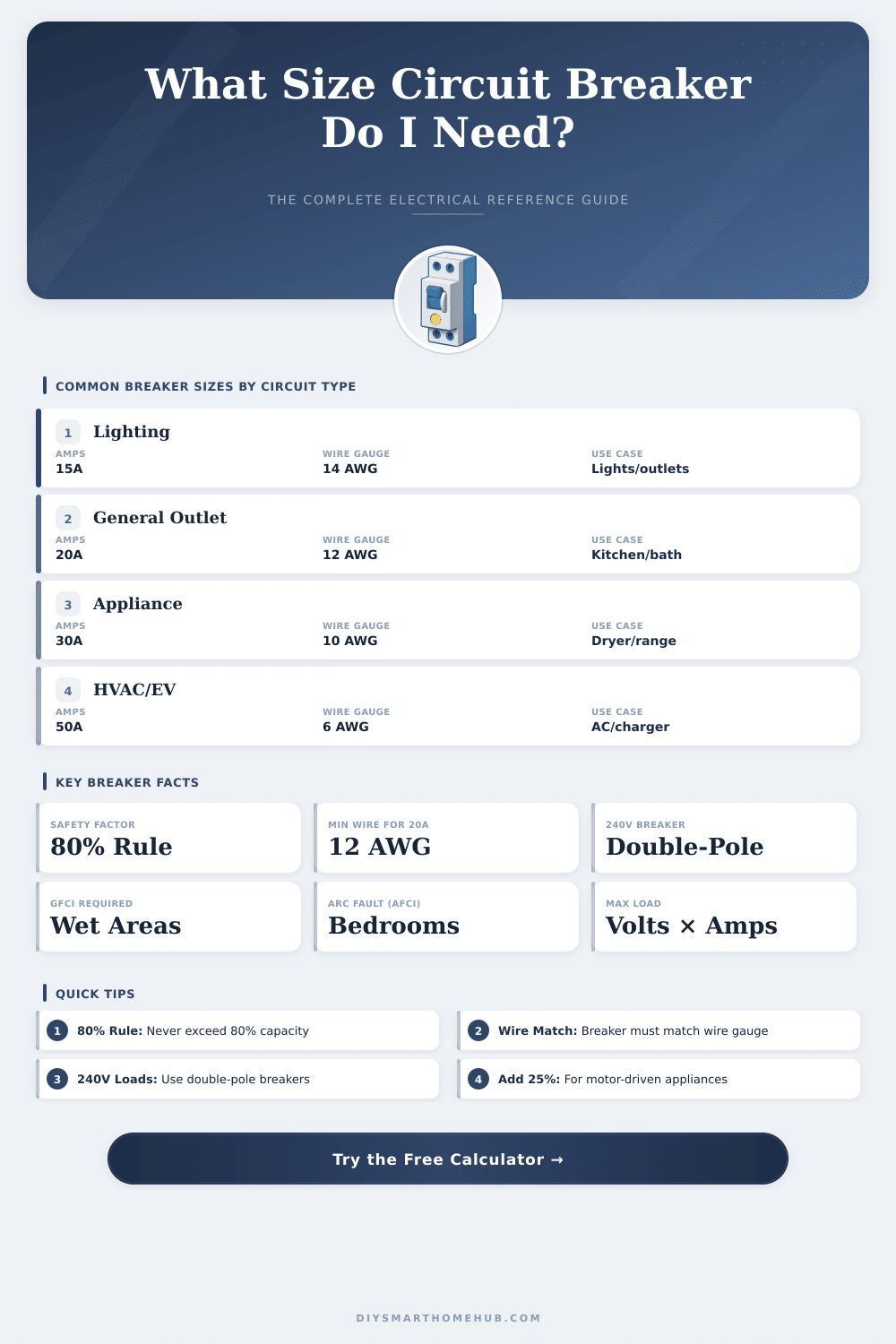
| Wire Gauge (AWG) | Max Breaker Size | Max Ampacity (60°C) | Common Use |
|---|---|---|---|
| 14 AWG | 15A | 15A | Lighting, general outlets |
| 12 AWG | 20A | 20A | Kitchen, bathroom GFCI |
| 10 AWG | 30A | 30A | Dryer, A/C, water heater |
| 8 AWG | 40A | 40A | Electric range, EV charger |
| 6 AWG | 55A | 55A | Large A/C, sub-feed |
| 4 AWG | 70A | 70A | Sub-panel feed |
| 2 AWG | 95A | 95A | 100A sub-panel |
| 1/0 AWG | 150A | 150A | Main panel feed |
| 3/0 AWG | 200A | 200A | 200A main service |
| Appliance | Volts | Typical Watts | Breaker Size |
|---|---|---|---|
| Lighting Circuit | 120V | 1,440W | 15A |
| General Outlet | 120V | 1,800W | 20A |
| Microwave | 120V | 1,000–1,500W | 20A |
| Refrigerator | 120V | 150–400W | 20A |
| Dishwasher | 120V | 1,200–1,500W | 20A |
| Clothes Washer | 120V | 500–1,000W | 20A |
| Clothes Dryer (electric) | 240V | 5,000–6,000W | 30A |
| Water Heater (electric) | 240V | 4,500–5,500W | 30A |
| Central A/C (2-ton) | 240V | 3,500–5,000W | 30A |
| Electric Range | 240V | 8,000–14,000W | 50A |
| EV Charger (Level 2) | 240V | 7,200W (30A) | 40A |
| Hot Tub / Spa | 240V | 4,000–6,000W | 50A |
| Breaker Size | Max Safe Load (80%) | At 120V (Watts) | At 240V (Watts) |
|---|---|---|---|
| 15A | 12A | 1,440W | 2,880W |
| 20A | 16A | 1,920W | 3,840W |
| 30A | 24A | 2,880W | 5,760W |
| 40A | 32A | 3,840W | 7,680W |
| 50A | 40A | 4,800W | 9,600W |
| 60A | 48A | 5,760W | 11,520W |
| 100A | 80A | 9,600W | 19,200W |
Choosing the right size of circuit breaker is important for the safety of the wiring. It works as automatic switch, that stops the flow of energy, when risk comes up. To choose it well you need to understand the power needs for every separate circuit, that changes based on the devices and tools, that you connect.
Here the important point (and this really is the main takeaway). The size of the wire decides the size of the circuit breaker, not the device itself. That forms the basic rule.
How to Choose the Right Size Circuit Breaker
For example, wire of 14th size goes with a circuit breaker of 15 amps. If you move to 12th size, then it matches with 20 amps. For 10th size you need a circuit breaker of 30 amps.
The task of the circuit breaker is to protect the wire against too much warming, not to protect the device.
In most home setups you use circuit breakers of 15 and 20 amps to cover almost 90 percent of the circuits. Standard outlets and light switches normally run on 15-amp circuit breakers. Kitchens and bathrooms are another case; they commonly need 20-amp circuit breakers, just like the circuits with protection against ground contact.
In a typical single-family home the main circuit breaker has a rating of 100 amps, from that feed 6 to 12 smaller circuit breakers. Most of those smaller ones are a mix of 15 and 20 amps, though sometimes there are some of 30 amps for separate uses.
The usual method to size a circuit breaker is 125 percent of the actual load. Like this you get 25-percent reserve. If some device must work more than for hours, that same 25-percent margin becomes required.
Here is why: too big circuit breakers allow the wires to warm up a lot, without stopping, what creates real risk for safety.
Sometimes the exact size, that calculations show, simply is not available in store versions. Here you simply choose the next standard size, and it works well. If your math gives 45 amps, then use a circuit breaker of 50 amps.
The standard sizes of circuit breakers are 15, 20, 25, 30, 35, 40, 45, 50, 60, 70, 80, 90 and 100 amps, with options bigger, that go up to 6000 amps.
Industrial and commercial places need totally different solutions. The heavy machines here need circuit breakers with much higher capacity, usually from 70 to 6000 amps. Some models have breaking power of 65 000 amps, so they can safely handle huge surges.
Here is the kind of protection, that factories and steelmills depend on.
Double circuit breaker usually limits to 120/240 volts with 15 or 20 amps and 10 000-amp breaking capacity. They have several names, double, tandem or piggyback circuit breakers. In Australia the situation is a bit different: circuit breakers of 10 amps serve for lighting circuits with 1.5 mm cable, while 20-amp ones feed outlets with 2.4 mm cable.
Bigger homes naturally need more circuit breakers in total. If you are not sure or plan to change the wires, then calling a licensed electrician is the wisest step.