⚡ Delta – Wye Transformer Calculator
Convert voltages & currents across Delta and Wye transformer configurations instantly
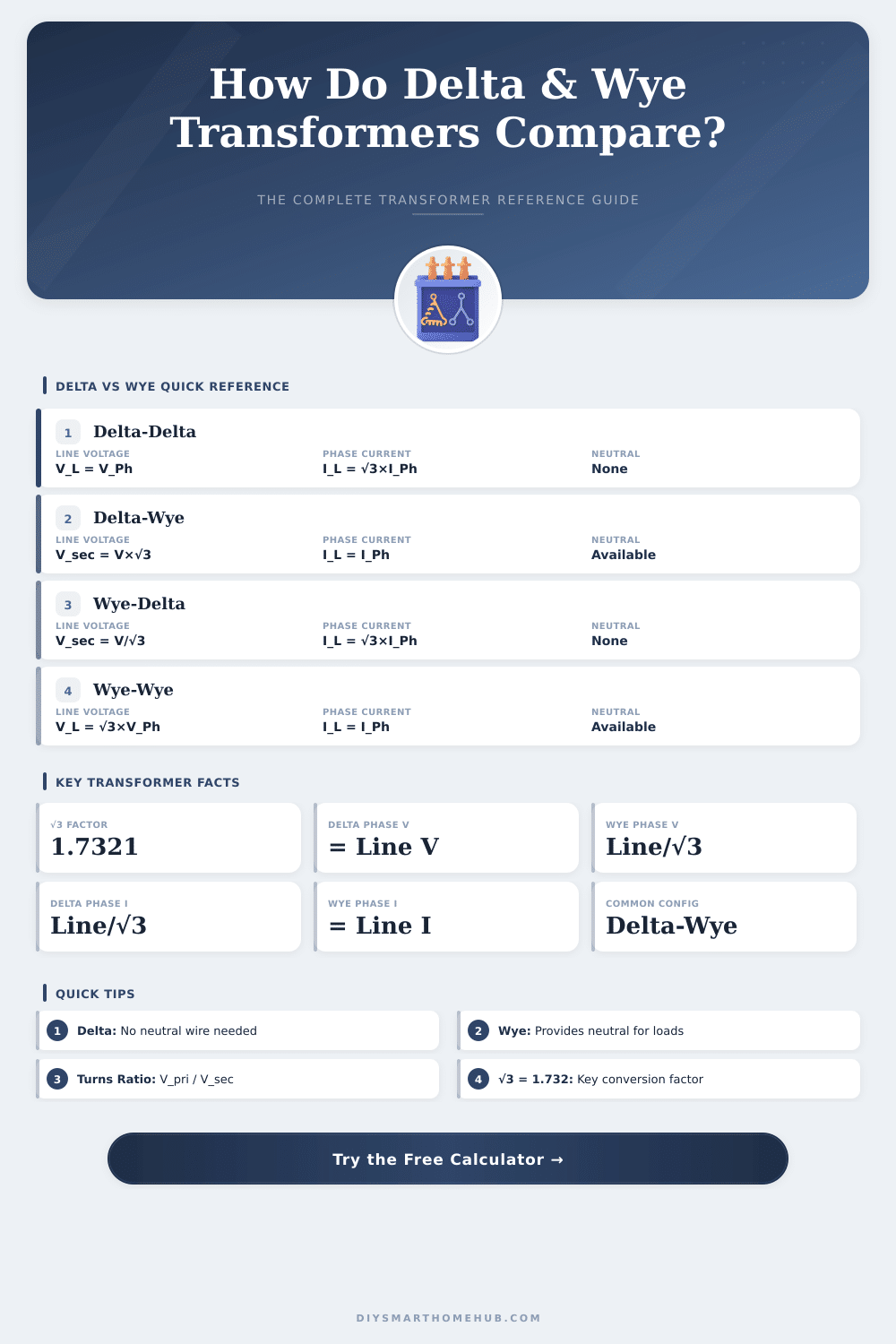
| Configuration | Primary Phase V | Secondary Phase V | Neutral Available | Common Use |
|---|---|---|---|---|
| Δ-Y (Delta-Wye) | = Vline,pri | Vline,sec / √3 | Yes (secondary) | Distribution, step-down |
| Y-Δ (Wye-Delta) | Vline,pri / √3 | = Vline,sec | No (primary only) | Step-up, HV transmission |
| Δ-Δ (Delta-Delta) | = Vline,pri | = Vline,sec | No | Industrial, legacy systems |
| Y-Y (Wye-Wye) | Vline,pri / √3 | Vline,sec / √3 | Yes (both sides) | HV transmission, MV systems |
| Primary (Δ) V | Secondary (Y) Vline | Secondary Vphase | Turns Ratio | Application |
|---|---|---|---|---|
| 480 V | 208 V | 120 V | 2.31:1 | Commercial building power |
| 480 V | 120 V | 69.3 V | 4.0:1 | Control circuits |
| 2,400 V | 480 V | 277 V | 5.0:1 | Industrial step-down |
| 4,160 V | 480 V | 277 V | 8.67:1 | Plant distribution |
| 13,800 V | 480 V | 277 V | 28.75:1 | Utility/industrial |
| 13,800 V | 4,160 V | 2,402 V | 3.32:1 | Subtransmission |
| 34,500 V | 13,800 V | 7,967 V | 2.50:1 | Distribution substation |
| 11,000 V | 415 V | 240 V | 26.51:1 | UK/EU distribution |
| kVA Rating | Primary 480V (A) | Primary 4160V (A) | Secondary 208V (A) | Secondary 480V (A) |
|---|---|---|---|---|
| 15 kVA | 18.0 A | 2.08 A | 41.6 A | 18.0 A |
| 30 kVA | 36.1 A | 4.16 A | 83.3 A | 36.1 A |
| 45 kVA | 54.1 A | 6.25 A | 124.9 A | 54.1 A |
| 75 kVA | 90.2 A | 10.4 A | 208.2 A | 90.2 A |
| 100 kVA | 120.3 A | 13.9 A | 277.6 A | 120.3 A |
| 150 kVA | 180.4 A | 20.8 A | 416.4 A | 180.4 A |
| 225 kVA | 270.6 A | 31.2 A | 624.7 A | 270.6 A |
| 300 kVA | 360.8 A | 41.6 A | 832.9 A | 360.8 A |
| 500 kVA | 601.4 A | 69.4 A | 1387.9 A | 601.4 A |
| 1000 kVA | 1202.8 A | 138.8 A | 2775.7 A | 1202.8 A |
Delta-star Transformer is a kind of three-phase energy converter. It applies delta connection for the windings in the basic part and star or Y-shaped arrangement for those in the secondary part. This setup ranks between the most common ties for three-phase Transformer units and one finds it commonly in commercial and industrial power systems in North America, Europe and many other regions of the globe.
In star setup, one binds one end of each from the three windings to create a neutral center. Every phase joins to the other finish of the matching coil. Usually one grounds the neutral, sometimes directly to the soil.
How a Delta-Star Transformer Works
That happens because the star link delivers both line-to-line and line-to-neutral voltages, what makes it practical for separate three-phase and single-phase loads. For instance, a 480V star system gives 480V between lines and 277V from line to neutral. So it backs both three-phase engines and single-phase light from one alone Transformer.
On the otehr hand, delta setups deliver only one grade of voltage.
Delta form three-wire system. Star needs four wires, because it carries the neutral. The delta in the basic part needs only three leads, what simplifies the supply.
Big practical advantage of the delta-star Transformer is, that it creates a good four-wire secondary with flat neutral. It also blocks the overflow of unbalanced loads, harmonies and grounding loops. The delta windings in the basic part block zero-sequence flows in the high part and separates the low-voltage soil from the medium-voltage soil ore neutral.
Harmonies form another key part here. Triple harmonic flows appear commonly in houses with computers, communications and data processing devices. The delta basic windings catch third harmonies inside the closed delta coil, although a bit of level yet can cross.
Delta-star Transformer units block triple harmonies from single-phase loads, what helps to clean the energy.
Interesting cause about those Transformer units is the phase shift. In North America, the high side voltage always leads the low side by 30 degrees. In other nations, that works the other way.
Copper-coil Transformer windings are more stable than aluminum coils. That makes the device safer against faults. During step down of 480/277 star to 208/120, delta-star Transformer units sparespace partly, because one does not need to draw a neutral wire in the basic part.
They also work well for variable-block frequency drives, because VFDs commonly need a grounded star source.