🌡️ Fahrenheit to Kelvin Converter
Convert °F to Kelvin instantly — with Celsius, Rankine & full temperature breakdown
| Convert From | Convert To | Formula | Example (32°F) |
|---|---|---|---|
| Fahrenheit (°F) | Kelvin (K) | K = (°F – 32) × 5/9 + 273.15 | 273.15 K |
| Fahrenheit (°F) | Celsius (°C) | °C = (°F – 32) × 5/9 | 0°C |
| Fahrenheit (°F) | Rankine (°R) | °R = °F + 459.67 | 491.67°R |
| Kelvin (K) | Fahrenheit (°F) | °F = (K – 273.15) × 9/5 + 32 | — |
| Celsius (°C) | Kelvin (K) | K = °C + 273.15 | 273.15 K |
| Rankine (°R) | Kelvin (K) | K = °R × 5/9 | — |
| Fahrenheit (°F) | Kelvin (K) | Celsius (°C) | Rankine (°R) |
|---|---|---|---|
| –459.67°F | 0 K | –273.15°C | 0°R |
| –40°F | 233.15 K | –40°C | 419.67°R |
| 0°F | 255.37 K | –17.78°C | 459.67°R |
| 32°F | 273.15 K | 0°C | 491.67°R |
| 50°F | 283.15 K | 10°C | 509.67°R |
| 68°F | 293.15 K | 20°C | 527.67°R |
| 72°F | 295.37 K | 22.22°C | 531.67°R |
| 98.6°F | 310.15 K | 37°C | 558.27°R |
| 100°F | 310.93 K | 37.78°C | 559.67°R |
| 212°F | 373.15 K | 100°C | 671.67°R |
| 350°F | 449.82 K | 176.67°C | 809.67°R |
| 451°F | 505.93 K | 232.78°C | 910.67°R |
| 1000°F | 810.93 K | 537.78°C | 1459.67°R |
| 5778°F | 3470.37 K | 3197.22°C | 6237.67°R |
| Event / Context | Kelvin (K) | Fahrenheit (°F) | Celsius (°C) |
|---|---|---|---|
| Absolute Zero | 0 K | –459.67°F | –273.15°C |
| Liquid Helium Boils | 4.22 K | –452.07°F | –268.93°C |
| Liquid Nitrogen Boils | 77.36 K | –320.44°F | –195.79°C |
| Dry Ice (CO2) | 194.65 K | –109°F | –78.5°C |
| Water Triple Point | 273.16 K | 32.02°F | 0.01°C |
| Standard Room Temp | 293.15 K | 68°F | 20°C |
| Human Body Temp | 310.15 K | 98.6°F | 37°C |
| Iron Melting Point | 1811 K | 2780°F | 1538°C |
| Surface of the Sun | 5778 K | 9940°F | 5505°C |
Converting between Fahrenheit and Kelvin maybe seems hard, but really it is quite easy when one recalls the basic rules. There are many free websites that do the calculation right away and they work both ways, from Fahrenheit to Kelvin or the other way around. Those sites usually show steps for conversions and explanations, so that everything becomes more clear.
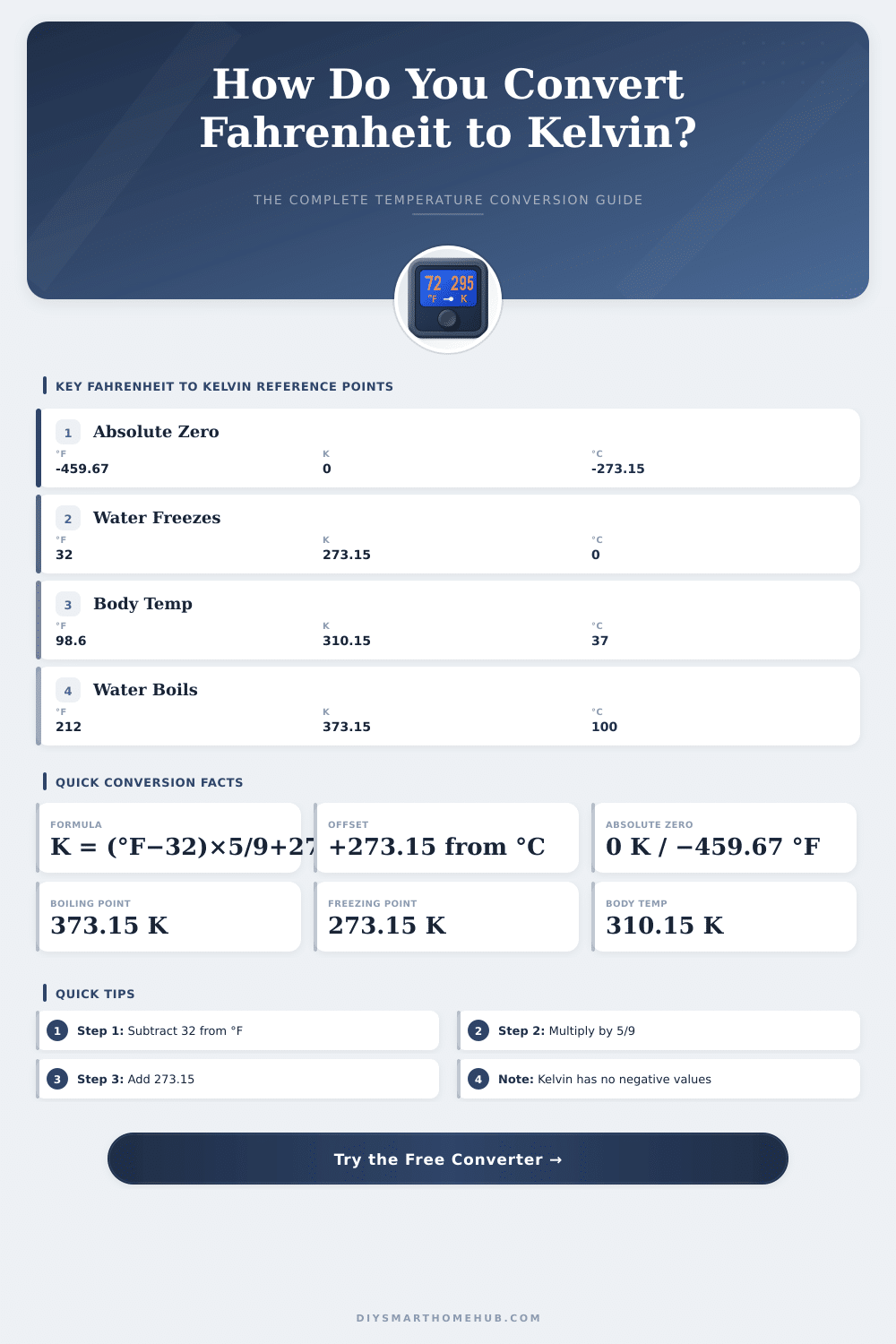
Here is how the main idea works. To go from Fahrenheit to Kelvin, first take 32 from the temperature in Fahrenheit, then multiply by 5, divide by 9 and finally add 273.15. This is how the formula looks: K = (°F − 32) × 5/9 + 273.15.
How to Convert Between Fahrenheit and Kelvin
One can also write it differently for the same math. The value in Kelvin equals (Fahrenheit + 459.67) × 5/9. Both ways reach the same result.
Here is a quick example. Assume that the temperature is 68°F. First remove 32, which gives 36. Then divdie 36 by 1.8, to get 20°C. Then add 273.15, to reach the value in Kelvin.
This last step of adding 273.15 is what changes Celsius to Kelvin.
To go the other way, from Kelvin to Fahrenheit, one needs another formula. The temperature in Fahrenheit equals (Kelvin − 273.15) × 9/5 + 32. Another version of that same formula is °F = K × 9/5 − 459.67.
For instance, 300 Kelvin results in 80.33°F using that weigh. Another sample: using the first version, remove 273.15 from the Kelvin figure, multiply by 1.8 and add 32.
Celsius and Kelvin have the same size of degrees. The only main difference lies in the starting point. Kelvin starts at absolute zero, while Celsius puts zero at the freezing point of water.
At very high heats, that difference of 273.15 almost does not matter any more.
Fahrenheit works differently. It puts 32°F as the freezing point of water and 212°F as the boiling point. The gap between those two points is split into 180 equal parts.
The scale of Fahrenheit stays the official one for temperature in some countries, like United States, the Bahamas, Belize and the Cayman Islands.
There is also a scale called Rankine. It starts at absolute zero, just like Kelvin. But instead of using the number system of Celsius, it follows that of Fahrenheit.
Basically, it is a version of Fahrenheit, made toavoid negative values.
Some online converters let users enter a value of Fahrenheit in one field and click a button to convert. Or one can put a value of Kelvin in another field to change it in the other direction. Those programs also convert between other scales for temperature, like Celsius, Rankine and Réaumur.