🌡️ R Value to U Value Calculator
Instantly convert R values to U values (and back) for walls, roofs, windows, and more. Supports imperial & metric RSI units.
| R Value (Imperial) | U Value (Imperial) | RSI (Metric) | U Value (Metric W/m²K) | Typical Application |
|---|---|---|---|---|
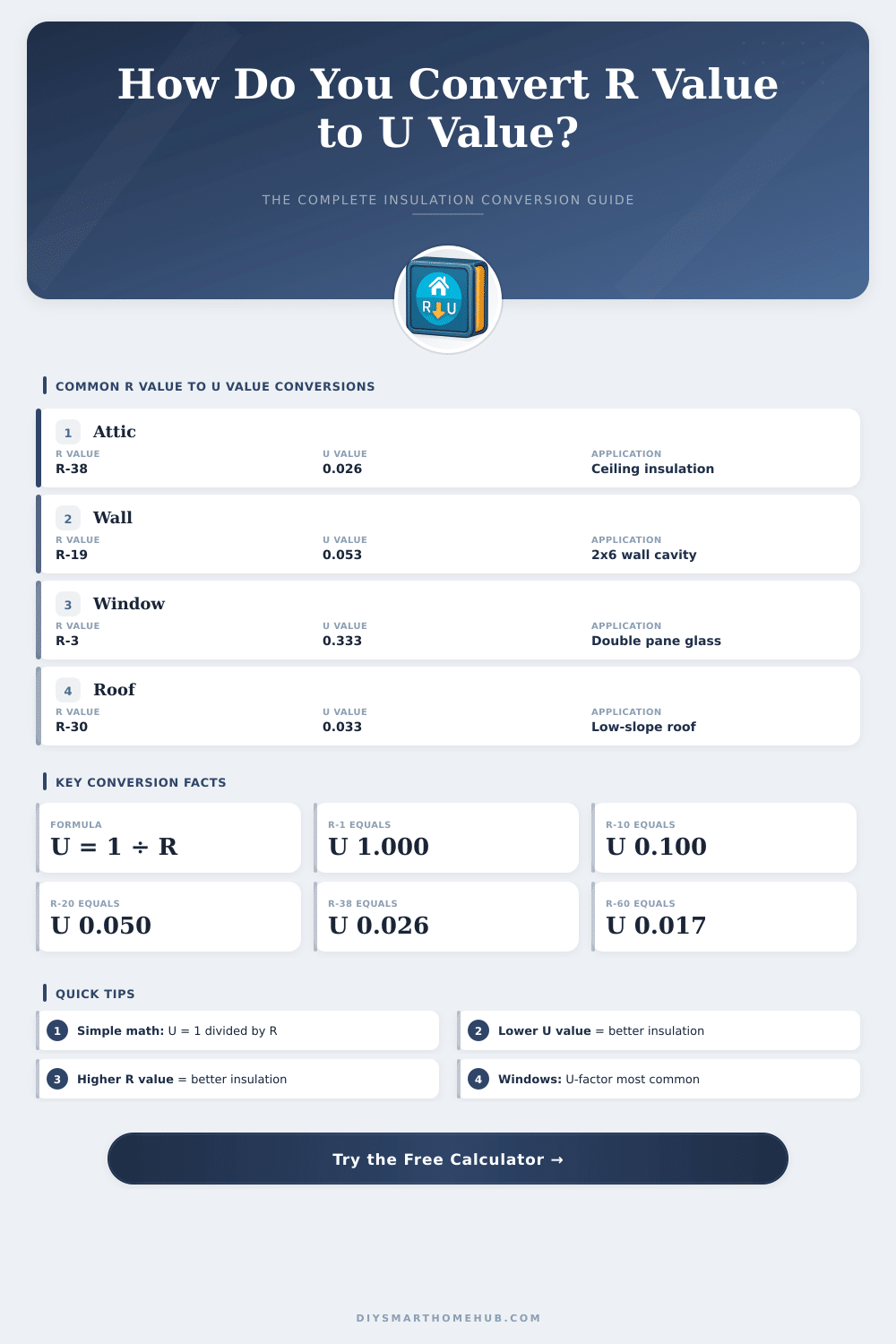
| R-1 | 1.000 | RSI 0.18 | 5.68 | Single layer sheathing |
| R-2 | 0.500 | RSI 0.35 | 2.84 | Rigid foam 1/2 in |
| R-3 | 0.333 | RSI 0.53 | 1.89 | Double-pane window |
| R-5 | 0.200 | RSI 0.88 | 1.14 | Exterior door, rigid foam |
| R-7 | 0.143 | RSI 1.23 | 0.81 | 2x4 wall cavity (fiberglass) |
| R-11 | 0.091 | RSI 1.94 | 0.52 | 2x4 batt insulation |
| R-13 | 0.077 | RSI 2.29 | 0.44 | 2x4 high-density batt |
| R-15 | 0.067 | RSI 2.64 | 0.38 | 2x4 wall w/ rigid foam |
| R-19 | 0.053 | RSI 3.35 | 0.30 | 2x6 wall cavity |
| R-21 | 0.048 | RSI 3.70 | 0.27 | 2x6 spray foam wall |
| R-25 | 0.040 | RSI 4.40 | 0.23 | Ceiling / floor insulation |
| R-30 | 0.033 | RSI 5.28 | 0.19 | Low-slope roof assembly |
| R-38 | 0.026 | RSI 6.69 | 0.15 | Attic insulation (cold climates) |
| R-49 | 0.020 | RSI 8.63 | 0.12 | Attic insulation (very cold) |
| R-60 | 0.017 | RSI 10.57 | 0.10 | Super-insulated attic |
| RSI Value (m²·K/W) | Imperial R Value | U-SI (W/m²K) | U-IP (BTU/hr·ft²·°F) |
|---|---|---|---|
| RSI 0.18 | R-1.0 | 5.68 | 1.000 |
| RSI 0.35 | R-2.0 | 2.84 | 0.500 |
| RSI 0.53 | R-3.0 | 1.89 | 0.333 |
| RSI 0.88 | R-5.0 | 1.14 | 0.200 |
| RSI 1.94 | R-11.0 | 0.52 | 0.091 |
| RSI 3.35 | R-19.0 | 0.30 | 0.053 |
| RSI 5.28 | R-30.0 | 0.19 | 0.033 |
| RSI 6.69 | R-38.0 | 0.15 | 0.026 |
| RSI 8.63 | R-49.0 | 0.12 | 0.020 |
| RSI 10.57 | R-60.0 | 0.10 | 0.017 |
| Assembly | Typical R Value | U Value | Heat Loss (BTU/hr/ft² @ 30°F ΔT) | W/m² @ 17°C ΔT |
|---|---|---|---|---|
| Single-pane window | R-1 | 1.000 | 30.0 | 94.5 |
| Double-pane window | R-3 | 0.333 | 10.0 | 31.5 |
| Triple-pane window | R-5 | 0.200 | 6.0 | 18.9 |
| Exterior door | R-5 | 0.200 | 6.0 | 18.9 |
| 2x4 wall (R-11) | R-11 | 0.091 | 2.73 | 8.6 |
| 2x6 wall (R-19) | R-19 | 0.053 | 1.58 | 5.0 |
| Attic (R-38) | R-38 | 0.026 | 0.79 | 2.5 |
| Super attic (R-60) | R-60 | 0.017 | 0.50 | 1.6 |
| Climate Zone | Attic Min | Wall Min | Floor Min | Window Max U |
|---|---|---|---|---|
| Zone 1 (Hot) | R-30 | R-13 | R-13 | U-0.50 |
| Zone 2 (Mixed-Hot) | R-38 | R-13 | R-19 | U-0.40 |
| Zone 3 (Warm) | R-38 | R-20 | R-19 | U-0.35 |
| Zone 4 (Mixed) | R-49 | R-20 | R-30 | U-0.35 |
| Zone 5 (Cool) | R-49 | R-20 | R-30 | U-0.30 |
| Zone 6 (Cold) | R-60 | R-20 | R-30 | U-0.30 |
| Zone 7 (Very Cold) | R-60 | R-21 | R-38 | U-0.25 |
| Zone 8 (Subarctic) | R-60 | R-21 | R-38 | U-0.20 |
R-value and U-value help to estimate how well materials block heat. They are like different scales for measuring energy loss. R-value works in one way while U-value works in another.
Both describe the same basic idea, but in different ways.
What are R-value and U-value?
R-value shows how strongly a material blocks heat flow. The bigger it is, the more well it can block heat. U-value is almost the opposite idea.
It counts how quickly heat passes through a surface. The lower the U-value the more energy it saves. R-value is simply the reverse of U-value, and the other way around.
Here is the spot where reasons become clear. One uses R-value for measuring insulation in walls, floors and roofs. U-value usually measures windows and doors.
Like this they relate to different parts of a house. The R-method considers only the insulating layers. The U-method includes the heat flow of evrything in the structure, together with thin layers on surfaces.
Both measures relate to the thickness of the material. An aluminum frame wall has weaker R-value than a wooden frame. Sellers commonly show R-figures, because a big number shows better insulation, which is easily understood.
U-values are fractions, that are hard too compare quickly.
Doubling insulation almost doubles costs. Even so, doubling the thickness of insulation rarely works, and one switches to better materials, which quickly raises cost.
R-value is useful also outside houses. In a camping cushion for sleep, it decides how well it protects from cool soil. A cushion with R-value of one to two and a half works for gentle conditions.
Between two and a half to five, it helps against cold near zero degrees Fahrenheit. Stacking layers of sleeping cushion on foam base, one adds R-values for total insulation. The listed R-value of a product usually describes the material itself, not the use in life.
Pressed foam or inflated cushions commonly perform badly inreal life.
In RVs, discussions about R-values are very popular. Even so, RVs have heat bridges and air gaps, so that insulation of only walls or ceilings does not well show the whole impact. Improving wall insulation without double-pane windows is a bit pointless, if single-pane windows have only R-value around one.
R-value relates exactly to resistance against heat flow through material. But folks care mostly about whole heat loss from all reasons, which is a slightly different case.