🔬 Frequency to Wavenumber Converter
Convert between frequency (Hz, kHz, MHz, GHz, THz), wavenumber (cm⁻¹, m⁻¹), wavelength, and energy — with spectroscopy reference data
| Spectral Region | Frequency Range | Wavenumber (cm⁻¹) | Wavelength Range | Typical Application |
|---|---|---|---|---|
| Radio Wave | < 300 MHz | < 0.01 | > 1 m | NMR, Radio astronomy |
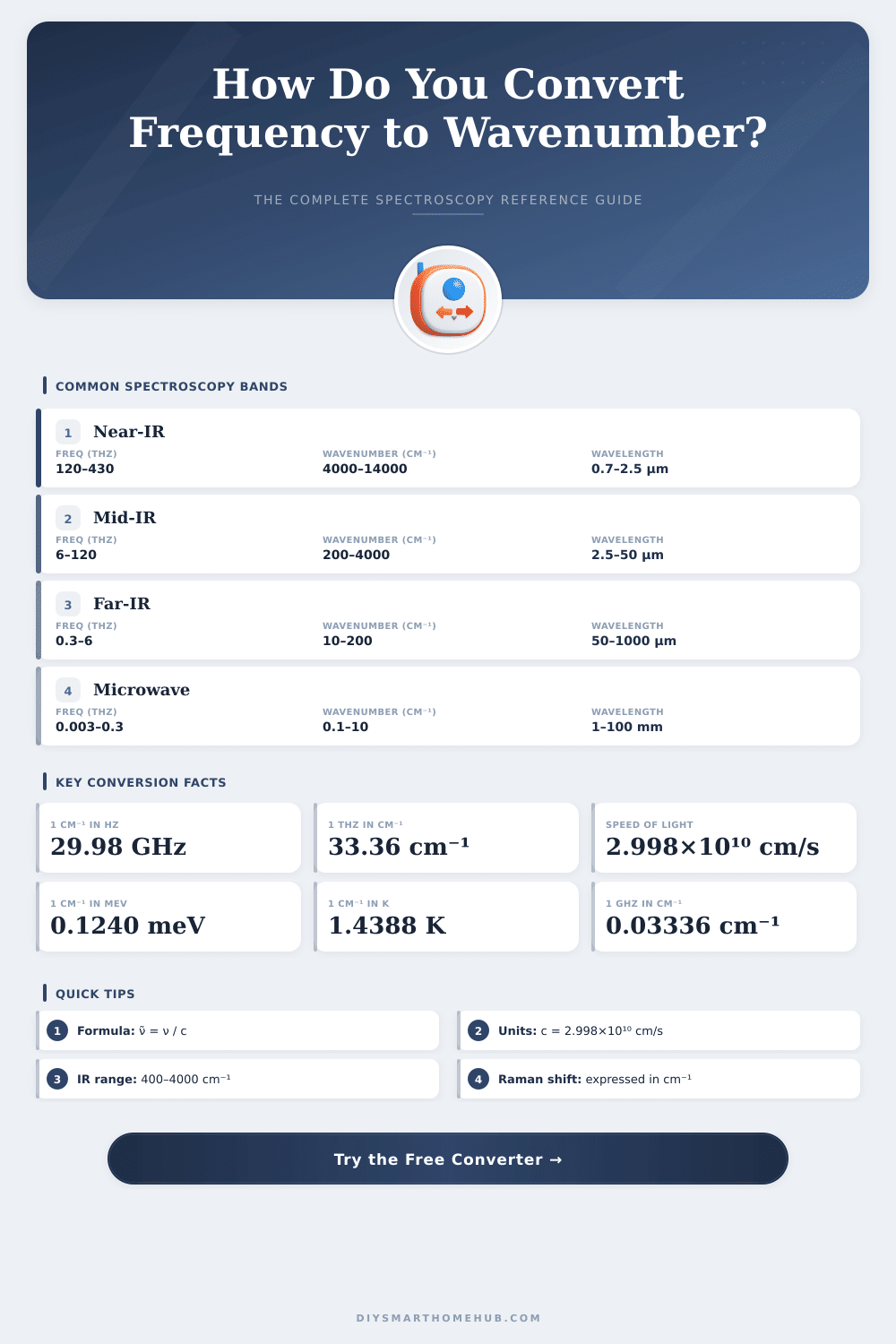
| Microwave | 300 MHz – 300 GHz | 0.01 – 10 | 1 mm – 1 m | Radar, rotational spectroscopy |
| mm-Wave | 30 – 300 GHz | 1 – 10 | 1 – 10 mm | 5G, atmospheric sensing |
| Far-IR (THz) | 0.3 – 10 THz | 10 – 333 | 30 – 1000 μm | THz spectroscopy, astronomy |
| Mid-IR | 10 – 120 THz | 333 – 4000 | 2.5 – 30 μm | FTIR, molecular fingerprinting |
| Near-IR | 120 – 430 THz | 4000 – 14,286 | 0.7 – 2.5 μm | NIR spectroscopy, fiber optics |
| Visible | 430 – 750 THz | 14,286 – 25,000 | 400 – 700 nm | Raman, UV-Vis spectroscopy |
| UV (Near) | 750 THz – 3 PHz | 25,000 – 100,000 | 100 – 400 nm | UV spectroscopy, photochemistry |
| Extreme UV | 3 – 30 PHz | 100,000 – 10⁶ | 10 – 100 nm | Photoionization, lithography |
| Soft X-ray | > 30 PHz | > 10⁶ | < 10 nm | X-ray spectroscopy, EXAFS |
| Frequency | in Hz | Wavenumber (cm⁻¹) | Wavenumber (m⁻¹) | Wavelength |
|---|---|---|---|---|
| 1 GHz | 1×10⁹ Hz | 0.03336 | 3.336 | 30.0 cm |
| 10 GHz | 1×10¹⁰ Hz | 0.3336 | 33.36 | 3.0 cm |
| 100 GHz | 1×10¹¹ Hz | 3.336 | 333.6 | 3.0 mm |
| 1 THz | 1×10¹² Hz | 33.36 | 3,336 | 300 μm |
| 10 THz | 1×10¹³ Hz | 333.6 | 33,356 | 30 μm |
| 30 THz | 3×10¹³ Hz | 1001 | 100,070 | 10 μm |
| 100 THz | 1×10¹4 Hz | 3336 | 333,560 | 3 μm |
| 300 THz | 3×10¹4 Hz | 10,007 | 1×10⁶ | 1 μm |
| 500 THz | 5×10¹4 Hz | 16,678 | 1.668×10⁶ | 600 nm |
| 750 THz | 7.5×10¹4 Hz | 25,017 | 2.502×10⁶ | 400 nm |
| Wavenumber (cm⁻¹) | Frequency (THz) | Bond / Mode | Technique | Notes |
|---|---|---|---|---|
| 3700 – 3200 | 110.9 – 95.9 | O–H stretch | IR | Broad in H-bonded systems |
| 3300 – 2500 | 98.9 – 74.9 | N–H, C–H stretch | IR / Raman | Amines, alkanes |
| 2349 | 70.4 | CO₂ asymm. stretch | IR | Atmospheric CO₂ |
| 2143 | 64.2 | CO stretch | IR | Carbon monoxide |
| 1750 – 1680 | 52.5 – 50.3 | C=O stretch (carbonyl) | IR | Ketones, esters, acids |
| 1630 – 1450 | 48.8 – 43.5 | C=C stretch | IR / Raman | Aromatics, alkenes |
| 1550 / 1350 | 46.5 / 40.5 | NO₂ asymm/symm | IR | Nitro compounds |
| 1083 | 32.5 | Si–O stretch | IR | Silicates, glass |
| 667 | 20.0 | CO₂ bending | IR | Out-of-plane bend |
| 400 – 200 | 12.0 – 6.0 | Metal–ligand stretch | Far-IR | Coordination compounds |
| Wavenumber (cm⁻¹) | Energy (meV) | Energy (kJ/mol) | Temperature (K) | Wavelength (μm) |
|---|---|---|---|---|
| 1 | 0.12398 | 0.01196 | 1.4388 | 10,000 |
| 10 | 1.2398 | 0.1196 | 14.388 | 1,000 |
| 100 | 12.398 | 1.196 | 143.88 | 100 |
| 200 | 24.797 | 2.392 | 287.76 | 50.0 |
| 400 | 49.593 | 4.785 | 575.52 | 25.0 |
| 1000 | 123.98 | 11.963 | 1438.8 | 10.0 |
| 2000 | 247.97 | 23.925 | 2877.6 | 5.0 |
| 4000 | 495.93 | 47.850 | 5755.2 | 2.5 |
| 10000 | 1239.8 | 119.63 | 14388 | 1.0 |
| 25000 | 3099.6 | 299.07 | 35970 | 0.4 |
wavenumber converter is a practical resource that eases the change between various units for describing waves. Wavenumber simply is the reverse of wavelength. It shows how many wave periods fit in one distance unit.
That idea is like the frequency, that shows how many cycles a wave completes during one time unit. In a travelling wave, frequency matches the number of whole wavelengths that pass a fixed spot each second.
What is wavenumber and how to convert it
wavenumber one can think of also as a measure of frequency or energy. It is linked to the frequency, so changes between those units become fairly easy. To count wavenumber one takes the frequency in hertz and divides it by the speed of light in centimetres each second.
The core of the formula is: wavenumber matches frequency divided by the speed of light.
frequency itself matches the speed of light in vacuum divided by wavelength. One commonly uses this relation when dealing with very long wavelengths, for instance in the radio spectrum, that extends from some hertz untli the terahertz range.
Converting between wavenumber values and nanometres is equally simple. From wavenumber in reciprocals of centimetre to nanometres one divides ten million by the wavenumber. The other way, from wavelength in nanometres to wavenumber one divides ten million by that length.
So if something happens at x nanometres, its wavenumber in reciprocals of centimetre is ten million divided buy x. The reverse operation one does the same way.
Spectral wavenumber can be turned into energy for a photon by means of the Planck constant. Here the refractive index of the medium also matters. Wavelength of light changes as it enters different surroundings, even so spectral wavenumber stays reliable for energycalculations.
There are online calculators that allow users to enter wavelength, wavenumber, frequency or energy in the field and then click the button to get the result. Some of them support commas and scientific notation. They automatically change units according to need, which simplifies the task.
There are also apps made for specialists in ultrafast laser technique. Those programs handle basic changes from wavelengths to wavenumber or frequency values, and they even settle more complex cases, like dispersion.
Values of wavenumber in reciprocals of centimetre can be turned into frequency in megahertz. Just multiply the wavenumber by 29 979.2458 to get megahertz. Dividing wavenumber into one finds the wavelength, although the result will be in centimetres, so one must care about the units.
Some converters work also as calculators for Raman shifts. They convert Raman shift and bandwidth between wavenumber values, wavelengths in nanometres, frequency in gigahertz or energies in electronvolts. Those resources save a lot of time when one jumps between different unit systems in spectroscopy andnearby fields.