📡 Frequency to Wavelength Converter
Convert any frequency to wavelength instantly — supports Hz, kHz, MHz, GHz & THz in both metric and imperial units
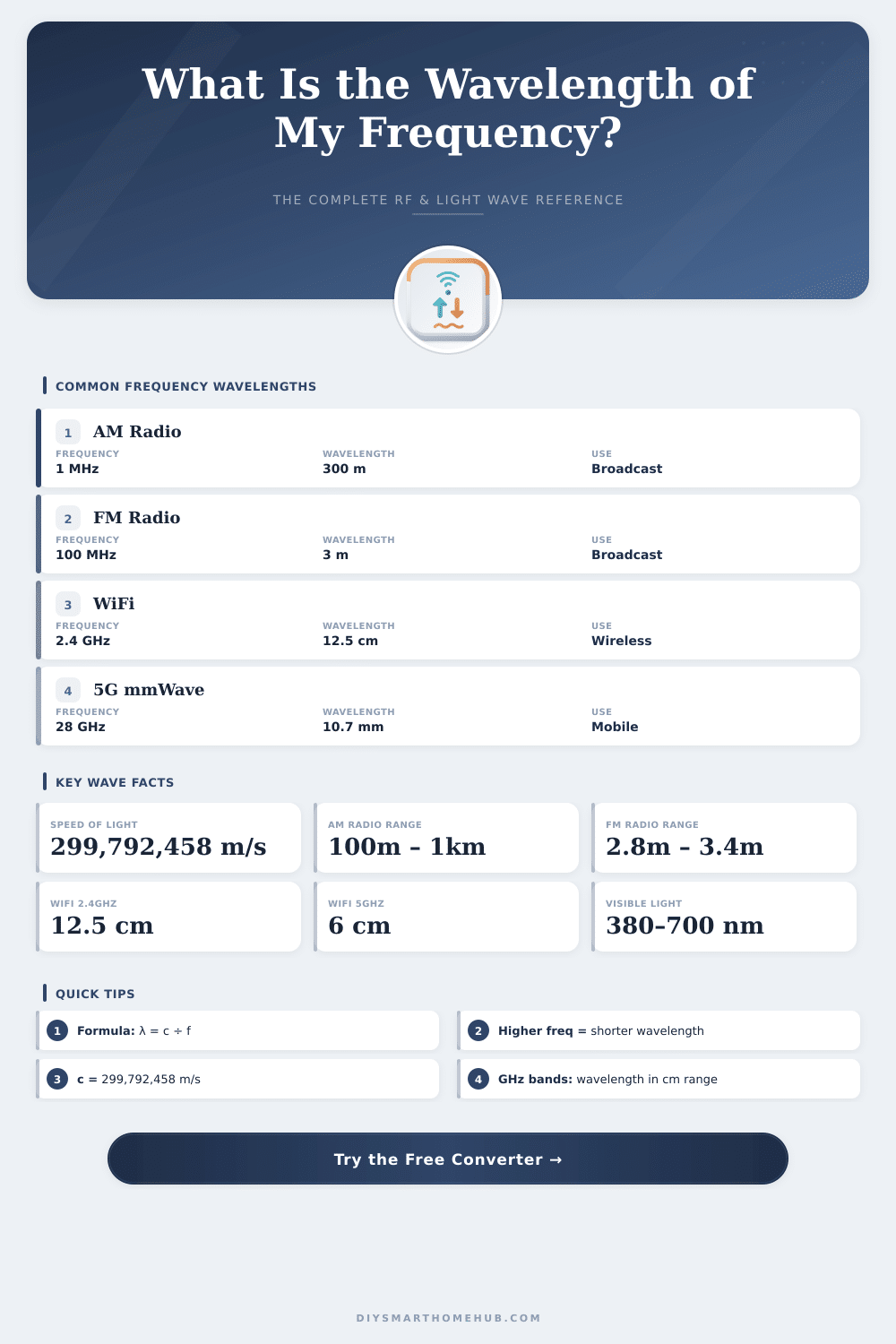
| Band Name | Abbreviation | Frequency Range | Wavelength Range | Typical Use |
|---|---|---|---|---|
| Extremely Low Freq | ELF | 3 – 30 Hz | 10,000 – 100,000 km | Submarine comms |
| Super Low Freq | SLF | 30 – 300 Hz | 1,000 – 10,000 km | AC power grid |
| Very Low Freq | VLF | 3 – 30 kHz | 10 – 100 km | Navigation, time signals |
| Low Freq | LF | 30 – 300 kHz | 1 – 10 km | AM longwave radio |
| Medium Freq | MF | 300 kHz – 3 MHz | 100 m – 1 km | AM broadcast radio |
| High Freq | HF | 3 – 30 MHz | 10 – 100 m | Shortwave, amateur radio |
| Very High Freq | VHF | 30 – 300 MHz | 1 – 10 m | FM radio, TV, aviation |
| Ultra High Freq | UHF | 300 MHz – 3 GHz | 10 cm – 1 m | TV, WiFi, LTE, GPS |
| Super High Freq | SHF | 3 – 30 GHz | 1 – 10 cm | Radar, satellite, WiFi 5G |
| Extremely High Freq | EHF | 30 – 300 GHz | 1 – 10 mm | 5G mmWave, security |
| Infrared | IR | 300 GHz – 430 THz | 700 nm – 1 mm | Remote controls, thermal |
| Visible Light | VIS | 430 – 750 THz | 400 – 700 nm | Human vision |
| Medium | Refractive Index / VF | Wave Speed | Wavelength at 2.4 GHz | Wavelength at 5 GHz |
|---|---|---|---|---|
| Vacuum / Free Space | n = 1.000 | 299,792,458 m/s | 124.9 mm | 60.0 mm |
| Air | n ≈ 1.0003 | ≈ 299,702,547 m/s | 124.9 mm | 59.9 mm |
| Freshwater | n = 1.333 | 224,900,644 m/s | 93.7 mm | 45.0 mm |
| Glass | n = 1.500 | 199,861,639 m/s | 83.3 mm | 40.0 mm |
| Optical Fiber | n = 1.468 | 204,218,296 m/s | 85.1 mm | 40.8 mm |
| Silicon | n = 3.500 | 85,655,000 m/s | 35.7 mm | 17.1 mm |
| Coax Cable | VF = 0.66 | 197,863,022 m/s | 82.4 mm | 39.6 mm |
| Twisted Pair | VF = 0.64 | 191,867,173 m/s | 79.9 mm | 38.4 mm |
| Meters (m) | Centimeters (cm) | Millimeters (mm) | Micrometers (µm) | Nanometers (nm) | Feet (ft) | Inches (in) |
|---|---|---|---|---|---|---|
| 1 m | 100 cm | 1,000 mm | 1,000,000 µm | 1,000,000,000 nm | 3.281 ft | 39.37 in |
| 0.1 m | 10 cm | 100 mm | 100,000 µm | 100,000,000 nm | 0.328 ft | 3.937 in |
| 0.01 m | 1 cm | 10 mm | 10,000 µm | 10,000,000 nm | 0.0328 ft | 0.394 in |
| 0.001 m | 0.1 cm | 1 mm | 1,000 µm | 1,000,000 nm | 0.00328 ft | 0.0394 in |
| 0.000001 m | 0.0001 cm | 0.001 mm | 1 µm | 1,000 nm | 0.00000328 ft | 0.0000394 in |
| 0.000000001 m | 0.0000001 cm | 0.000001 mm | 0.001 µm | 1 nm | 3.28e–9 ft | 3.94e–8 in |
Whether you need to convert between wavelengths and frequencies? A wavelength-frequency converter can be your helper. Those programs allow you to switch between both without stopping your work taking the wavelength of an electromagnetic wave and giving its frequency value; or the other way.
The best part? Almost all are freely available online as calculators, so anyone that needs them can use them.
How to Convert Wavelength and Frequency
The convert itself is not hard because when one understands the basics. One simply rearranges the equation that ties wavelength, frequency and the speed of a wave. Enter two known values, solve for the third and done.
Because the speed of light is fixed, one can even prepare a whole table for the relation between wavelengths and frequencies, which is very handy.
How to find wavelength? Divide the speed of light by the frequency. Light travels at around 300 millions of metres each second, to be more exact, around 299 792 458 metres each second.
Wavelength is the distance between two peaks of a wave, measured in metres. Frequency on the other hand measures in cycles each second. When one has those definitions, the math goes natrually.
Many converters allow change between various units, depending on your work. This is useful, because different areas use different labels. Here is a sample of a free tool, that supports conversions for more than 35 units of frequency and wavelengths.
We talk about hertz, exahertz, petahertz, terahertz, so everything from radio waves too microwaves.
Besides the general converters, there are also dedicated versions. Radio frequency engineers use separate tools for wireless signal work and frequency planning in communications. Workers with lasers have their own calculators, that switch between laser wavelength and frequency in both directions.
There are even niche tools, that estimate wavelength of a signal specially in dielectric materials, as involved with cables and RF-boards.
Some calculators go beyond the basic conversion. One of them counts coherent length directly from a linear beam, which is handy for optical work. Another takes conversions of ITU-based allocations, when one goes from frequency to wavelength.
And for optical systems, there are tools, that handle optical wavelengths and frequency conversions directly.
One must know about another concept, the wave number, that one calculates, it is frequency divided by the speed of light or the other way, one divided by wavelength. There is also photon energy, that mixes frequencies with the Planck constant and the basic formula. This matters especially for short wavelengths and high-energy radiation, like x-rays and gamma rays.
To convert delta frequency into delta wavelength, one needs another formula. Delta frequency equals the speed of light times delta wavelength, all divided by the square of wavelength. So, if you have a delta wavelength of 0.4 nanometres and your wavelength is 1550 nanometres, the deltafrequency results in around 50 gigahertz.
The math always checks out.