⚡ Time of Use (TOU) Calculator
Find your peak & off-peak energy usage — optimize when you run appliances to reduce your electricity bill
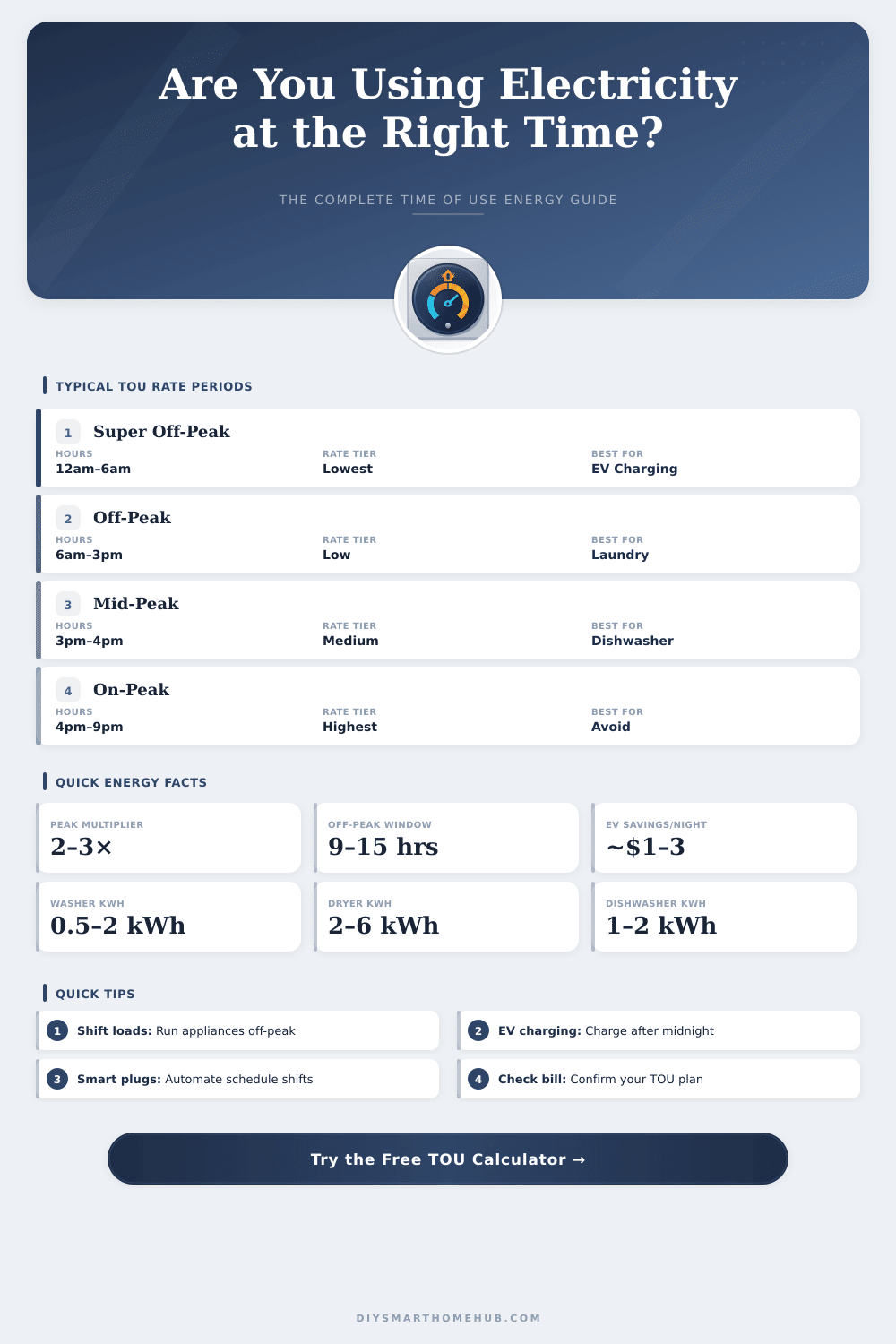
| Period | Typical Hours | Rate Tier | Usage Recommendation |
|---|---|---|---|
| Super Off-Peak | 12:00 AM – 6:00 AM | Lowest (e.g. $0.07/kWh) | EV charging, water heater, pool pump |
| Off-Peak | 6:00 AM – 3:00 PM | Low (e.g. $0.12/kWh) | Laundry, dishwasher, pre-cooling |
| Mid-Peak | 3:00 PM – 4:00 PM | Medium (e.g. $0.22/kWh) | Delay heavy loads if possible |
| On-Peak | 4:00 PM – 9:00 PM | Highest (e.g. $0.32/kWh) | Minimize usage; avoid EV/dryer |
| Appliance | Watts | kWh per Cycle/Hour | Monthly kWh (avg) |
|---|---|---|---|
| Central Air Conditioner | 3,500 W | 3.5 kWh/hr | ~200–400 kWh |
| Electric Water Heater | 4,500 W | 4.5 kWh/hr | ~150–300 kWh |
| EV (Level 2 Charger) | 7,200 W | 7.2 kWh/hr | ~200–450 kWh |
| Electric Clothes Dryer | 5,600 W | 5.0 kWh/cycle | ~50–100 kWh |
| Washing Machine | 500 W | 0.5 kWh/cycle | ~10–20 kWh |
| Dishwasher | 1,800 W | 1.2 kWh/cycle | ~20–40 kWh |
| Pool Pump (1 HP) | 1,500 W | 1.5 kWh/hr | ~90–200 kWh |
| Refrigerator | 150 W | 0.15 kWh/hr | ~45–75 kWh |
| Desktop Computer | 200 W | 0.2 kWh/hr | ~20–50 kWh |
| 50" LED TV | 100 W | 0.1 kWh/hr | ~10–20 kWh |
| Appliance | Daily kWh | Cost at Peak | Cost Off-Peak |
|---|---|---|---|
| EV Charging (50 mi/day) | 15 kWh | $4.80/day | $1.05–$1.80/day |
| Electric Dryer (1 load) | 5 kWh | $1.60/cycle | $0.35–$0.60/cycle |
| Dishwasher (1 cycle) | 1.2 kWh | $0.38/cycle | $0.08–$0.14/cycle |
| Pool Pump (6 hrs) | 9 kWh | $2.88/day | $0.63–$1.08/day |
| Water Heater (2 hrs) | 9 kWh | $2.88/day | $0.63–$1.08/day |
The price by time of use is a system that makes the price of electricity more tied to the peak use for users. Such plans offer different prices depending on the hour in the day and work best when few people use energy. The main idea is simple: electricity costs more during high demand and less when demand is low.
Peak times usually happen in the late afternoon and evening. Some plans set the peak between 4 in the afternoon and 9 in the evening, while others choose a window from 5 in the afternoon until 8 in the evening on workdays. The exact hours change based on the supplier.
How Time of Use Electricity Prices Work
Moving energy use away from those peak hours is the main way to save money with these plans.
From October until May, some plans let clients pay under the usual price any time of the day. In the summer months, from June until September, the savings come by moving energy use to hours outside peak, for example from midnight until 8 in the morning. One supplier offers a really low price for times outside peak all year, around 14 percent of the standard price, from midnight until 8 in teh morning.
Even so in summer, the peak hours can double the price and extra charges for high peak can count from 2 in the afternoon until 6 in the evening on workdays.
Such plans are made to give clients ways to lower there whole costs. Some plans require a yearly contract. During the first year, one can get a promise that the bill does not go over by more than 10 percent what it would be under usual prices.
Important note though; some plans do not let clients return to the usual plan after they switch to the price by time of use.
People owning electric cars commonly benefit. One owner of an electric car saw his electric bill drop in dollars, although the monthly use grew by 400 kilowatt-hours. A ground heat pump running during most of the night under prices outside peak also helped.
Other folk with electric heaters set the thermostat to escape the peak times and the bill dropped to around 60 percent of what it was before in years.
Putting timers on big energy users like electric water heaters helps them run during periods outside peak. Smart home devices or simple timers can automate the use of dryers, washing machines or chargers for electric cars in cheaper hours. Solar panels make energy during the day, but prices by time of use commonly reach the highest level in the evening.
Here batteries to store energy become really useful. A home battery saves extra solar energy and powers the house when the peak arrives.
Summer air conditioning can indeed make these plans more expensive, because the daily summer prices beat the regular by a bit. Monthly emails with tips about moving usage and about reading bills can help save energy and money. Whether price by time of use truly works depends on the lifestyle and on whether most of theenergy use can happen away from the peak times.