✈️ Travel Carbon Footprint Calculator
Calculate CO₂ emissions for flights, car trips, trains, buses & more — with multi-leg journey support
Short Haul Flight
Long Haul Flight
Petrol Car (solo)
Train (avg)
Coach / Bus
Electric Vehicle
Motorcycle
Ferry (avg)
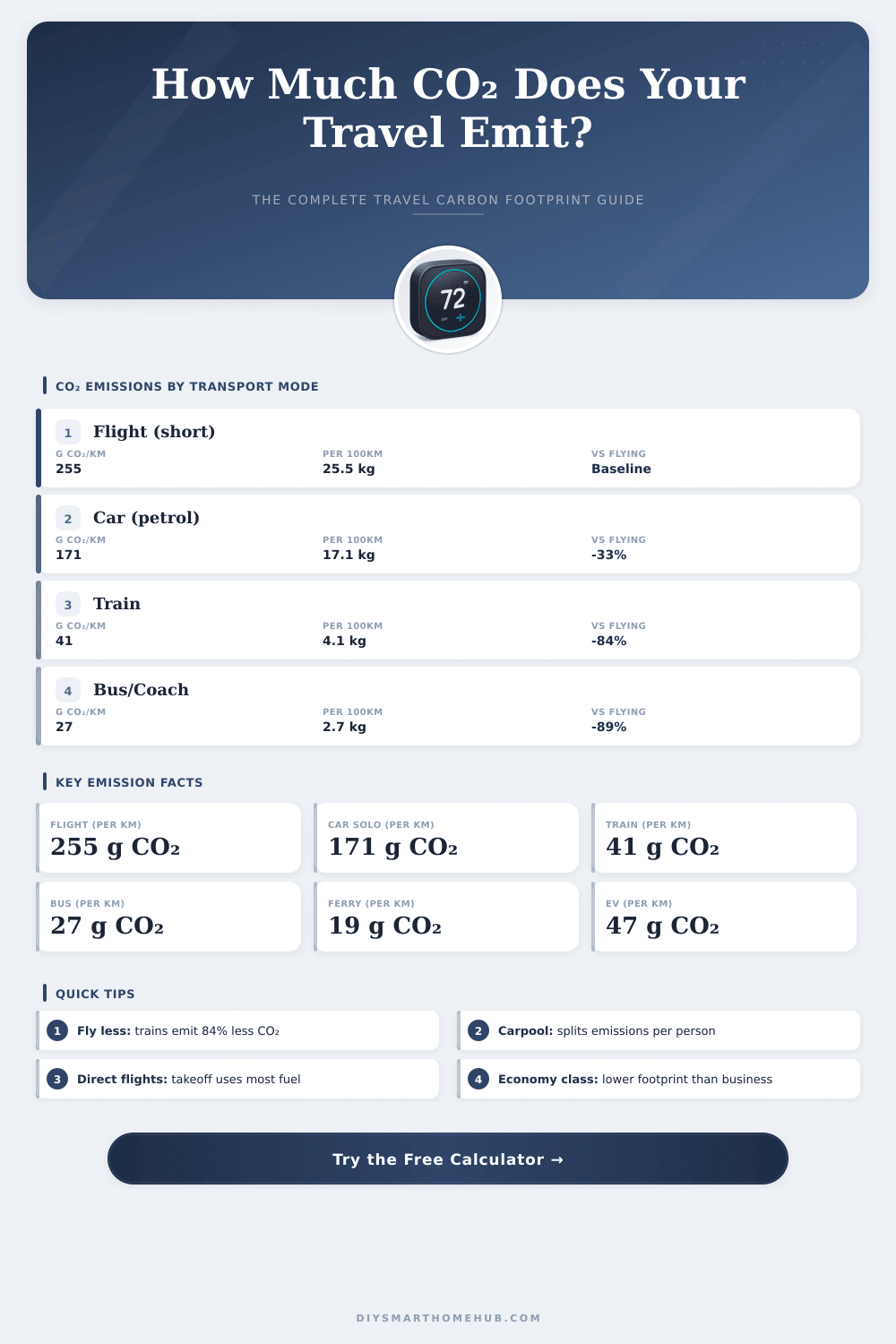
| Transport Mode | Class / Type | g CO₂ / km / person | kg CO₂ per 100km | vs Economy Flight |
|---|---|---|---|---|
| ✈ Flight | Economy (short-haul) | 255 | 25.5 kg | Baseline |
| ✈ Flight | Economy (long-haul) | 195 | 19.5 kg | -24% |
| ✈ Flight | Business class | 586 | 58.6 kg | +130% |
| ✈ Flight | First class | 1170 | 117 kg | +359% |
| 🚗 Car | Petrol (solo driver) | 171 | 17.1 kg | -33% |
| 🚗 Car | Diesel (solo driver) | 168 | 16.8 kg | -34% |
| 🚗 Car | Petrol (2 passengers) | 86 | 8.6 kg | -66% |
| 🚗 Car | Electric vehicle | 47 | 4.7 kg | -82% |
| 🚆 Train | National rail (avg) | 41 | 4.1 kg | -84% |
| 🚆 Train | Eurostar (intl) | 6 | 0.6 kg | -98% |
| 🚌 Bus/Coach | Local bus | 27 | 2.7 kg | -89% |
| ⛴ Ferry | Average foot passenger | 19 | 1.9 kg | -93% |
| 🏍 Motorcycle | Average motorbike | 113 | 11.3 kg | -56% |
| Trip | Distance | By Plane | By Train | By Car (solo) |
|---|---|---|---|---|
| New York – Boston | 340 km | 86.7 kg | 14 kg | 58.1 kg |
| London – Paris | 454 km | 115.8 kg | 2.7 kg | 77.6 kg |
| LA – New York | 4,500 km | 877.5 kg | 184.5 kg | 769.5 kg |
| London – Madrid | 1,800 km | 351 kg | 73.8 kg | 307.8 kg |
| Sydney – Melbourne | 900 km | 175.5 kg | 36.9 kg | 153.9 kg |
| NY – London | 5,570 km | 1,086 kg | N/A | N/A |
Transportation reports about more than quarter of the global emissions of carbon dioxide from energy. In some rich lands, where folks commonly travel it forms one of the main parts of the personal carbon footprint. The tourist carbon footprint falls in around 8 to 9 percent of the total world emissions, according to what enters in the calculation.
When more folks around the globe can allow themselves journeys, that environmental trace simply will grow.
Travel and Carbon Emissions
Flight is one of the main causes of emissions of gases that warm the ground in tourism. Jet planes generate the most carbon during takeoff and landing. Like this every pause and stop in flight add extra emissions.
Choose the shortest route to reduce the traveled miles in the sky and reduce the carbon for every passenger. Direct flights genuinely matter. In economy class one tends to produce only half of the carbon trace compared to business class, because passengers take only half the space.
In a heavier plane, the more fuel it uses. If one visits with big objects like surfboards or skis, better to loan them in teh place than transport them.
Emissions besides carbon dioxide from air travel consist chiefly from oxides of nitrogen, that planes cast flying above 9 000 metres. One developed method to estimate emissions of carbon dioxide from flights, based on data about types of planes, ways, factor of burden of passengers and transported goods.
Trains and buses deserve attention. Avoid flights for more short journeys, although flying occasionally stays the only real option. Understanding the difference of carbon trace between train and car already altered the travel habits of many folks.
Sharing rides in cars also strongly lowers the personal carbon trace. Public transport widely beats the use of car on fossil fuel, even if it is not electric. Cycling and walking is even more helpful, and one can use them during holidays to.
Holidays by means of RV form an interesting sample. Four folks in one RV usually have a smaller carbon trace than flying, renting a car and staying in a hotel. RVs commonly stay in small areas, follow nice weather and many do not travel very long.
A typical RV weighs more and burns more fuel, but some makers work on better fuel efficiency and lower total carbon traces. Even so, some fancy RVs are built with imported materials from the whole world, what creates a big trace already before the vehicle moves.
Camping helps as a way for low carbon living. A normal American family has a yearly carbon trace of 48 tons of CO2 equivalent, and around 30 percent of that comes from transportation. Richer folks tend to spend more for journeys with high carbon, and when folks earn more than 40 000 dollars yearly, theirtourist carbon traces jump by around 13 percent for every 10 percent increase of income.