✈️ Flight Carbon Footprint Calculator
Calculate CO₂ emissions for any flight route by cabin class, distance, and passenger count
Economy
Prem. Economy
Business
First Class
| Route Type | Distance Range | Economy (kg CO₂) | Business (kg CO₂) | First Class (kg CO₂) |
|---|---|---|---|---|
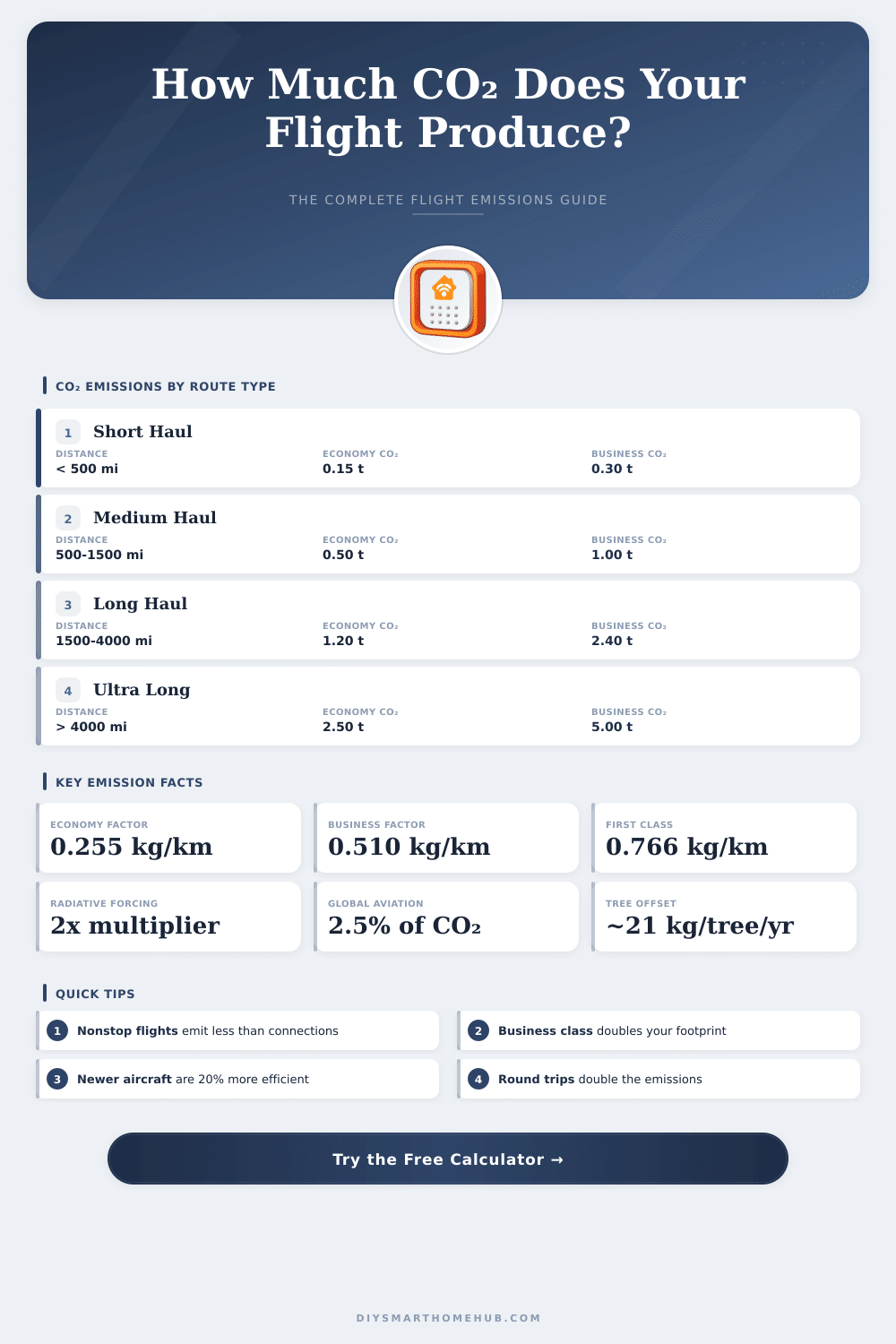
| Very Short | 0–300 mi (0–480 km) | 30–90 | 60–180 | 90–270 |
| Short Haul | 300–1,000 mi (480–1,600 km) | 90–295 | 180–590 | 270–885 |
| Medium Haul | 1,000–3,000 mi (1,600–4,800 km) | 295–885 | 590–1,770 | 885–2,655 |
| Long Haul | 3,000–6,000 mi (4,800–9,650 km) | 885–1,770 | 1,770–3,540 | 2,655–5,310 |
| Ultra Long Haul | 6,000+ mi (9,650+ km) | 1,770+ | 3,540+ | 5,310+ |
| Aircraft Type | Efficiency Modifier | Typical Range | Seat Capacity |
|---|---|---|---|
| Regional Jet (CRJ/E-Jet) | +18% vs average | Up to 1,500 mi | 50–100 |
| Turboprop (ATR/Q400) | +8% vs average | Up to 800 mi | 30–70 |
| Narrowbody (737/A320) | –5% vs average | Up to 3,500 mi | 120–200 |
| Widebody (777/A380) | +5% vs average | Intercontinental | 200–550 |
| Next-Gen (787/A350) | –20% vs average | Ultra long haul | 200–350 |
| CO₂ Amount | Trees Needed (1 yr) | Context Example | Offset Category |
|---|---|---|---|
| 100 kg CO₂ | ~5 trees | Short domestic flight | Low |
| 500 kg CO₂ | ~24 trees | US coast-to-coast | Moderate |
| 1,000 kg CO₂ | ~48 trees | Transatlantic economy | High |
| 2,500 kg CO₂ | ~119 trees | Transatlantic business | Very High |
| 5,000 kg CO₂ | ~238 trees | Long haul first class | Extreme |
| Route | Miles | Kilometers | Flight Time (approx.) |
|---|---|---|---|
| NYC – Miami | 1,280 mi | 2,060 km | ~3 hrs |
| NYC – Los Angeles | 2,750 mi | 4,425 km | ~5.5 hrs |
| London – New York | 3,459 mi | 5,567 km | ~7 hrs |
| London – Dubai | 3,400 mi | 5,470 km | ~7 hrs |
| Los Angeles – Tokyo | 5,478 mi | 8,815 km | ~11.5 hrs |
| Sydney – Singapore | 3,910 mi | 6,292 km | ~8 hrs |
Flying ranks among the most carbon intense activities that folk can do. Even so it makes up only about 2.5 % of the world carbon output. Here is the key: almost no one on the planet flies regularly.
Imagine if each person on Earth would do only one long-range journey by plane yearly, the output of aviation would surpass the whole production of CO₂ in United States. So for those that commonly travel, flying probably forms a big part of their personal carbon trace.
How Flying Adds to Your Carbon Footprint
Flights form the main source of carbon output in the travel trace. They are useful thoughts during planning of journeys.
Various online calculators exist to help folks estimate, how much CO₂ their flying creates. For instance, one resource computes the CO₂ output for one passenger according to particular distance, and it considers also nitrate offsets as well as aerosols, that adjust to CO₂. Beyond that, the calculator of the ICAO bases on industrial data, including kinds of planes, particular ways, factors of passenger load and transported goods. The new version goes furhter, including nitrous oxide, water vapor and impacts of contrail clouds.
Notably, many of those carbon calculators can undercount the real total impact of flights. The actual output maybe a lot surpasses what they point.
The best way to estimate the carbon trace of a flight is by passenger per kilometer. Simply observe the whole carbon of one flight, one must share it by the amount of passengers and the travelled distance. Because of clear conversions, a passenger in economy class puts out between 0.13 kg.
And 0.2 kg. Of CO₂ match each kilometer, according too the length of the flight. For business class the output per passenger each kilometer threefold surpasses that of economy, while first class quadruples, because such seats involve more space and allow bigger baggage.
Takeoff and arrival consume a huge amount of fuel. So choose direct flights instead of those with stops to help reduce output, because each station adds new takeoff and arrival. Long journeys indeed reach better efficiency than short, until the plane loads so much fuel that it lowers the output.
One commonly considers short flights unnecessary, because other ways exist to cover such distances with less impact. For instance, replacing European short flights with trains would make a big change. A domestic flight produces around 246 grams of CO₂ each kilometer, while a national train only around 35 grams.
Some people offset their flight output by investing in efforts like forest protection or green energy sources. Even so, planting trees has weak security, if the planted trees burn in a forest fire, all stored carbon escapes right away back into the atmosphere. A more careful approach to travel could start with simple counting ofyour flight output instead of taking an all-or-nothing position on flying.