⚡ Transformer Sizing Calculator
Calculate the correct kVA rating for single-phase & three-phase transformers from load, voltage & power factor
| kVA Rating | 120V (1ϖ) | 240V (1ϖ) | 208V (3ϖ) | 480V (3ϖ) |
|---|---|---|---|---|
| 1 kVA | 8.33 A | 4.17 A | 2.78 A | 1.20 A |
| 5 kVA | 41.7 A | 20.8 A | 13.9 A | 6.01 A |
| 10 kVA | 83.3 A | 41.7 A | 27.8 A | 12.0 A |
| 15 kVA | 125 A | 62.5 A | 41.6 A | 18.0 A |
| 25 kVA | 208 A | 104 A | 69.4 A | 30.1 A |
| 37.5 kVA | — | 156 A | 104 A | 45.1 A |
| 50 kVA | — | 208 A | 139 A | 60.2 A |
| 75 kVA | — | 313 A | 208 A | 90.2 A |
| 100 kVA | — | 417 A | 278 A | 120 A |
| 167 kVA | — | — | 464 A | 201 A |
| 225 kVA | — | — | 625 A | 271 A |
| 500 kVA | — | — | 1388 A | 601 A |
| kVA Size | Phase | Typical Application | Connected Load (approx) |
|---|---|---|---|
| 1 – 3 kVA | 1ϖ | Control panels, instrumentation | Up to 2.4 kW |
| 5 – 15 kVA | 1ϖ | Small office, residential panels | Up to 12 kW |
| 25 – 50 kVA | 1ϖ | Small commercial, HVAC units | Up to 40 kW |
| 75 – 167 kVA | 3ϖ | Office buildings, retail stores | Up to 130 kW |
| 225 – 500 kVA | 3ϖ | Industrial, data centers | Up to 400 kW |
| 750 – 2500 kVA | 3ϖ | Large industrial, substations | Up to 2000 kW |
| Formula | Single-Phase | Three-Phase | Notes |
|---|---|---|---|
| kVA from kW | kVA = kW / PF | kVA = kW / PF | PF = power factor |
| kVA from Amps | kVA = (V × A) / 1000 | kVA = (V × A × 1.732) / 1000 | 1.732 = √3 |
| Amps from kVA | A = (kVA × 1000) / V | A = (kVA × 1000) / (V × 1.732) | At secondary voltage |
| With demand factor | kVA = (kW × DF) / PF | kVA = (kW × DF) / PF | DF = demand factor |
| NEC 125% rule | kVA × 1.25 | kVA × 1.25 | Minimum continuous rating |
| kVA Range | Typical %Z | Voltage Regulation | Short-Circuit Current Impact |
|---|---|---|---|
| 1 – 10 kVA | 2 – 4% | Low drop | Higher fault current |
| 15 – 50 kVA | 2 – 5% | Moderate | Moderate fault current |
| 75 – 167 kVA | 4 – 5.75% | Good regulation | Lower fault current |
| 225 – 500 kVA | 5 – 5.75% | Good regulation | Lower fault current |
| 750 kVA+ | 5.75 – 7.5% | Highest regulation | Lowest fault current |
Choosing the right size of transformer is really important. That affects the safety, the cost and the function of the whole system. If the transformer is too small and operates at or near its maximum capacity, it makes too much heat.
That extra heat can damage the insulation inside, stop protective systems and shorten the lifespan of the devices.
How to Choose the Right Transformer Size
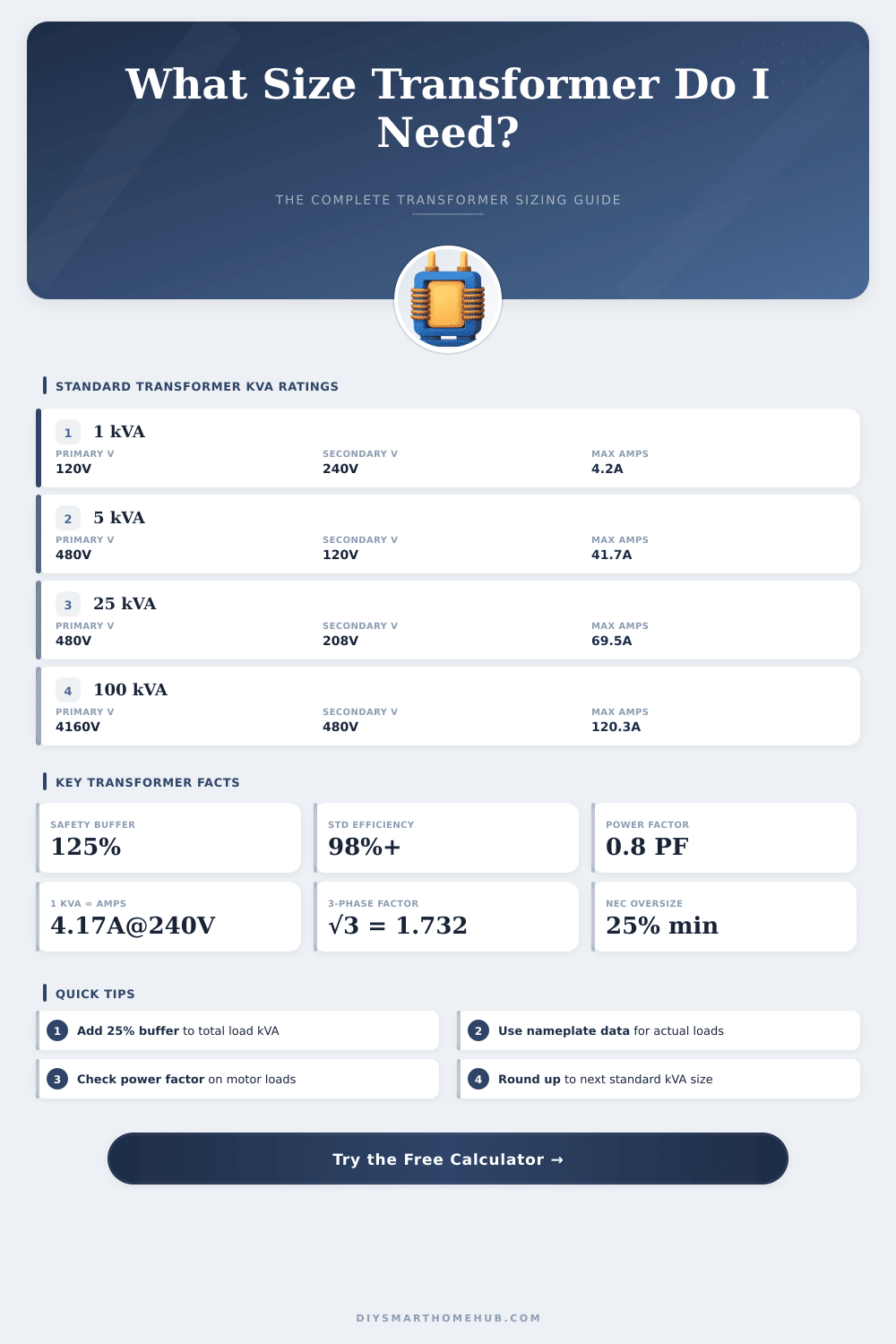
A common first step is to count the whole load in amps. A practical way is to take the maximum load of the gear in amps and add around 20 percent to it. Like this one gets a good guess for the required transformer size.
However the load in amps is only one part of the whole picture.
The power factor also matters. For a system with 0.8 power factor, more attention is needed. To reach a precise size, one multiplies the whole load by the reverse of teh power factor.
Skipping this step can lead to picking a transformer that is too tiny for the real need.
When the load is counted, the result usually shows in kVA. A transformer with 1.0 kVA rating matches to one with 1 000 VA. That amount can last 100 volts at 10 amps of flow.
In three-phase systems the calculation is volts times amps times 1.732, then divided by 1 000. At the end of the math, one rounds too the nearest standard size.
Standard sizes of transformers have their reason. For single-phase transformers typical ratings are 5, 10, 15, 25, 37.5, 50, 75 and 100 kVA. Choosing a standard size from a catalogue costs less and goes more quickly than ordering a special model, that is more expensive and needs more time for delivery.
Adding a safety buffer is a wise idea. A buffer of 20 percent above the estimated capacity is normal practice. For instance, for a typical load of around 2 kVA, a transformer of 2.5 kVA is a better choice.
A smaller model would work technically, but leave no space for future additions.
Engines introduce an extra level of trouble. A transformer that powers an engine is commonly sized according to the starting traits of that engine. If one uses a variable frequency or soft starter, the needs of the transformer are 1 to 1.5 times the flow of the engine.
Starting directly on a loaded line can raise that to three times or even more.
The load always must stay under the listed maximum of the transformer. Connecting a load that matches exactly to the maximum rating is not good thinking. Many folks size the transformer to reach the full capacity of the panel that it feeds, especially if more loads will likely be added later.
Electricians sometimes install transformers rated for only 40 to 50 percent of the planned load, because standard calculations of loads are very careful. What counts asthe right size of transformer can even differ by region.