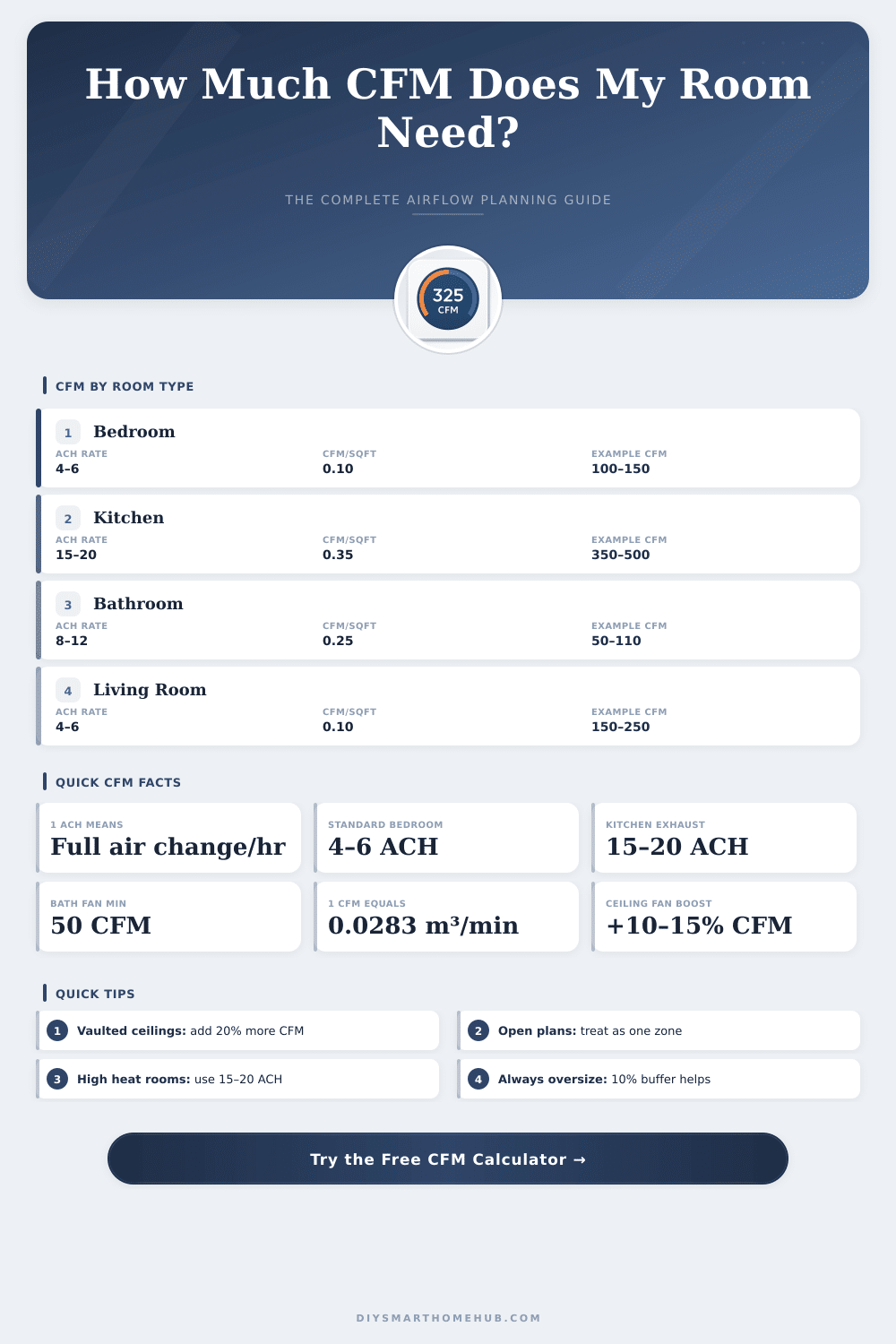
💨 Room Size CFM Calculator
Calculate the exact airflow (CFM) your room needs based on size, ceiling height, and room type
| Room Size (sq ft) | 8 ft Ceiling | 9 ft Ceiling | 10 ft Ceiling | ACH Used |
|---|---|---|---|---|
| 100 sq ft (10x10) | 53 CFM | 60 CFM | 67 CFM | 4 ACH |
| 168 sq ft (12x14) | 90 CFM | 101 CFM | 112 CFM | 4 ACH |
| 200 sq ft (10x20) | 107 CFM | 120 CFM | 133 CFM | 4 ACH |
| 300 sq ft (15x20) | 160 CFM | 180 CFM | 200 CFM | 4 ACH |
| 400 sq ft (20x20) | 213 CFM | 240 CFM | 267 CFM | 4 ACH |
| 600 sq ft (20x30) | 320 CFM | 360 CFM | 400 CFM | 4 ACH |
| 800 sq ft (custom) | 427 CFM | 480 CFM | 533 CFM | 4 ACH |
| Room Type | Min CFM/sqft | Min CFM/person | Typical Total CFM |
|---|---|---|---|
| Bedroom | 0.06 | 5 | 30–100 CFM |
| Living / Family Room | 0.06 | 5 | 50–200 CFM |
| Kitchen | 0.12 | 5 | 100–500 CFM |
| Bathroom (no window) | N/A | N/A | 50–110 CFM |
| Home Office | 0.06 | 5 | 50–150 CFM |
| Garage | 0.10 | N/A | 100–400 CFM |
| Home Gym | 0.10 | 10 | 100–350 CFM |
| Server Room | 0.35+ | N/A | 200–1000+ CFM |
| CFM Value | m³/min | m³/hr | L/s |
|---|---|---|---|
| 50 CFM | 1.42 m³/min | 85.0 m³/hr | 23.6 L/s |
| 100 CFM | 2.83 m³/min | 169.9 m³/hr | 47.2 L/s |
| 200 CFM | 5.66 m³/min | 339.8 m³/hr | 94.4 L/s |
| 300 CFM | 8.50 m³/min | 509.7 m³/hr | 141.6 L/s |
| 500 CFM | 14.16 m³/min | 849.5 m³/hr | 236.0 L/s |
| 1000 CFM | 28.32 m³/min | 1699.0 m³/hr | 471.9 L/s |
Find the right CFM for room is not this easy, although it seems simple at first. CFM, or Cubic Feet per Minute, shows simply how much air flows through the space during a set time. Whether dealing with air cleaners, heaters, heating ventilation systems or exhaust setups, specialists count CFM so that everything works correctly.
Honestly mistake in this number can ruin your whole setup.
How to Find the Right CFM for a Room
A good starting idea is about one CFM for every square foot of the floor. For instance, for room of 10 by 12 feet, what does 120 square feet, you need about 120 CFM from the air channel. But here the key spot: CFM and square feet do not match entirely.
They measure different things, and mixing them causes typical mistakes.
For the real math, one takes the volume of the room in Cubic feet, multiplies it by the wanted air turns each hour, then divides by 60 for the minutes. To get the volume, multiply the length by the width and height. Room with 5 by 10 by 7 feet results in 350 Cubic feet.
The amount of air changes each hour; in short ACH, vaires according to the use of the room. Three such changes each hour is commonly the best average.
Bigger CFM usually gives more efficient flow of air, but it is not always that simple a cause. For rooms under 200 square feet, one finds well between 2 000 and 3 000 CFM. Even so, what truly works depends on the space itself and on its purpose.
In a typical bedroom, one can use from 100 to 200 CFM, although some calculations suggest almost 376 CFM four bedrooms. There is no one solution for everything here.
When the central ventilation is weak, one must raise the CFM to make up for it. Big room usually needs a stronger heater, but no rule covers all cases. Remember the air channels, they must be sized for the whole system CFM.
If they are too small, negative pressure builds in the house, what can cause backdraft in devices with fire. It really is a serious cause.
Most makers of air cleaners estimate the size based on ceilings of 8 feet and ACH of 4.8. Change the height of the ceiling, and the numbers adjust. For whole home systems, if you need around 1 600 CFM through all rooms, a 4-ton AC unit will work well.
If one drops to 1 200 CFM, a 3-ton system is enough. Those values assume standard ceilings of 8 feet, good insulation and mild climate.
For bathrooms especially, the law requires at least 50 CFM for occasional use, while 20 CFM is enough for constant burst of air. Also the noise matters, so do notignore it. A calculator for HVAC CFM can guide you in the math of the needs for every room, based on volume and ACH needs for good airflow.