⚡ Ampere to VA Converter
Convert amps to volt-amperes for single-phase & three-phase electrical systems
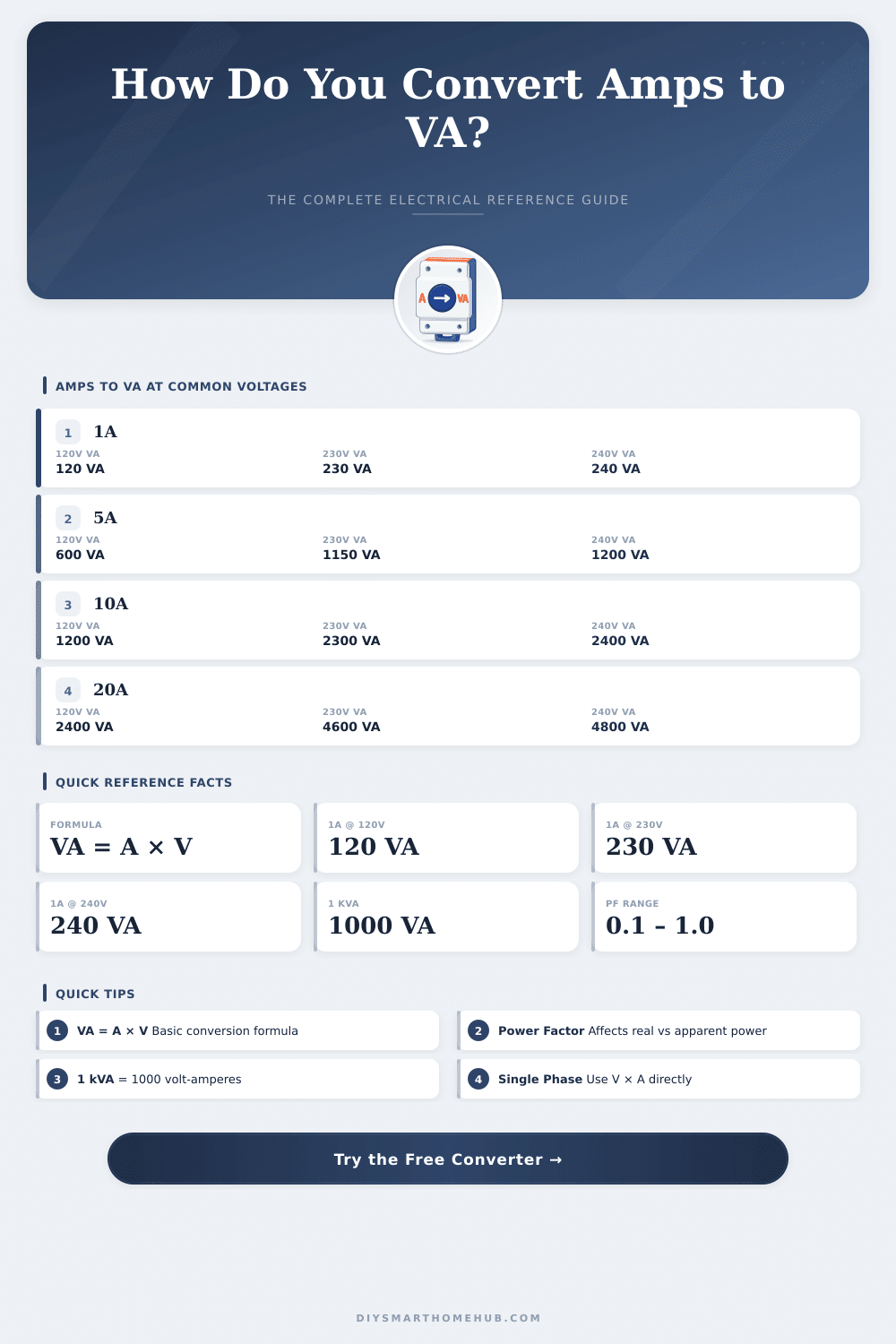
| Amperes (A) | @ 120V (VA) | @ 230V (VA) | @ 240V (VA) | @ 277V (VA) |
|---|---|---|---|---|
| 1 A | 120 VA | 230 VA | 240 VA | 277 VA |
| 5 A | 600 VA | 1,150 VA | 1,200 VA | 1,385 VA |
| 10 A | 1,200 VA | 2,300 VA | 2,400 VA | 2,770 VA |
| 15 A | 1,800 VA | 3,450 VA | 3,600 VA | 4,155 VA |
| 20 A | 2,400 VA | 4,600 VA | 4,800 VA | 5,540 VA |
| 30 A | 3,600 VA | 6,900 VA | 7,200 VA | 8,310 VA |
| 50 A | 6,000 VA | 11,500 VA | 12,000 VA | 13,850 VA |
| 100 A | 12,000 VA | 23,000 VA | 24,000 VA | 27,700 VA |
| Amperes (A) | @ 208V 3Φ (VA) | @ 400V 3Φ (VA) | @ 480V 3Φ (VA) | kVA Equivalent |
|---|---|---|---|---|
| 5 A | 1,801 VA | 3,464 VA | 4,157 VA | 1.8 – 4.2 kVA |
| 10 A | 3,603 VA | 6,928 VA | 8,314 VA | 3.6 – 8.3 kVA |
| 20 A | 7,206 VA | 13,856 VA | 16,627 VA | 7.2 – 16.6 kVA |
| 30 A | 10,809 VA | 20,785 VA | 24,941 VA | 10.8 – 24.9 kVA |
| 50 A | 18,015 VA | 34,641 VA | 41,569 VA | 18 – 41.6 kVA |
| 100 A | 36,030 VA | 69,282 VA | 83,138 VA | 36 – 83.1 kVA |
| Volt-Amperes (VA) | kVA | Watts (PF 0.85) | Watts (PF 1.0) |
|---|---|---|---|
| 500 VA | 0.5 kVA | 425 W | 500 W |
| 1,000 VA | 1 kVA | 850 W | 1,000 W |
| 1,500 VA | 1.5 kVA | 1,275 W | 1,500 W |
| 2,000 VA | 2 kVA | 1,700 W | 2,000 W |
| 5,000 VA | 5 kVA | 4,250 W | 5,000 W |
| 10,000 VA | 10 kVA | 8,500 W | 10,000 W |
| Application | Typical Amps | Voltage | Approx. VA Needed |
|---|---|---|---|
| Home Computer + Monitor | 3–5 A | 120 V | 360–600 VA |
| Small Office UPS | 5–8 A | 120 V | 600–960 VA |
| Server (Rack Unit) | 8–12 A | 120/230 V | 960–2,760 VA |
| Central Air Conditioner | 15–30 A | 240 V | 3,600–7,200 VA |
| Home Generator Load | 20–50 A | 240 V | 4,800–12,000 VA |
| Commercial HVAC | 30–100 A | 208/480 V | 6,240–48,000 VA |
Convert between amperoj and volt-amperoj is a task that commonly happens in work with electrical setups. More folks learn this type of knowledge about electricity especially while they install systems with sunpaneloj. Two common units in electrical work are amperoj and volt-amperoj (VA), and knowing how to exchange them really helps.
What exactly does VA mean? It simply shows the result of volts multiplied by amperoj. One uses it to point out the ability of any device, based on how much energy it can safely handle.
How to Convert Amps and Volt-Amperes (VA)
Such a device can be either the supplier or the consumer. The rating in volt-amperoj shows how much current flows through the device in an electrical net.
The most basic rule for exchange amperoj to VA one can find very easy. The visible energy in volt-amperoj matches the voltage in volts, multiplied by the current in amperoj. So, if one knows the voltage, just multiply it by the amperoj to get the value in VA.
To go the otehr way, from VA to amperoj, one simply divides the VA by the volts. The law about watts says that energy in watts matches volts multiplied by amperoj, and those same ideas are useful for changes with VA.
In three-phase nets, things shift a bit. The rule one uses either with the voltage between lines or with the voltage between line and neutral. If one uses the line-to-line voltage, the visible energy in VA matches the square root of three, multiplied by the current in amperoj and by the voltage.
For the line-to-neutral voltage, it matches three times the current times the voltage. To go from VA too amperoj in a three-phase system, just rearrange the rule and divide right.
A handy method for milliamps. To convert milliamps to VA, first one must change them to amperoj, dividing by a thousand, and then multiply by the voltage.
A table for changes can show how the current in amperoj relates to matching energy in volt-amperoj for various numbers. For instance, assuming typical voltage of 240 V and power factor of 0.8, one can change different values of amperoj to VA. To convert from VA to amperoj, you need to know the voltage and the power factor for the consumer.
Getting the difference between watts and volt-amperoj also matters. In circuits with steady current, the current and the voltage move together, so watts and VA almost match. In circuits with changing current, the current can lead or follow the voltage, and so VA and watts commonly differ.
A calculator for volt-amperoj can be very handy for such electrical work, because it does fast and exact changes for uses tied to energy. Thatinstrument works with single-phase and three-phase nets, though single-phase usually is the standard setup.