⚡ kWh to Joules Converter
Convert kilowatt-hours to joules instantly — plus MJ, Wh, BTU, and calorie equivalents
| kWh | Joules (J) | Megajoules (MJ) | Watt-hours (Wh) | BTU |
|---|---|---|---|---|
| 0.001 | 3,600 | 0.0036 | 1 | 3.41 |
| 0.01 | 36,000 | 0.036 | 10 | 34.12 |
| 0.1 | 360,000 | 0.36 | 100 | 341.21 |
| 0.5 | 1,800,000 | 1.8 | 500 | 1,706.07 |
| 1 | 3,600,000 | 3.6 | 1,000 | 3,412.14 |
| 5 | 18,000,000 | 18 | 5,000 | 17,060.7 |
| 10 | 36,000,000 | 36 | 10,000 | 34,121.4 |
| 50 | 180,000,000 | 180 | 50,000 | 170,607 |
| 100 | 360,000,000 | 360 | 100,000 | 341,214 |
| 500 | 1,800,000,000 | 1,800 | 500,000 | 1,706,070 |
| 1,000 | 3,600,000,000 | 3,600 | 1,000,000 | 3,412,141 |
| Output Unit | Value | Symbol | Notes |
|---|---|---|---|
| Joules | 3,600,000 | J | Exact definition |
| Kilojoules | 3,600 | kJ | 1 kJ = 1,000 J |
| Megajoules | 3.6 | MJ | 1 MJ = 1,000,000 J |
| Gigajoules | 0.0036 | GJ | 1 GJ = 10 J |
| Watt-hours | 1,000 | Wh | 1 kWh = 1,000 Wh |
| Megawatt-hours | 0.001 | MWh | 1 MWh = 1,000 kWh |
| BTU | 3,412.14 | BTU | British Thermal Units |
| Calories | 859,845.23 | cal | Thermochemical |
| Kilocalories | 859.845 | kcal | Food calories (Cal) |
| Electron volts | 2.247 × 10²⁵ | eV | Atomic physics |
| Foot-pounds | 2,655,224 | ft·lbf | Imperial mechanical |
| Appliance / Scenario | Typical kWh | Joules | MJ |
|---|---|---|---|
| LED bulb (1 hour, 10W) | 0.01 | 36,000 | 0.036 |
| Laptop (1 hour, 50W) | 0.05 | 180,000 | 0.18 |
| Microwave (1 hour, 1kW) | 1 | 3,600,000 | 3.6 |
| Electric shower (1 hour, 8kW) | 8 | 28,800,000 | 28.8 |
| EV charge (partial, 10 kWh) | 10 | 36,000,000 | 36 |
| Average daily home use (US) | 30 | 108,000,000 | 108 |
| Refrigerator (monthly) | 45 | 162,000,000 | 162 |
| Solar panel (daily, 400W) | 2 | 7,200,000 | 7.2 |
| Average US home (monthly) | 886 | 3,189,600,000 | 3,189.6 |
Converting between kilowatt-hours and joules is pretty simple when you understand the basic rule. The kilowatt-hour, or kWh, serves as a unit for energy. One uses it especially to describe electrical energy.
It shows the energy that a device uses during one hour at power of a thousand watts. The tie between watts, time and energy forms the basis for all such conversions.
Convert kWh to joules and joules to kWh
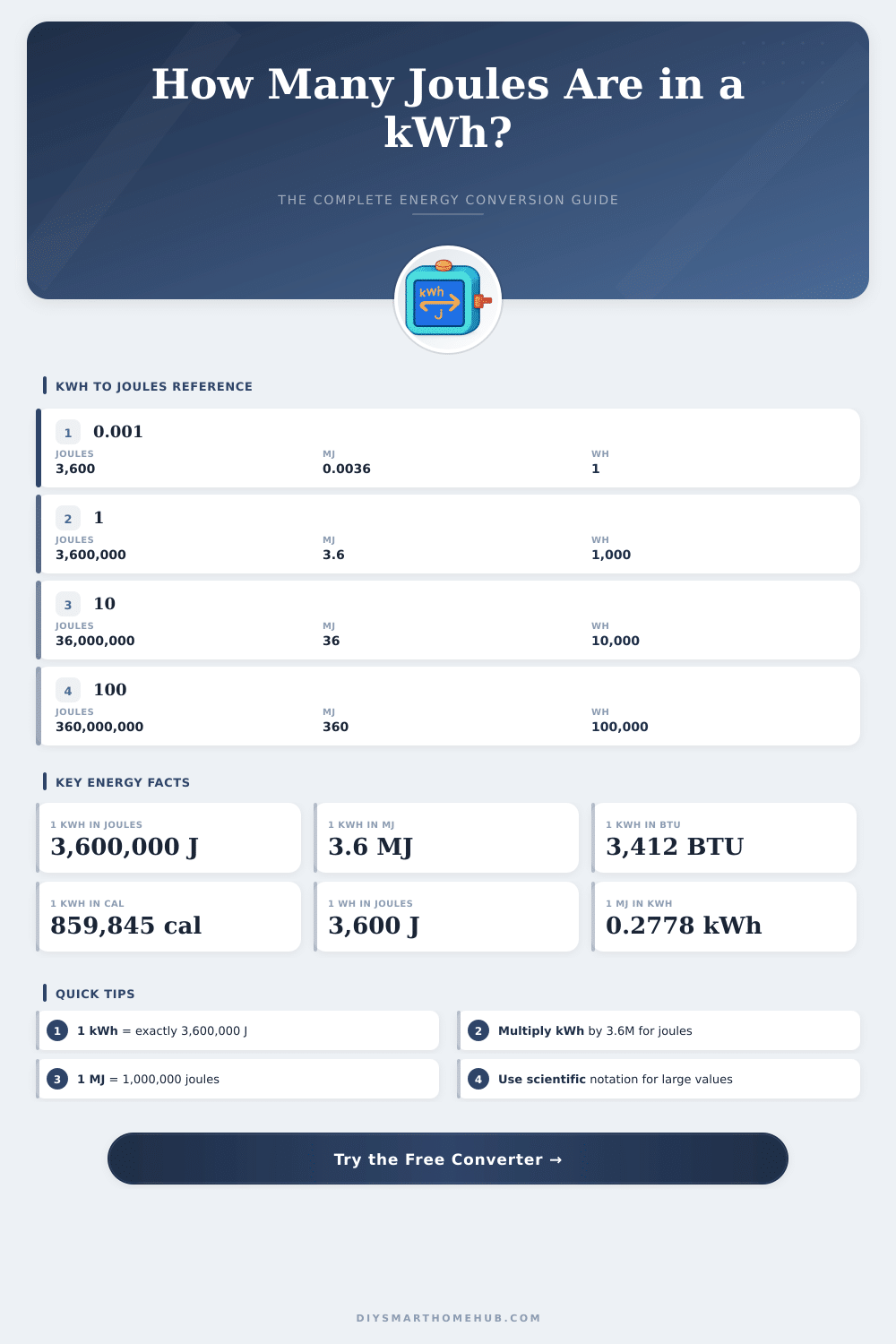
Here is the main point that one must recall. One kWh matches 3 600 000 joules. One can write that also as 3.6 times ten to the power of six joules.
To convert kWh to joules simply multiply the value of kWh by 3 600 000. To go from joules to kWh, divide the joules by 3 600 000.
Where does that number come from? One watt matches one joule per second. So one joule is one watt multiplied by one second.
Because one kilowatt holds 1000 watts and one hour has 3600 seconds, one gets 1000 tiems 3600, which makes 3 600 000 joules. That equals 3.6 megajoules, because one megajoule is one million joules.
A simple example helps to show that. To convert 5 000 000 joules to kilowatt-hours, divide 5 000 000 by 3 600 000. The result comes to around 1.388889 kWh.
Really easy stuff.
Now assume that you own 1 kWh and want too know how many joules that is; the answer is 3 600 000 joules. For 3 kWh, multiply 3 600 000 by 3. That gives 10 800 000 joules.
One joule in kilowatt-hours is a really small amount. It matches around 2.7777777777778 times ten to the negative seventh power kWh. Not an easy number that you recall, but online calculators handle it right away.
One common mistake is worth noting. Watts measure power, while watt-hours or kilowatt-hours measure energy. They are different but related ideas.
Like how miles per hour show speed, but miles alone measure distance. They relate, but are notthe same.
Online converters simplify the whole process quickly. They allow users to convert joules to kilowatt-hours or the other way around. Many of them include tables for conversions and steps, along with options for other energy units.
Simple formulas, handy calculators and quick links for common energy values all help to reach correct results with little work.
Another example from daily life ties everything together. Assume that a device uses 0.06 kW and runs for eight hours; that is 0.06 multiplied by eight, which gives 0.48 kWh. Knowing that one kWh matches around 3.6 megajoules, you can then easily count the energy in joules too.