💡 Lighting Beam Angle Calculator
Calculate beam spread diameter, spacing, and coverage area for any fixture and mounting height
Accent / Feature
Task / Focal
General / Room
Ambient / Wash
Tight Beam
Industrial Flood
Wide Wash
Indirect / Diffuse
| Beam Angle | 6 ft (1.8 m) | 8 ft (2.4 m) | 10 ft (3.0 m) | 12 ft (3.7 m) | 16 ft (4.9 m) |
|---|---|---|---|---|---|
| 10° | 1.1 ft / 0.3 m | 1.4 ft / 0.4 m | 1.8 ft / 0.5 m | 2.1 ft / 0.6 m | 2.8 ft / 0.9 m |
| 15° | 1.6 ft / 0.5 m | 2.1 ft / 0.6 m | 2.7 ft / 0.8 m | 3.2 ft / 1.0 m | 4.3 ft / 1.3 m |
| 25° | 2.7 ft / 0.8 m | 3.6 ft / 1.1 m | 4.5 ft / 1.4 m | 5.3 ft / 1.6 m | 7.1 ft / 2.2 m |
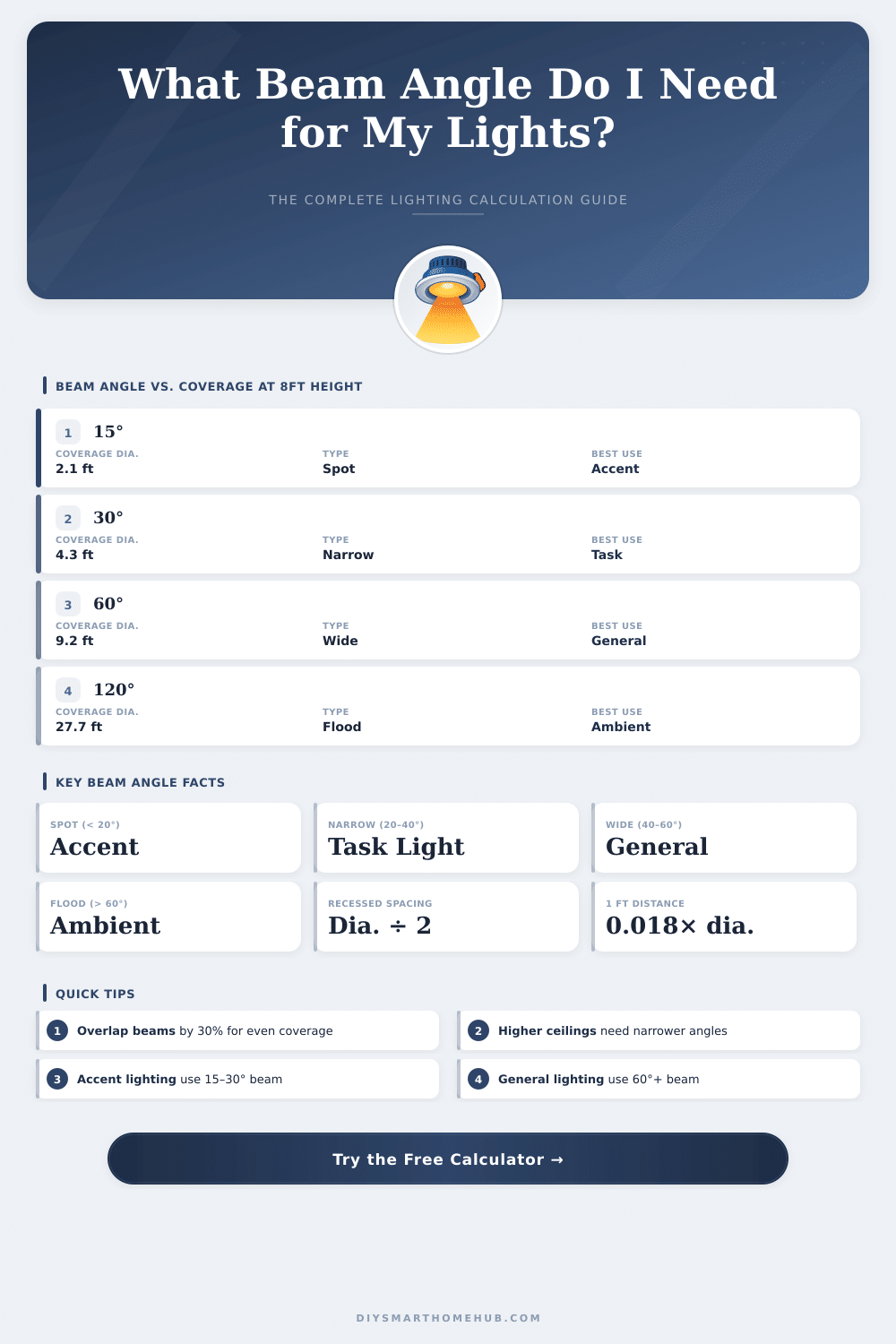
| 30° | 3.2 ft / 1.0 m | 4.3 ft / 1.3 m | 5.4 ft / 1.6 m | 6.4 ft / 2.0 m | 8.6 ft / 2.6 m |
| 45° | 5.0 ft / 1.5 m | 6.6 ft / 2.0 m | 8.3 ft / 2.5 m | 9.9 ft / 3.0 m | 13.3 ft / 4.1 m |
| 60° | 6.9 ft / 2.1 m | 9.2 ft / 2.8 m | 11.5 ft / 3.5 m | 13.9 ft / 4.2 m | 18.5 ft / 5.6 m |
| 90° | 12.0 ft / 3.7 m | 16.0 ft / 4.9 m | 20.0 ft / 6.1 m | 24.0 ft / 7.3 m | 32.0 ft / 9.8 m |
| 120° | 20.8 ft / 6.3 m | 27.7 ft / 8.5 m | 34.6 ft / 10.6 m | 41.6 ft / 12.7 m | 55.4 ft / 16.9 m |
| Beam Angle | 8 ft Ceiling | 10 ft Ceiling | 12 ft Ceiling | Coverage Type |
|---|---|---|---|---|
| 15° | 1.5 ft / 0.5 m | 1.9 ft / 0.6 m | 2.2 ft / 0.7 m | Spot / Accent |
| 25° | 2.5 ft / 0.8 m | 3.1 ft / 1.0 m | 3.7 ft / 1.1 m | Narrow Task |
| 30° | 3.0 ft / 0.9 m | 3.8 ft / 1.2 m | 4.5 ft / 1.4 m | Task / Focal |
| 45° | 4.6 ft / 1.4 m | 5.8 ft / 1.8 m | 6.9 ft / 2.1 m | General |
| 60° | 6.5 ft / 2.0 m | 8.1 ft / 2.5 m | 9.7 ft / 3.0 m | Ambient |
| 90° | 11.2 ft / 3.4 m | 14.0 ft / 4.3 m | 16.8 ft / 5.1 m | Wide Ambient |
| Room / Space | Recommended Lux | Foot-Candles (fc) | Suggested Beam Angle |
|---|---|---|---|
| Living Room (ambient) | 100–200 lux | 9–19 fc | 60°–120° |
| Kitchen (task) | 300–500 lux | 28–46 fc | 30°–45° |
| Bedroom | 100–300 lux | 9–28 fc | 45°–90° |
| Bathroom / Vanity | 300–500 lux | 28–46 fc | 30°–60° |
| Office / Desk | 300–750 lux | 28–70 fc | 25°–45° |
| Retail / Commercial | 500–1000 lux | 46–93 fc | 20°–45° |
| Warehouse / Industrial | 200–500 lux | 19–46 fc | 60°–120° |
| Accent / Artwork | 50–150 lux | 5–14 fc | 10°–25° |
| Stage / Theater | 500–2000 lux | 46–186 fc | 5°–25° |
| Outdoor Pathway | 5–50 lux | 0.5–5 fc | 60°–180° |
| Room Size | Area (sq ft) | Area (m²) | Fixtures Needed (30°) | Fixtures Needed (60°) |
|---|---|---|---|---|
| Small Bathroom | 40 sq ft | 3.7 m² | 3–4 | 1–2 |
| Small Bedroom (10x10) | 100 sq ft | 9.3 m² | 6–8 | 2–3 |
| Standard Bedroom (12x14) | 168 sq ft | 15.6 m² | 9–12 | 3–5 |
| Living Room (14x18) | 252 sq ft | 23.4 m² | 14–18 | 5–7 |
| Open Plan (20x30) | 600 sq ft | 55.7 m² | 33–42 | 11–14 |
| Commercial Floor (50x60) | 3000 sq ft | 278.7 m² | 165–200 | 55–70 |
Beam Angle simply points, as far as the light shows after it exits from the lamp, and one measures it in degrees. It extends from the brightest parts until here, where the light starts to become less bright. Exactly said, it marks the scope where the intensity of the light stays above half of its maximum.
There also exists the field angle, that covers an even bigger area, here the glow sinks until only 10 percent of the peak. If you ever turned a lantern directly before you, then the field angle shows how far broadly the visible light spreads during it go.
How Beam Angle Affects Light
Average bulbs spread light everywhere around them, covering a whole circle of 360 degrees. And commercial use? Such light does not focus easily in one direction.
Intensity and Beam Angle is two steps of same cause, the feeling of glow affects strongly, what angle you choose in the end.
Narrow beams have a unique trait: they focus the light in a precise place. A beam of 15 degrees works as if a spotlight, that hits the image directly. Some lamps become even more precise…
For instance a 7-degree spot or 12-degree angle for very delicate objects. Most spotlights limit to under 25 degrees. That focus gives real force and depth, which does, that building elements seem more sharp and dramatic.
A wall, lit by a 15-degree beam, would stay clear and focused, without waste of light, that spreads useless.
On the other hand, a beam of 120 degrees fills a hole room with soft and spread light. Lamps with broad angle commonly range between 45 and 120 degrees, here one finds flood lights. For general Lighting in a room, bigger angles get the task done well.
They spread bright light above vast surfaces, without warm places. Beams of middle size, around 24 until 40 degrees, mix both worlds and offer good covering without a heavy toll of intensity.
The Beam Angle determines directly, how much floor receives light. Smaller angles limit the covered area; bigger ones extend it. Assume you have a room of 40 square feet with a ceiling at 34 feet height.
One light of 60 degrees, placed in the center, would cover the whole floor. Even so think about this, in rooms with very high ceilings you need to use narrow angles for ceiling or wall lamps, otherwise the light hits walls instead of the floor.
NEMA ratings split LED beams into seven groups. The first ends at 10 until 18 degrees, ideal for spotlights with long reach. At the other end, the seventh reaches 130 degrees or more, fit for close flood uses.
To choose the right Beam Angle, it changes everything, when you light building details, landscape objects or paths. A group of trees shines best from up with a broad beam and much brightness. The more far the lamp stands from the trees, the bigger ground it reaches.
Also for shipLighting the angle matters a lot, because one must follow certain standards of sailing safety.