⚡ MW to kWh Converter
Convert megawatts (power) to kilowatt-hours (energy) — enter power, duration, and get instant results
| Power (MW) | 1 Hour (kWh) | 24 Hours (kWh) | 1 Month (kWh) | 1 Year (kWh) |
|---|
| Unit | Equals kWh | Equals MWh | Equals GWh |
|---|
| Plant Type | Typical Size (MW) | Annual kWh (at CF) | Capacity Factor |
|---|
| Energy Amount | kWh | Homes Powered (1 yr) | Equivalent |
|---|
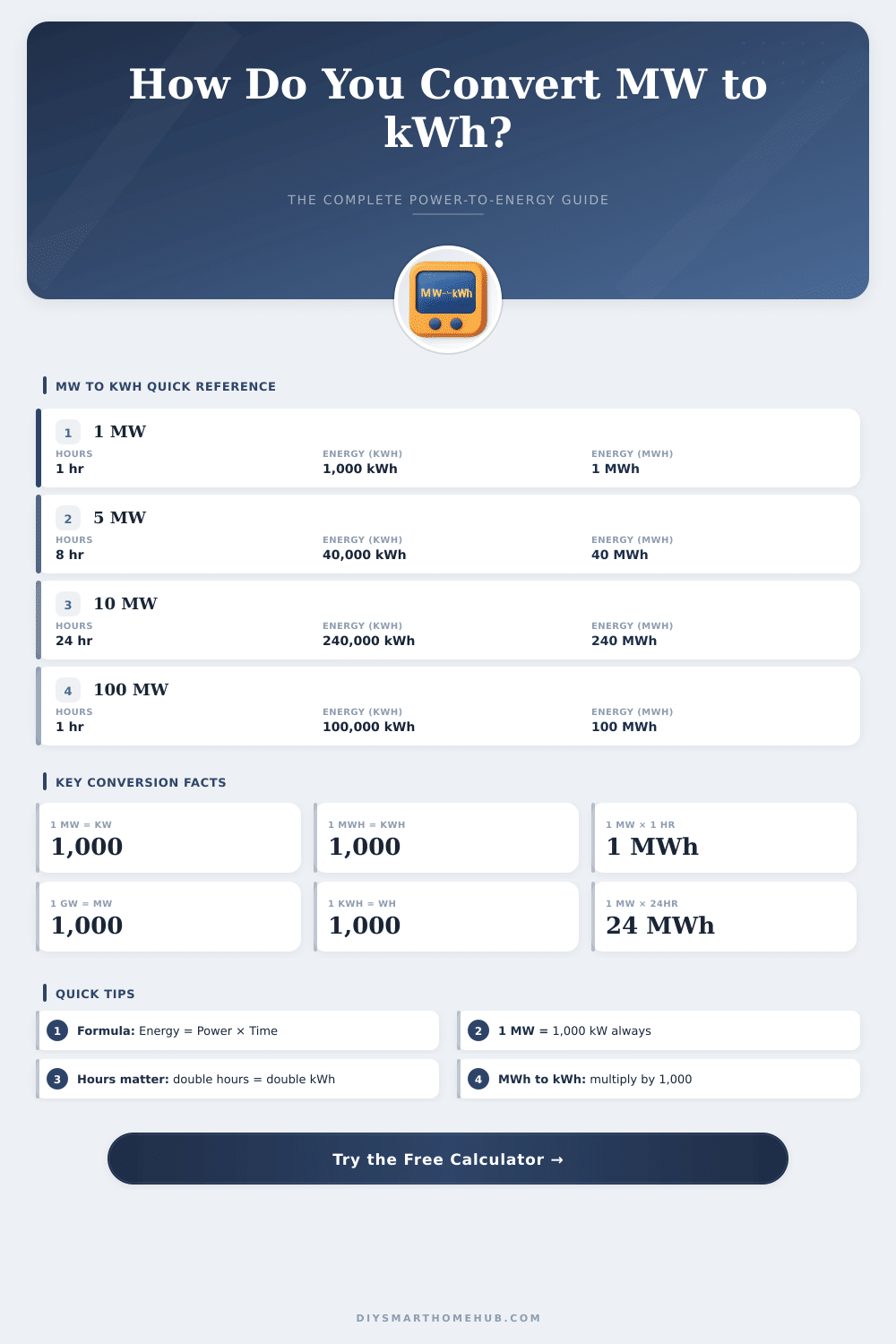
Converting between megavat-hours and kilovat-hours is a bit simple, if one knows the basic rule. To pass MWh to kWh simply multiply by 1 000. Because one MWh matches 1 000 kWh, so 5 MWh is 5 000 kWh.
Very easy, right?
How to convert between MWh and kWh
The other direction works just as well. To go from kWh to MWh, divide the number of kilovat-hours by 1 000. Like this one kWh equals 0,001 MWh.
This basic conversion rule stays the same, no matter waht numbers you work with.
People do those conversions, because most home electric bills show in kilovat-hours. So when energy data come in MWh, convert them to kWh helps better understand and compare with the monthly seen values on the bill.
There are websites with converters, that speed this up. Some programs allow you to enter a value in megavat-hours and click a button to right away receive the result in kilovat-hours. Many of them also offer links and rules to check.
Some even help to convert megavats to kilovats or search other units of power.
Here is something important to remember. Megavats and kilovats measure power, while megavat-hours and kilovat-hours measure energy. They are linked, but very different.
Compare watts with vat-hours like to compare miles per hour with total miles. The first shows speed, the others the whole amount.
The energy depends on power and time together. For instance, a machine with 2 kW power, that works for 2 hours, uses 4 kWh. So it is only power times time.
These units can quickly become huge. For instance, 1 gigavat matches 1 000 megavats, so 1 000 000 kilovats. And 1 GWh is 1 million kWh.
Like this 124 363 GWh equals 124 363 000 000 kWh. Those big numbers the conversions do not change.
Here is a practical example to mention. If boilers have a total load of 43,11 MW and work around 4 380 hours yearly with 80 percent effect, the yearly energy use comes to about 151 057 440 kWh, or around 151 GWh four the year.
The rule to convert megavats to kilovats as power is also simple. Multiply the megavat number by 1 000. So 1 MW matches 1 000 kW.
The base unit of energy in SI is the joule, and kWh and MWh are only bigger, practical ways to express energy. One joule matches around 2,7777777777778E-7 kWh.
Whether one deals with small home devices or big power systems, knowing how to switch between those units helps tounderstand the energy numbers that appear everywhere.