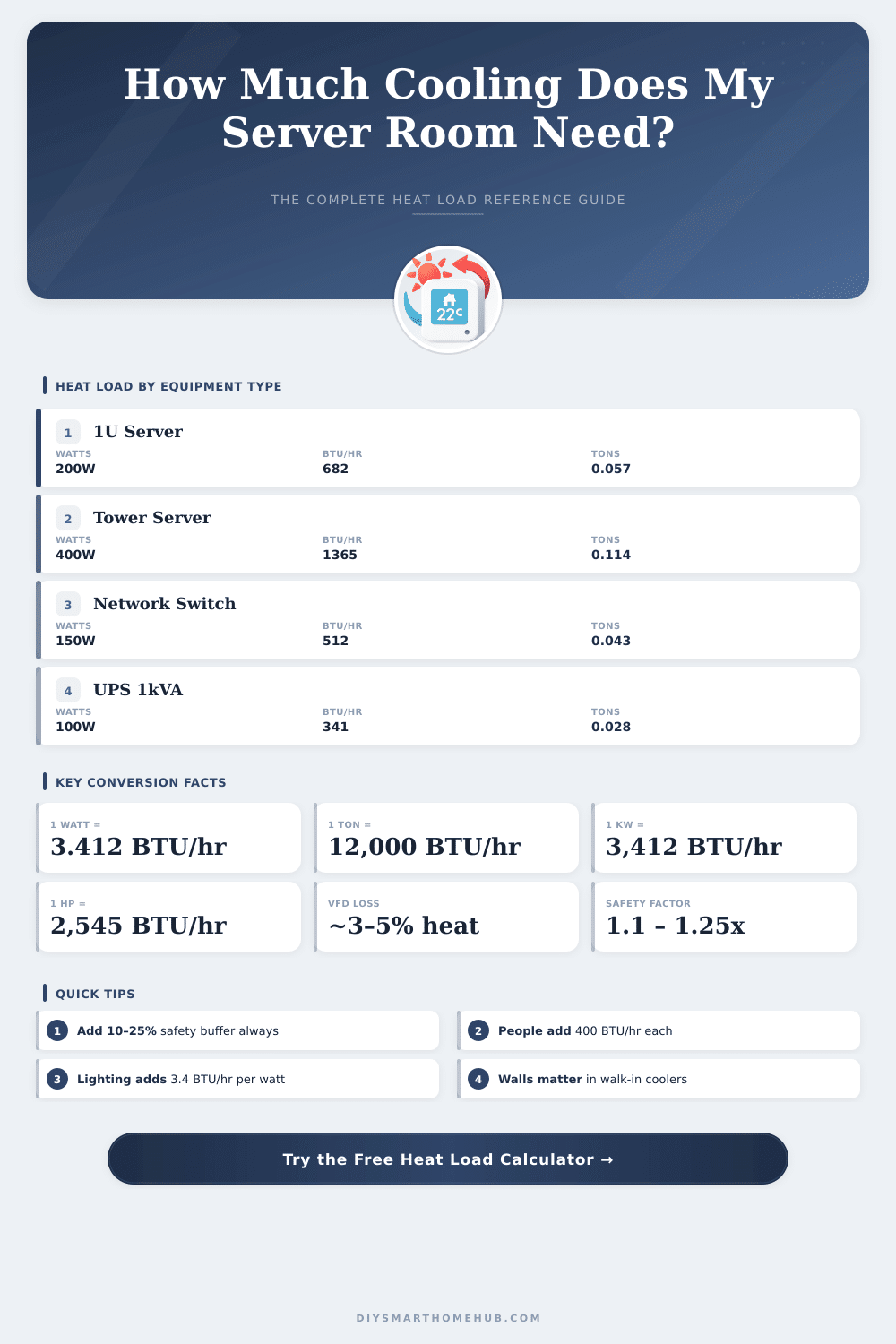
🌡️ Heat Load Calculator
Server Room • Electrical Enclosure • Refrigeration • Walk-In Cooler • VFD Panel
| Equipment Type | Typical Watts | BTU/hr | Cooling Tons |
|---|---|---|---|
| 1U Rack Server (entry) | 150–250W | 512–853 | 0.043–0.071 |
| 1U Rack Server (high perf) | 300–500W | 1,024–1,706 | 0.085–0.142 |
| 2U Rack Server | 400–700W | 1,365–2,388 | 0.114–0.199 |
| Blade Chassis (full) | 4,000–8,000W | 13,648–27,296 | 1.14–2.27 |
| Network Switch (24-port) | 100–200W | 341–682 | 0.028–0.057 |
| Core Router / Firewall | 200–500W | 682–1,706 | 0.057–0.142 |
| UPS 1 kVA (losses only) | 50–100W | 171–341 | 0.014–0.028 |
| UPS 10 kVA (losses only) | 300–600W | 1,024–2,047 | 0.085–0.171 |
| Storage Array (mid) | 500–1,500W | 1,706–5,118 | 0.142–0.427 |
| Full 42U Rack (loaded) | 5,000–20,000W | 17,060–68,240 | 1.42–5.69 |
| Wall / Panel Type | R-Value | U-Value (BTU/hr·ft²·°F) | Heat Gain (BTU/hr per 100 ft² ΔT=30) |
|---|---|---|---|
| 4-inch Polyurethane Panel | R-25 | 0.040 | 120 |
| 3-inch Polyurethane Panel | R-22 | 0.045 | 135 |
| Standard Insulated Wall | R-19 | 0.053 | 159 |
| 2-inch Foam Board | R-10 | 0.100 | 300 |
| Uninsulated Metal | R-4 | 0.250 | 750 |
| Standard Drywall + Batt | R-11 | 0.091 | 273 |
| Motor Rating | VFD Efficiency | Heat Dissipated (W) | BTU/hr |
|---|---|---|---|
| 1.5 kW (2 HP) | 97% | 45 W | 154 |
| 4 kW (5 HP) | 97% | 120 W | 409 |
| 7.5 kW (10 HP) | 97% | 225 W | 768 |
| 15 kW (20 HP) | 97% | 450 W | 1,535 |
| 22 kW (30 HP) | 97% | 660 W | 2,252 |
| 37 kW (50 HP) | 97% | 1,110 W | 3,787 |
| 55 kW (75 HP) | 96% | 2,200 W | 7,506 |
| 110 kW (150 HP) | 96% | 4,400 W | 15,013 |
| Cooling Capacity | BTU/hr | Watts (kW) | Typical Application |
|---|---|---|---|
| 0.5 Ton | 6,000 | 1.76 kW | Small enclosure / closet server |
| 1 Ton | 12,000 | 3.52 kW | Small server room (2–4 racks) |
| 2 Ton | 24,000 | 7.03 kW | Medium server room (5–8 racks) |
| 3 Ton | 36,000 | 10.55 kW | Medium data room (10 racks) |
| 5 Ton | 60,000 | 17.58 kW | Large server room (15–20 racks) |
| 10 Ton | 120,000 | 35.17 kW | Data center row / large room |
| 20 Ton | 240,000 | 70.34 kW | Enterprise data center |
Warm load calculator takes issue about the computations about that how many heating or cooling requires building genuinely. It considers elements as the quality of insulation and the climate of your region, for estimate exactly the demands of your cooling systems. The mainstream notion is ensure that your device answers to the space, if you err, end with system, that is either too strong or lack the necessary power.
Online calculators help about many from those tasks easily. They allow to owners of homes quickly control the needs of heating and cooling space according to the specifications of their building. One favourite mode is the method according to square feet, it uses the surface and add factors as levels of insulation, arrangement of windows and other causes, that affects the temperatures.
How to Find Your Home Heating and Cooling Needs
Most many from those programs start with internal target temperature of 72 degrees as default.
Calculators based on Manual J go more carefully in the causes. For instance LoadCalc execute the computations of Manual J for find the precise BTU-demands for the whole home. You elect first your state or province, later your concrete city.
What separates this, are the room-by-room calculation, that surpasses the simple surface arithmetic. Because it researches, as every room are done and to what it is exposed, you recieve much more accurate results. That regularity helps also size yours channels according to the apt mode.
So exist also the basic general calculators. They estimate the BTU-needs according to the temperature-swing, that you intend, so the difference between exterior weather and the desired internal temperature. The formula are genuinely easy: one takes the surface in square feet, multiplies by height of ceiling, later by the temperature-difference, ultimately by coefficient.
For home of 3,000 square feet with 8-foot ceilings and 40-degree swing, one finds around 129,600 BTUs.
One BTU matches roughly to 1,055 joules, and it shows, what require for move one pound of water won degree. Some calculators require to enter the mass flow, the particular heat and the temperature-change for output the heat load.
Professional installers use more rugged tools. The heat load Calculator, done for certified installers of low-carbon heaters, that must follow the standard BS EN 12831-1:2017, this is the need for heat pumps and biomass systems. Big programs as Trace 3D and HAP 6.2 apply models of balance of ground heat, although they had a bit of troubles in the introduction, because it yet is fairly new for them.
Trace 700 exist more long and seem more usual, but many users do not receive enough training for use its whole skill. OpenStudio can count loads purely, even so you require something as SketchUp for genuinely build the models.
Too big cooling systems were usual before, because the load computations did not have a lot of gravity before heatpumps spread. Now everything adjusted, and precise calculations became even more important than before.