⚡ Farad to Ampere Calculator
Convert capacitance (F, mF, µF, nF) + voltage + discharge time to current in amperes
1 C per volt
1/1,000 Farad
1/1,000,000 Farad
1/1,000,000,000 Farad
Smallest common unit
Amps from discharge
in Coulombs
in Joules
| Voltage (V) | Time 1ms | Time 10ms | Time 100ms | Time 1s |
|---|---|---|---|---|
| 3.3 V | 1.551 A | 0.1551 A | 15.51 mA | 1.551 mA |
| 5 V | 2.35 A | 0.235 A | 23.5 mA | 2.35 mA |
| 9 V | 4.23 A | 0.423 A | 42.3 mA | 4.23 mA |
| 12 V | 5.64 A | 0.564 A | 56.4 mA | 5.64 mA |
| 24 V | 11.28 A | 1.128 A | 112.8 mA | 11.28 mA |
| 48 V | 22.56 A | 2.256 A | 225.6 mA | 22.56 mA |
| Capacitance | Voltage | Charge Q (C) | Energy E (J) | Equivalent mAh |
|---|---|---|---|---|
| 1 F | 5 V | 5 C | 12.5 J | 1.389 mAh |
| 1 F | 12 V | 12 C | 72 J | 3.333 mAh |
| 100 mF | 24 V | 2.4 C | 28.8 J | 0.667 mAh |
| 470 µF | 5 V | 2.35 mC | 5.875 mJ | 0.653 µAh |
| 2200 µF | 12 V | 26.4 mC | 158.4 mJ | 7.333 µAh |
| 10 F | 48 V | 480 C | 11,520 J | 133.3 mAh |
| Resistance (Ω) | Capacitance | Time Constant τ | Full Discharge (~5τ) |
|---|---|---|---|
| 100 Ω | 470 µF | 47 ms | 235 ms |
| 1 kΩ | 100 µF | 100 ms | 500 ms |
| 10 kΩ | 10 µF | 100 ms | 500 ms |
| 10 Ω | 1000 µF | 10 ms | 50 ms |
| 1 Ω | 1 F | 1 s | 5 s |
| 0.01 Ω | 10 F | 100 ms | 500 ms |
| Application | Typical Cap Range | Voltage | Peak Current |
|---|---|---|---|
| Signal Filtering | 100 pF – 100 µF | 3.3–5 V | < 100 mA |
| PSU Smoothing | 470 µF – 4700 µF | 5–24 V | 1–10 A |
| Motor Starting | 10 mF – 1 F | 12–48 V | 10–100 A |
| Audio Coupling | 1 µF – 100 mF | 5–24 V | 0.1–5 A |
| IoT Backup | 1 F – 50 F | 2.7–5.5 V | 0.1–2 A |
| EV Supercap | 100 F – 5000 F | 2.7–2.85 V/cell | 100–2000 A |
| LED Driver | 100 µF – 10 mF | 5–48 V | 0.3–3 A |
| Logic Bypass | 100 nF – 10 µF | 1.8–3.3 V | < 50 mA |
The farad is the unit for measuring capacitance, so whether a capacitor is able to store a lot of energy. It is named after the scientist Michael Faraday. One farad means the capacitance that stores one coulomb of charge at one volt.
So a capacitor with two farads would need two coulombs of charge for every increase of one volt.
What Is a Farad and How It Links to Amps and Volts
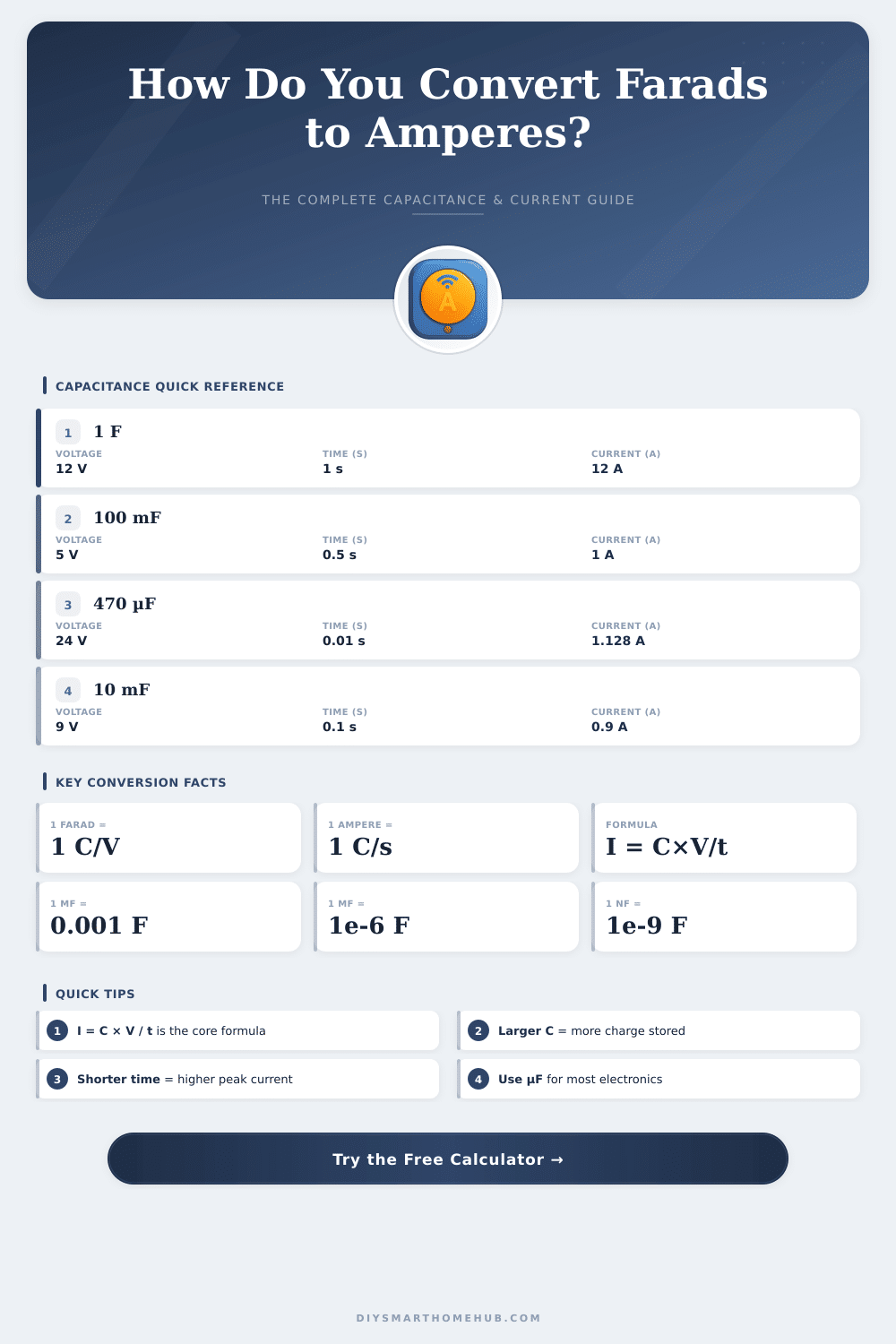
Here now the link between farads and amperes. One farad matches one ampere-second divided by one volt. So 1 F = 1 A·s/V.
One defines the farad using coulombs, and a coulomb is the amount of electric charge that one ampere moves during one second. So one coulomb matches one ampere multiplied by one second. And because one farad stores one coulomb at one volt, everything connects nicely.
A capacitor of one farad, when you charge it to one volt, stores one coulomb of charge. You can reach that by feeding in one ampere for one second. It really gets simple when you break it down lkie this.
In basic SI-units one farad matches one second squared divided by (ampere squared times mass unit times length unit squared). It seems hard, but it only shows how farads relate to seconds, amperes, kilos and metres. Among other units relevant is the volt, watt, joule, newton, ohm, hertz, siemens and henry.
There is a formula four counting current flow from capacitance. It is I = C × dV/dt, but simplified I = C · V / t. Here C shows capacitance in farads, V the voltage in volts, t the time in seconds, and I the current in amperes. The charge on a capacitor is found by Q = C × V, where Q is in coulombs.
People commonly mix up the difference between farads and ampere-hours. Farads measure capacitance, while ampere-hours measure charge. One ampere-hour matches 3600 coulombs, so 3600 ampere-seconds.
When you divide 3600 ampere-seconds by 12 volts, you get 300 farads. Even so more capacitance is needed, because the voltage drops while the capacitor releases.
There is no direct conversion between farads and ampere-hours, because they measure different things. The energy in a capacitor is calculated as half of C times V squared, and the result is in joules. On the other hand ampere-hours show how many amperes during one hour a battery delivers in steady electricity.
The ohm measures resistance, while the farad measures capacitance. They relate, but are notthe same.
One ampere-second per volt matches almost exactly to one farad, namely 1.0005. Because of rounding, mistakes can happen, so always check the results.