💡 Lighting Power Density Calculator
Calculate LPD (W/ft² or W/m²) and compare against ASHRAE 90.1 code limits
| Fixture / Lamp Type | Typical LPD (W/ft²) | Typical LPD (W/m²) | Efficacy (lm/W) | Notes |
|---|---|---|---|---|
| LED Panel / Troffer | 0.5 – 0.85 | 5.4 – 9.1 | 100 – 150 | Best efficiency |
| LED Troffer (2x4) | 0.6 – 0.90 | 6.5 – 9.7 | 90 – 140 | Office standard |
| LED Downlight / Can | 0.6 – 1.0 | 6.5 – 10.8 | 80 – 120 | Residential/retail |
| LED Track Lighting | 0.9 – 1.5 | 9.7 – 16.1 | 80 – 110 | Accent/retail |
| LED High Bay | 0.5 – 0.80 | 5.4 – 8.6 | 120 – 160 | Industrial |
| Fluorescent T8 | 1.0 – 1.4 | 10.8 – 15.1 | 80 – 100 | Older office standard |
| Fluorescent T5 | 0.8 – 1.2 | 8.6 – 12.9 | 90 – 105 | High output variant |
| Metal Halide (HID) | 1.2 – 2.0 | 12.9 – 21.5 | 60 – 100 | Warehouse/sports |
| Incandescent / Halogen | 2.0 – 4.0 | 21.5 – 43.1 | 10 – 25 | Very inefficient |
| Space Type | LPD Limit (W/ft²) | LPD Limit (W/m²) | ASHRAE Version | Compliance Notes |
|---|---|---|---|---|
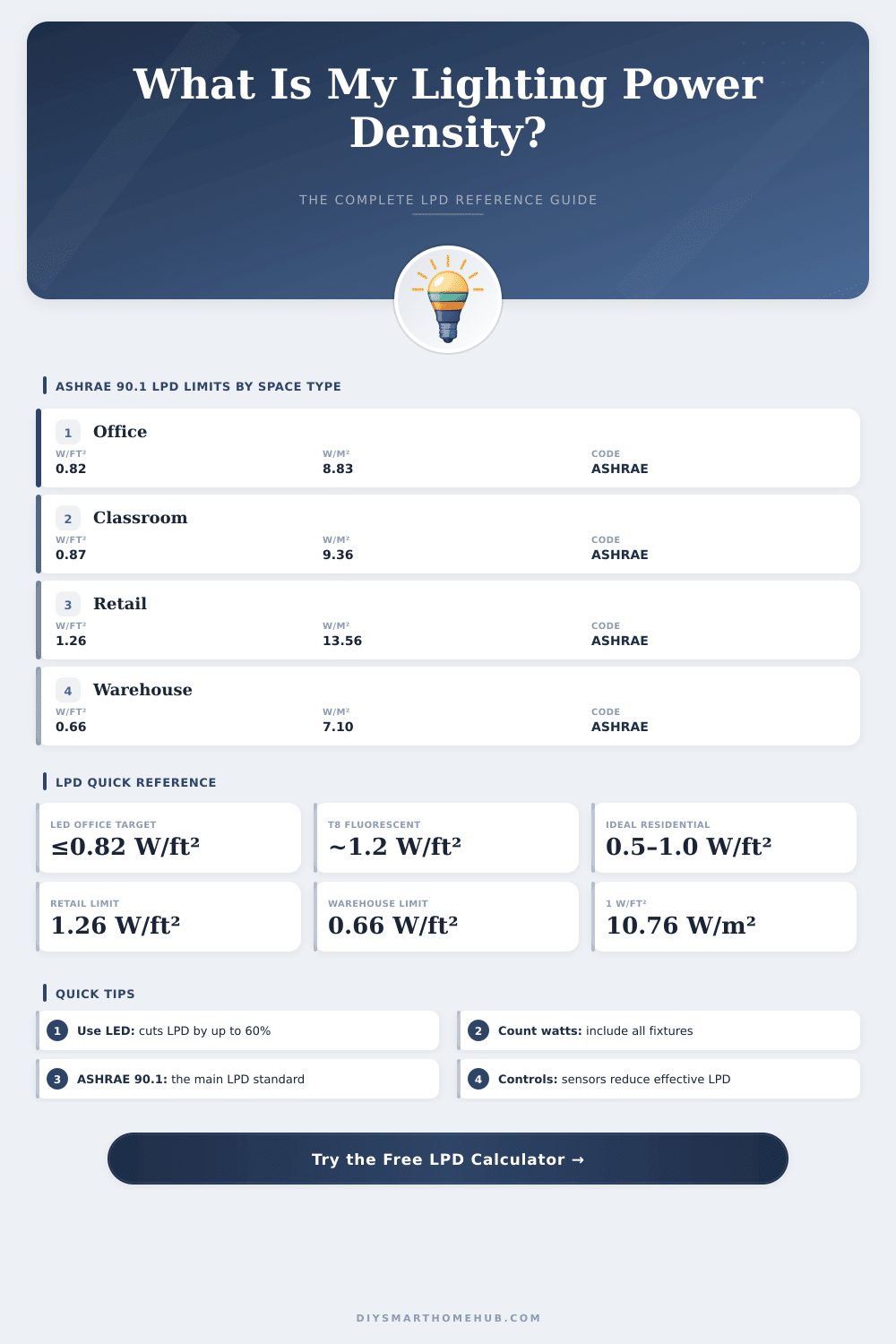
| Office – Open Plan | 0.82 | 8.83 | 90.1-2019 | Space-by-space method |
| Office – Enclosed | 0.74 | 7.97 | 90.1-2019 | Space-by-space method |
| Conference Room | 0.97 | 10.44 | 90.1-2019 | Includes AV lighting |
| Classroom / Lecture | 0.87 | 9.36 | 90.1-2019 | Includes board lighting |
| Retail – Sales Area | 1.26 | 13.56 | 90.1-2019 | Accent lighting included |
| Warehouse – Bulk | 0.66 | 7.10 | 90.1-2019 | High bay zone |
| Corridor / Transition | 0.71 | 7.64 | 90.1-2019 | Active zones only |
| Lobby / Atrium | 0.90 | 9.69 | 90.1-2019 | Ground floor lobby |
| Gymnasium / Sports | 1.20 | 12.92 | 90.1-2019 | Multipurpose use |
| Restroom / Locker | 0.98 | 10.55 | 90.1-2019 | Includes vanity lighting |
| Dining / Restaurant | 0.97 | 10.44 | 90.1-2019 | Ambient + accent |
| Residential – Living | 0.60 | 6.46 | IECC 2021 | Per IECC residential |
| Room Area (ft²) | Room Area (m²) | @ 0.82 W/ft² (W) | @ 1.0 W/ft² (W) | @ 1.26 W/ft² (W) | Max Fixtures (40W LED) |
|---|---|---|---|---|---|
| 100 | 9.3 | 82 | 100 | 126 | 2 |
| 200 | 18.6 | 164 | 200 | 252 | 4 |
| 400 | 37.2 | 328 | 400 | 504 | 8 |
| 600 | 55.7 | 492 | 600 | 756 | 12 |
| 1000 | 92.9 | 820 | 1,000 | 1,260 | 20 |
| 2000 | 185.8 | 1,640 | 2,000 | 2,520 | 41 |
| 5000 | 464.5 | 4,100 | 5,000 | 6,300 | 102 |
| 10000 | 929.0 | 8,200 | 10,000 | 12,600 | 205 |
Lighting Power Density, or LPD, helps to estimate how many electricity uses the lighting in a building. It points the used energy regarding the spatial size. In short, it includes everything that consumes the lights, ballasts, controls, converters and all other parts tied to the lighting.
Usually one states it by means of watts per square foot or per square metre.
What is Lighting Power Density?
To estimate the LPD, one shares the whole lighting energy use in watts by the whole net floor surface of the space. Like this one receives a value that shows the energy efficiency of the lighting here. Really simple math.
Planning a fresh building or doing a big renewal, the lighting setups must follow the local or state energy codes. Most commonly that wants to say, that a set amount of LPD is allowed. Owners of buildings usually focus only on meeting those coded rules, when they first hear about design of lighting.
Even so reaching only the minimum is basically saying, that you drive well only because you do not pass the speed limit. Good ligthing means much more than that.
Various kinds of buildings have different limits for LPD. For instance according to the method of building area, an office can have up to 0,82 watts per square foot. A store receives a lower cap at 0,60 watts per square foot.
About hotels the standard of ASHRAE suggests around 5,4 watts per square metre. Sports halls have there own rules, that need LPD under 0,73 watts per square foot according to ASHRAE 90.1-2019.
To finish the math, one finds the whole allowed energy by multiplying the whole surface of the building by the highest allowed density. Later one adds the lighting energy of all installed devices. The total lighting energy use for a building is made up of the sum of the lighting densities for every kind of area, multiplied by the net lit floor surfaces.
Roads also have separate standards for LPD. Every kind of road needs differently, what changes the math. That forms a balance between energy saving and actual needs of lighting.
Also the distance between poles and the height of fixtures plays a role. A bigger gap between poles needs more rugged devices to keep the light level, what can raise theenergy density.
One hard spot with LPD is, that it looks only at the watts of the tubes. It does not care about factors like lumens per watt or color rendering. So 64 watts of fluorescent light, installed at ten feet high, deliver totally different light on the floor than 60 watts of basic bulbs.
The main needs for lighting power density come from standards like ASHRAE 90.1-2016. Lamps use electricity and at the same time work as a heat source in the room.