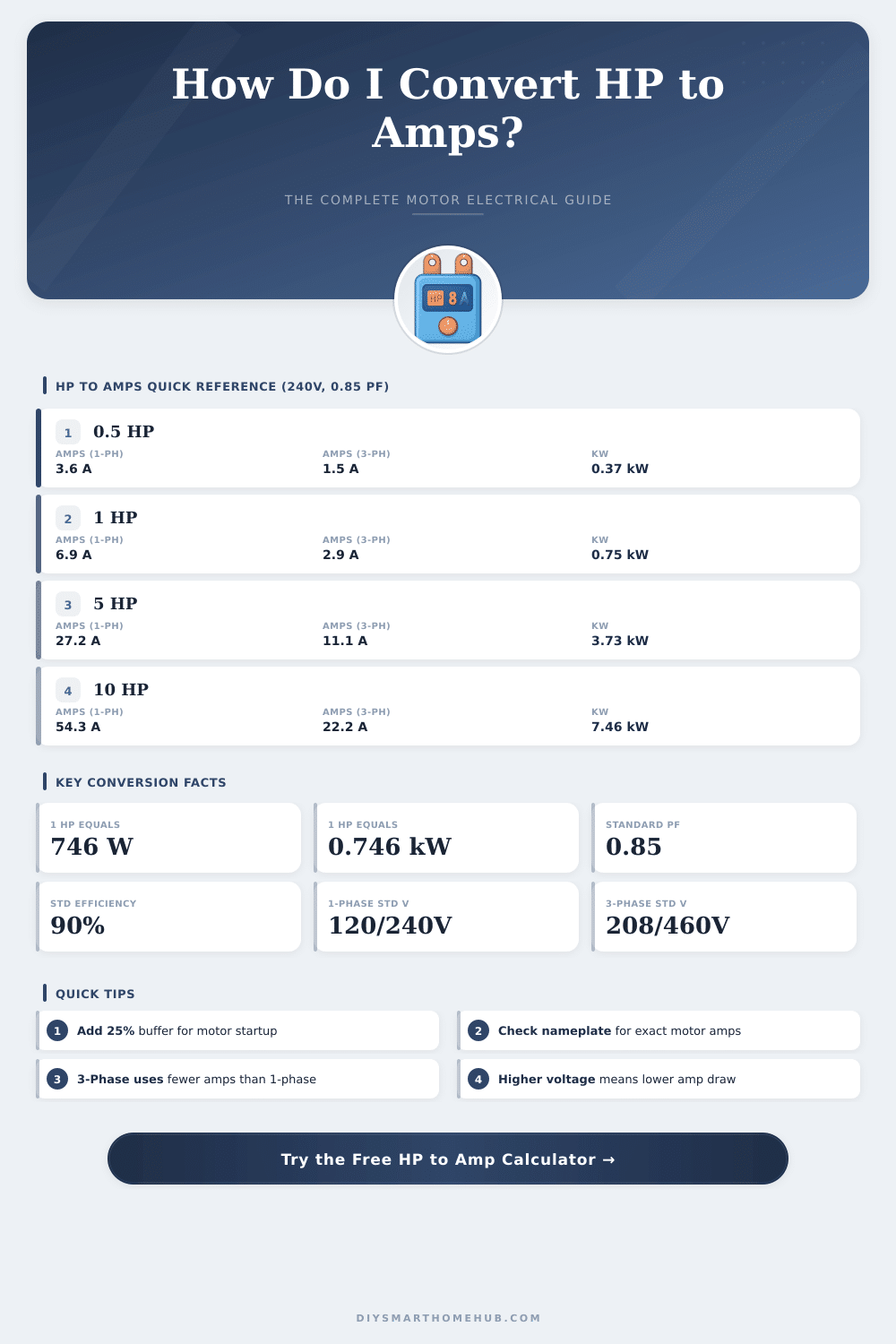
⚡ HP to Ampere Converter
Convert horsepower to amps for single-phase and three-phase motors with efficiency and power factor
| Horsepower | Watts (kW) | Amps @ 120V | Amps @ 240V | Amps @ 230V (EU) |
|---|---|---|---|---|
| 0.25 HP | 186.5 W (0.19 kW) | 1.81 A | 0.91 A | 0.94 A |
| 0.5 HP | 373 W (0.37 kW) | 3.62 A | 1.81 A | 1.89 A |
| 0.75 HP | 559.5 W (0.56 kW) | 5.43 A | 2.72 A | 2.83 A |
| 1 HP | 746 W (0.75 kW) | 7.25 A | 3.62 A | 3.77 A |
| 1.5 HP | 1,119 W (1.12 kW) | 10.87 A | 5.43 A | 5.66 A |
| 2 HP | 1,492 W (1.49 kW) | 14.49 A | 7.25 A | 7.54 A |
| 3 HP | 2,238 W (2.24 kW) | 21.74 A | 10.87 A | 11.31 A |
| 5 HP | 3,730 W (3.73 kW) | 36.23 A | 18.12 A | 18.86 A |
| 10 HP | 7,460 W (7.46 kW) | 72.46 A | 36.23 A | 37.72 A |
| Horsepower | Watts (kW) | Amps @ 208V | Amps @ 460V | Amps @ 400V (EU) |
|---|---|---|---|---|
| 1 HP | 746 W (0.75 kW) | 2.71 A | 1.23 A | 1.41 A |
| 2 HP | 1,492 W (1.49 kW) | 5.42 A | 2.45 A | 2.82 A |
| 3 HP | 2,238 W (2.24 kW) | 8.13 A | 3.68 A | 4.23 A |
| 5 HP | 3,730 W (3.73 kW) | 13.55 A | 6.13 A | 7.05 A |
| 7.5 HP | 5,595 W (5.6 kW) | 20.33 A | 9.19 A | 10.57 A |
| 10 HP | 7,460 W (7.46 kW) | 27.10 A | 12.26 A | 14.10 A |
| 15 HP | 11,190 W (11.2 kW) | 40.65 A | 18.39 A | 21.14 A |
| 20 HP | 14,920 W (14.9 kW) | 54.20 A | 24.52 A | 28.19 A |
| 25 HP | 18,650 W (18.7 kW) | 67.75 A | 30.65 A | 35.24 A |
| 50 HP | 37,300 W (37.3 kW) | 135.5 A | 61.3 A | 70.5 A |
| Motor HP | Full Load Amps (240V 1-Ph) | NEC Breaker Size (125%) | Min Wire Gauge (AWG) |
|---|---|---|---|
| 0.5 HP | ~4.9 A | 15 A | 14 AWG |
| 1 HP | ~9.8 A | 15 A | 14 AWG |
| 2 HP | ~13.8 A | 20 A | 12 AWG |
| 3 HP | ~17.0 A | 25 A | 10 AWG |
| 5 HP | ~28.0 A | 40 A | 10 AWG |
| 7.5 HP | ~40.0 A | 60 A | 8 AWG |
| 10 HP | ~50.0 A | 70 A | 6 AWG |
| Motor / Load Type | Typical PF | Typical Efficiency | Notes |
|---|---|---|---|
| Induction Motor (full load) | 0.85–0.90 | 87–95% | Most common type |
| Induction Motor (partial load) | 0.70–0.80 | 80–87% | PF drops at low load |
| Synchronous Motor | 0.90–1.00 | 90–96% | Can correct PF |
| DC Motor | 0.95–1.00 | 85–95% | PF near unity (DC) |
| Pool / Pump Motor | 0.82–0.88 | 82–90% | Single phase common |
| Air Compressor Motor | 0.85–0.90 | 85–92% | High starting current |
| Fan / Blower Motor | 0.80–0.88 | 80–90% | Variable load |
| Conveyor Motor | 0.85–0.92 | 88–94% | Fairly constant load |
Converter for horsepowers proves to be a handy help for changing horsepower to any other units of power that you need. When you know the force, the distance and the time that it involved free online calculators can estimate the horsepower for you quite fast. The charm of those tools is that one can easily switch between different units of power without needing to spend big effort on your part.
Conversion of horsepowers to watts probably is the most commonly used. Around 745.7 watts sit in one horsepower. Hence reverse that, go from watts to horsepowers, results in something simple.
How to Convert Horsepower to Other Units
Just take your watts and multiply by 1.34102. Assume that you have an engine that pumps 50 kW, that mathces to around 67 horsepowers. Or take 463.5 kW, multiply it by 1.34 and you will end at roughly 621 horsepowers.
Metric horsepower holds a bit different value in the math. To convert 15 metric horsepower, multiply by 0.73549875, which gives around 11 kW. Those converters do not limit only to the game with watts.
They well handle tons, BTU each hour, pound-feet each hour, MBH and pound-feet of force each our, without any problem. Switching between kW and horsepowers becomes easy when you find the right tool.
Old horsepower, written as hp(S), forms its own case entirely. To change it to other units of power, simply multiply by the right conversion factor. Here is a value to recall: 746 watts match to one horsepower.
Even so, one VA does not match to one watt, unless the circuit has a power factor of one.
Here is where things start to confuse for many folks. You cannot directly convert CC to horsepowers. The problem is that cubic centimetres measure volume, while horsepowers measure power, that is apples against oranges.
An engine of 100 cc for a lawn mower can only produce 2.5 horsepowers, but an engine of 100 cc for racing in go-karts can reach more than 25 horsepowers. Two-stroke engines usually give more horsepowers per cc than four-stroke engines. An engine of 725 cc could have from 20 horsepowers to 28, depending on how it is made.
To estimate horsepowers of an engine, you need to know the RPM when it reaches maximum power. With non-metric units, the formula is: horsepowers match to RPM multiplied by torque, then divided by 5250. Tests on engine dynamometers usually show the power as it changes through different RPM and torque loads.
Converting wheel horsepower to crank horsepower comes up quite commonly. One way is to divide wheel horsepower by 0.85 to get crank horsepower. The trouble?
Loss in the drivetrain is not truly a fixed percentage, although many folks treat it like this. BHP and horsepowers arebasically the same, which helps when one compares values from various sources.