⚡ Electric Generator Wattage Calculator
Select your appliances, enter quantities, and instantly find the right generator size for your needs.
Check the appliances you want to run simultaneously. Adjust quantities and running watts as needed. Starting watts are pre-filled with typical surge values.
| On | Appliance | Qty | Running W | Starting W | Total Run W |
|---|
| Appliance | Category | Running Watts | Starting Watts | Notes |
|---|---|---|---|---|
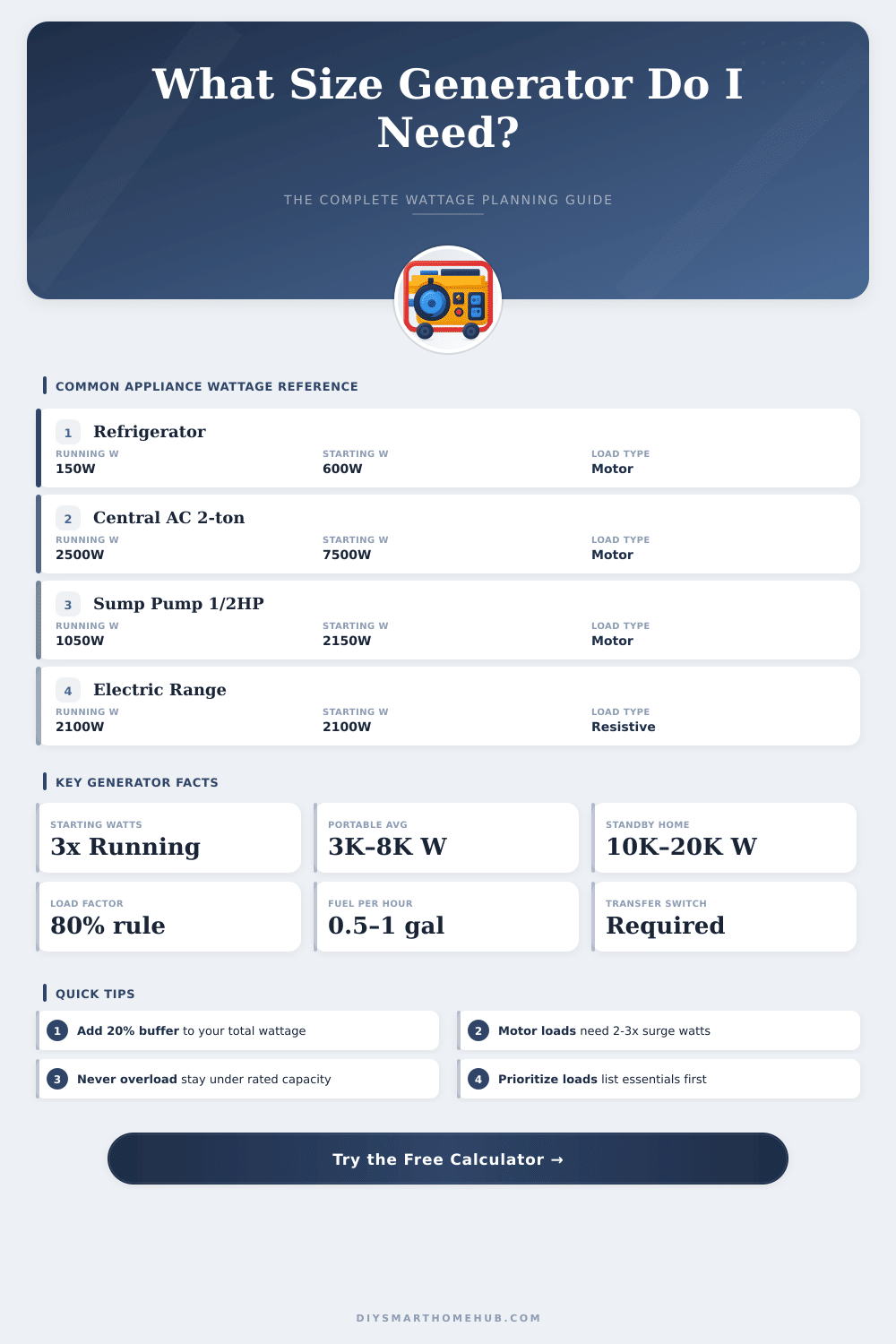
| Refrigerator | Kitchen | 150–400W | 600–1200W | Motor load, cycles on/off |
| Chest Freezer | Kitchen | 100–200W | 400–600W | Motor load |
| Microwave (1000W) | Kitchen | 1000–1500W | 1000–1500W | Resistive load |
| Electric Range (1 burner) | Kitchen | 1500–2500W | 1500–2500W | Resistive, high draw |
| Coffee Maker | Kitchen | 600–1200W | 600–1200W | Resistive load |
| Central AC 2-ton | Cooling | 2500–3500W | 7500–9800W | High surge motor |
| Window AC 10,000 BTU | Cooling | 900–1440W | 2700–4320W | Motor load |
| Portable AC | Cooling | 900–1400W | 1800–2800W | Motor load |
| Electric Furnace Fan | Heating | 800–1200W | 2400–3600W | Blower motor |
| Space Heater | Heating | 750–1500W | 750–1500W | Resistive, no surge |
| Sump Pump 1/2 HP | Plumbing | 1050W | 2150W | Motor, important emergency |
| Well Pump 1/2 HP | Plumbing | 1000W | 2100W | Motor load |
| Washing Machine | Laundry | 500–1000W | 1800–2300W | Motor + heating |
| Electric Dryer | Laundry | 5000–6000W | 5000–6000W | 240V resistive |
| LED Lights (10 bulbs) | Lighting | 60–100W | 60–100W | Resistive, very low |
| Incandescent (10 bulbs) | Lighting | 600–1000W | 600–1000W | Resistive load |
| TV (55" LED) | Electronics | 60–150W | 60–150W | Very low draw |
| Desktop Computer | Electronics | 200–400W | 200–400W | No surge |
| Laptop | Electronics | 45–90W | 45–90W | Very low |
| Internet Router | Electronics | 10–20W | 10–20W | Minimal load |
| CPAP Machine | Medical | 30–60W | 30–60W | With humidifier: +60W |
| Home Oxygen Concentrator | Medical | 150–350W | 150–350W | Critical load |
| Circular Saw 7-1/4" | Power Tools | 1400–1800W | 4200–5400W | High surge motor |
| Table Saw 10" | Power Tools | 1800–2200W | 4500–6600W | High surge |
| Air Compressor 1 HP | Power Tools | 1500W | 4500W | 3x surge typical |
| Electric Welder (140A) | Power Tools | 3500–5500W | 3500–5500W | 240V, resistive arc |
| Water Heater (electric) | Household | 4000–5500W | 4000–5500W | 240V resistive |
| Garage Door Opener | Household | 350–550W | 700–1100W | Brief surge |
| Load Type | Starting Surge | Examples | Generator Impact |
|---|---|---|---|
| Resistive | None (1x) | Heaters, lights, toasters | Low — easy to power |
| Inductive (small motor) | 2–3x running | Fans, small pumps | Moderate surge demand |
| Inductive (large motor) | 3–7x running | AC, well pump, compressor | High surge — size for start |
| Electronic / Inverter | 1.2–1.5x | Variable speed motors, EVSEs | Low surge, smooth start |
| Arc / Welding | 1x (no surge) | Welders, heating elements | Steady high draw |
| Scenario | Typical Load | Recommended Size | Generator Type |
|---|---|---|---|
| Camping / RV essentials | 500–1,500W | 2,000W | Inverter |
| Apartment emergency backup | 1,500–2,500W | 3,000W | Inverter / Portable |
| Basic home backup (no AC) | 3,000–5,000W | 5,500W | Portable |
| Home backup with window AC | 5,000–7,500W | 8,000W | Portable |
| Home backup with central AC | 8,000–12,000W | 14,000W | Portable / Standby |
| Whole home automatic standby | 10,000–16,000W | 20,000W | Standby |
| Large home / luxury standby | 16,000–25,000W | 30,000W | Standby |
| Small job site | 4,000–8,000W | 10,000W | Portable / Towable |
| Large construction site | 15,000–30,000W | 35,000W+ | Towable / Industrial |
| Outdoor event / stage | 10,000–25,000W | 30,000W | Towable |
| Generator Size | 50% Load (gal/hr) | 75% Load (gal/hr) | 100% Load (gal/hr) | 8-hr Runtime (75% load) |
|---|---|---|---|---|
| 2,000W Portable | 0.10 | 0.14 | 0.18 | 1.1 gal |
| 3,500W Portable | 0.20 | 0.28 | 0.35 | 2.2 gal |
| 5,500W Portable | 0.30 | 0.43 | 0.55 | 3.4 gal |
| 8,000W Portable | 0.45 | 0.63 | 0.80 | 5.0 gal |
| 12,000W Portable | 0.65 | 0.90 | 1.15 | 7.2 gal |
| 20,000W Standby | 1.20 | 1.65 | 2.10 | 13.2 gal |
Count the right power for a generator can seem hard, but really it comes down to simple math. One gets the watts by multiplying the voltage by the amps. Like this if a device uses 2 amps at 5 volts, that makes 10 watts.
The size of a generator measures equally, in watts, and it shows how much electricity it can generate.
How to Choose the Right Generator Size
Two kinds of watts you must consider. The starting watts one needs to begin a tool. The running watts use to keep the function of devices after they already started.
Devices with engines commonly need more power to start than to maintain the work. For instance, an air conditioner of 15,000 BTU for RV needs around 3,500 watts to start, but only 1,500 watts while it runs. A smaller model of 7,000 BTU needs 1,700 watts to start and then drops to 600 watts in use.
RV with 30-ampere system at 120 volts can handle up to around 3,600 watts. Like this, a generator of 3,600 watts would give just as much energy as a link to shore power. A quieter electric generator of 3,200 watts works well to run the air conditioner in a 30-ampere setup, staying quite silent for campgrounds.
When the amount reaches 4,000 running watts plus 2,000 starting, a generator of 6,000 watts would work best. Too big a model wastes fuel, while too small risks damaging tools. It is wise too buy one with enough capacity for everything at 50 percent of its maximum.
To get precise numbers, check the label under the devices or use a watt meter. Websites with watt calculators also help. Just answer some questions about the tools you use, and they automatically add the whole power that is needed, including running and starting watts.
A fridge could use only 130 watts in use and 400 to start. A generator of 1,600 to 1,800 running watts works well for many everyday needs, if one does not plan to use central air. A tiny quiet electric generator of 1,000 watts can power most devices at a campsite, except a microwave and air conditioner.
For a double air conditioner, one needs at least 3,500 watts.
Choosing a generator, make sure that it matches the wiring; whether 30-ampere or 50-ampere. A generator with less power can create crashes in the system. The best way to escape problems is to add the starting watts of everything and find a model that covers that whole amount.
Hiring a certified electricianto do the math is also a smart step.