🔋 Ampere Hours (Ah) Calculator
Calculate exact battery capacity needed for any system — solar, RV, marine, off-grid & more
| Appliance | Typical Watts | Ah/hr at 12V | Ah/hr at 24V |
|---|---|---|---|
| LED Light Bulb | 10 W | 0.83 Ah | 0.42 Ah |
| Phone Charger | 18 W | 1.5 Ah | 0.75 Ah |
| Laptop | 65 W | 5.4 Ah | 2.7 Ah |
| 12V Fan | 20 W | 1.67 Ah | 0.83 Ah |
| TV (32") | 55 W | 4.6 Ah | 2.3 Ah |
| Mini Fridge | 80 W | 6.7 Ah | 3.3 Ah |
| Full Refrigerator | 150 W | 12.5 Ah | 6.25 Ah |
| Air Conditioner (5k BTU) | 550 W | 45.8 Ah | 22.9 Ah |
| Coffee Maker | 900 W | 75 Ah | 37.5 Ah |
| Microwave | 1000 W | 83.3 Ah | 41.7 Ah |
| Watt-Hours (Wh) | Ah at 6V | Ah at 12V | Ah at 24V |
|---|---|---|---|
| 50 Wh | 8.3 Ah | 4.2 Ah | 2.1 Ah |
| 100 Wh | 16.7 Ah | 8.3 Ah | 4.2 Ah |
| 200 Wh | 33.3 Ah | 16.7 Ah | 8.3 Ah |
| 500 Wh | 83.3 Ah | 41.7 Ah | 20.8 Ah |
| 1000 Wh (1 kWh) | 166.7 Ah | 83.3 Ah | 41.7 Ah |
| 2000 Wh (2 kWh) | 333.3 Ah | 166.7 Ah | 83.3 Ah |
| 5000 Wh (5 kWh) | 833.3 Ah | 416.7 Ah | 208.3 Ah |
| 10000 Wh (10 kWh) | 1666.7 Ah | 833.3 Ah | 416.7 Ah |
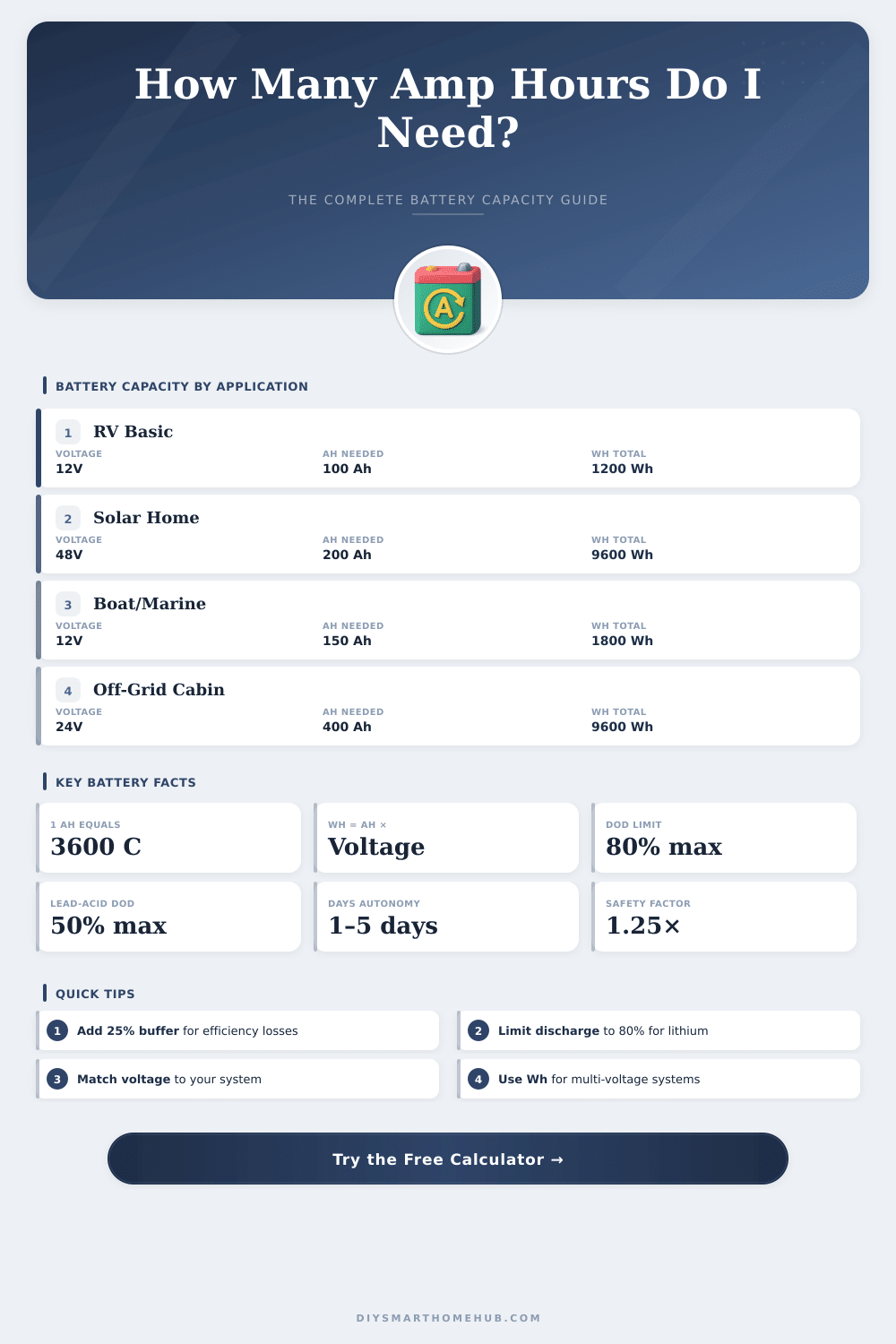
| Application | System Voltage | Typical Ah | Typical Wh |
|---|---|---|---|
| Camping / Portable | 12V | 50–100 Ah | 600–1200 Wh |
| RV / Motorhome | 12V | 100–300 Ah | 1.2–3.6 kWh |
| Boat / Marine | 12V | 100–200 Ah | 1.2–2.4 kWh |
| Off-Grid Cabin | 24V / 48V | 200–600 Ah | 5–30 kWh |
| Solar Home Backup | 48V | 100–400 Ah | 5–20 kWh |
| Electric Bike | 36V / 48V | 10–20 Ah | 360–960 Wh |
| Golf Cart | 36V / 48V | 100–200 Ah | 3.6–9.6 kWh |
| Telecom / Remote | 12V / 48V | 100–500 Ah | 1.2–24 kWh |
Amp-hours, usually written as Ah form the unit for electrical charge. The idea itself is very basic. One amp-hour matches to one amp of constant flow during one whole hour.
That results in 3600 coulombs of charge. It helps to estimate how much charge passes through a circuit over time.
What Amp-Hours Mean for Batteries
The formula for that is easy. One multiplies the amount in amps by the time in hours. For instance, if a battery delivers 2 amps for 10 hours, that makes 20 amp-hours.
Here the amps and hours balance one to the other. If one doubles the flow, the tiem halves.
For tiny batteries, like those in phones or AA-size cells, the rating commonly comes in milliamp-hours, or mAh. Big batteries, for instance in cars or recreational vehicles, use amp-hours instead. A standard deep-cycle battery for a recreational vehicle could have around 80 amp-hours, which means that it could give one amp four 80 hours.
Here comes the trouble. Not always is it possible to simply share the amp-hours equally. It depends on the chemistry of the battery and its internal resistance.
A tiny AA-battery with 2500 mAh, designed for 50 mA flow, could last around 50 hours at that rate. But if one pushes it to 200 mA, it only lasts 10 hours instead of the expected 12.5. Stronger flows make the voltage drop more quickly.
The rating of amp-hours decides directly how long a battery can feed a device. A battery of 12 volts with 20 amp-hours would deliver 1 amp for 20 hours or 2 amps for 10 hours. The standard in industry for rating batteries is based on a 20-hour discharge period.
Amp-hours and watt-hours are not the same. Amp-hours show how much charge the battery holds. Watt-hours show the energy content.
To get watt-hours, one multiplies amp-hours by the voltage. A battery with 210 amp-hours at 12 volts gives 2520 watt-hours. Charge itself is not energy.
Energy in joules comes from the product of charge and voltage.
A deep-cycle lead-acid battery should not discharge under 50 percent. So a 200 amp-hour battery only delivers around 100 usable amp-hours. Batteries also lose capacity over time, so it will fall to about 80 amp-hours.
When batteries connect in series, the amp-hours stay the same, but the voltages add up. Two 6-volt batteries with 232 amp-hours in series result in 12 volts and 232 amp-hours. In parallel the voltage stays the same, but amp-hours add up.
Two 12-volt batteries with 150 amp-hours in parallel give 12 volts and 300 amp-hours. Knowing those rules is useful for building a batterybank, for instance for a recreational vehicle or solar system.