⚡ Coulomb to Ampere Converter
Convert electric charge (coulombs) to current (amperes) using time. Instant results with metric & SI equivalents.
| Charge (C) | Time (s) | Current (A) | Current (mA) | Use Case |
|---|---|---|---|---|
| 0.001 C | 1 s | 0.001 A | 1 mA | Microcontroller pin |
| 0.1 C | 1 s | 0.1 A | 100 mA | USB 1.0 device |
| 1 C | 1 s | 1 A | 1000 mA | USB fast charge |
| 5 C | 1 s | 5 A | 5000 mA | USB-C PD port |
| 10 C | 2 s | 5 A | 5000 mA | Power bank output |
| 100 C | 20 s | 5 A | 5000 mA | Motor start surge |
| 3600 C | 3600 s | 1 A | 1000 mA | 1 Ah battery discharge |
| 7200 C | 3600 s | 2 A | 2000 mA | 2 Ah Li-Ion cell |
| 18000 C | 3600 s | 5 A | 5000 mA | 5 Ah power tool |
| 96485 C | 96485 s | 1 A | 1000 mA | 1 Faraday electrolysis |
| Capacity (mAh) | Capacity (Ah) | Charge (C) | At 1A Runtime | Typical Device |
|---|---|---|---|---|
| 500 mAh | 0.5 Ah | 1800 C | 0.5 hours | Smartwatch |
| 1000 mAh | 1.0 Ah | 3600 C | 1 hour | Earbuds case |
| 2000 mAh | 2.0 Ah | 7200 C | 2 hours | Budget phone |
| 3000 mAh | 3.0 Ah | 10800 C | 3 hours | Mid-range phone |
| 4500 mAh | 4.5 Ah | 16200 C | 4.5 hours | Flagship phone |
| 10000 mAh | 10 Ah | 36000 C | 10 hours | Power bank |
| 20000 mAh | 20 Ah | 72000 C | 20 hours | Laptop power bank |
| 100000 mAh | 100 Ah | 360000 C | 100 hours | Car battery (approx) |
| Unit | Symbol | In Coulombs | Common Use |
|---|---|---|---|
| Microcoulomb | μC | 0.000001 C | Capacitor discharge |
| Millicoulomb | mC | 0.001 C | Sensor signals |
| Coulomb | C | 1 C | Standard SI unit |
| Kilocoulomb | kC | 1000 C | Industrial processes |
| Milliampere-hour | mAh | 3.6 C | Battery capacity |
| Ampere-hour | Ah | 3600 C | Battery capacity |
| Faraday | F | 96485 C | Electrochemistry |
| Elementary charge | e | 1.602×10⁻¹⁹ C | Particle physics |
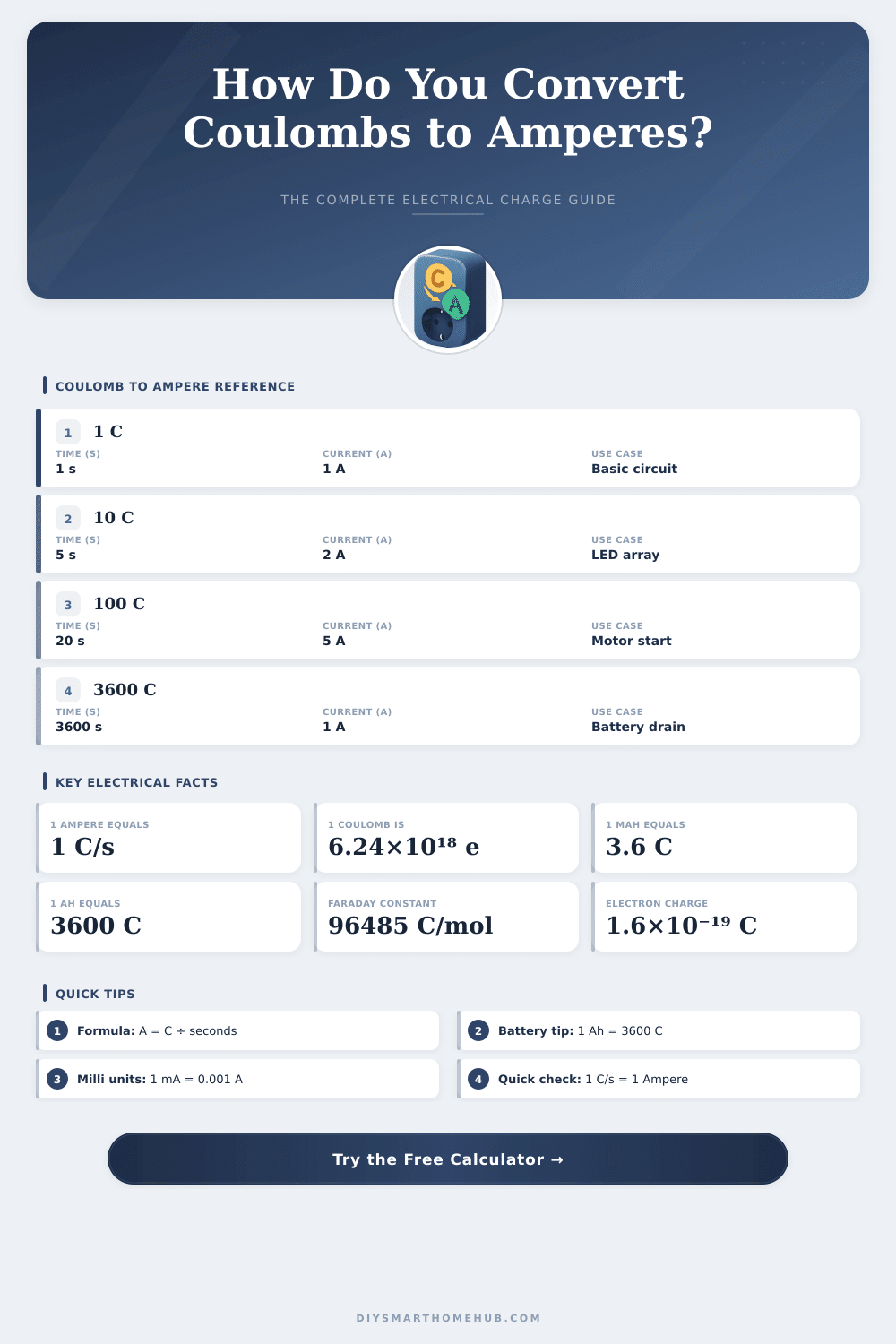
Current (A) = Charge (C) ÷ Time (s). This is the definition of the ampere in SI units. One ampere is exactly one coulomb of charge flowing past a point per second. For battery applications, remember that 1 mAh = 3.6 C and 1 Ah = 3600 C.
For small electronics, milliamperes (mA) are most practical. For industrial machinery or arc welding, kiloamperes (kA) may apply. Always match your charge and time units before dividing — mixing hours and seconds is the most common conversion error.
coulomb-ampere converters are simply online tools, that allow you to swap between units of electrical charge and electrical current. Those two are closely linked, but they measure two quite separate physical things. Well understand those differences before you try to convert anything.
In the SI system we use the coulomb to measure electrical charge. It is defined as the amount of charge that bears flow of one ampere for exactly one second. Because of that, one ampere for one second matches one coulomb, everything else builds on this rule.
How to Convert Between Coulombs and Amperes
Here is where it becomes a bit tricky; you can not directly convert coulomb to ampere. Because they are separate units for different physical things. The ampere describes the current, that one can think of as the speed by which the charge passes through a spot.
The coulomb simply shows the whole amount of charge itself. To bridge that difference, you must bring the time into the calculation. Sharing coulombs by seconds?
That gives amperes.
The easiest way to express ampere is one coulomb each second, or 1 A = 1 C/s. Like this, if 5 coulombs of charge pass through a spot each second, that gives 5 amperes of current. The opposite calculation works just as well.
You take the length of the current and multiply it by the strength, oh, yes, and you get the whole charge that flows through it.
Online converters handle that right away and for free. They do fast and precise conversions between coulombs and ampere-seconds, and they commonly include other units for charge. The most many have conversion tables rite beside the calculator.
So, about ampere-hours we must think. One ampere-hour matches 3600 coulombs, so converting means multiplying by that number. Milliampere-hour?
It is 3.6 coulombs. Ampere-minute comes to around 60 coulombs. All those follow the usual SI rules.
Current is now more easily measured exactly than the charge itself. Most folks first measure the current regularly, then convert that value to coulombs. Here also something funny, one ampere matches roughly 6.241 × 10^18 electrons, that pass through a spot.
One reason that confuses folks is the effort to convert volts to coulombs. It is not possible to do that. The volt measures energy per unit of charge, so joules shared by coulombs.
It is an entirely different thing than the coulomb, so there is no direct conversion between them.
Converting amperes to coulombs follows a basic rule: multiply the amperes by the time in seconds and you get coulombs. Theseutilities do all the math for you and give precise results right away.