⚡ Electrical Load Diversity Calculator
Calculate your panel’s true demand load, diversity factor, and recommended breaker size for any building type.
| Load / Appliance Name | Category | Power (W) | Qty | Usage Factor | Remove |
|---|
| Appliance / Load | Typical Watts | Category | Typical Usage Factor |
|---|---|---|---|
| Central Air Conditioner | 3,000 – 5,000 W | HVAC | 0.65 |
| Electric Furnace / Heater | 5,000 – 20,000 W | HVAC | 0.60 |
| Electric Water Heater | 3,500 – 5,500 W | Appliance | 0.30 |
| Electric Clothes Dryer | 4,000 – 6,000 W | Appliance | 0.25 |
| Electric Range / Oven | 6,000 – 12,000 W | Cooking | 0.40 |
| Dishwasher | 1,200 – 2,400 W | Appliance | 0.25 |
| Refrigerator / Freezer | 100 – 800 W | Appliance | 0.33 |
| EV Charger (Level 2) | 3,300 – 7,200 W | EV | 0.50 |
| Lighting (Residential) | 500 – 3,000 W | Lighting | 0.70 |
| General Receptacles | 180 W per circuit | Misc | 0.50 |
| Office Workstation | 200 – 600 W | Office | 0.75 |
| Server / Rack Unit | 500 – 2,000 W | IT | 0.90 |
| Panel Size | @ 120V Capacity (W) | @ 240V Capacity (W) | Typical Use Case |
|---|---|---|---|
| 60A Panel | 7,200 W | 14,400 W | Small older home |
| 100A Panel | 12,000 W | 24,000 W | Average home (no EV) |
| 150A Panel | 18,000 W | 36,000 W | Home + small additions |
| 200A Panel | 24,000 W | 48,000 W | Modern home / EV / solar |
| 320A Panel | 38,400 W | 76,800 W | Large home / small commercial |
| 400A Panel | 48,000 W | 96,000 W | Commercial / industrial |
| 600A Service | 72,000 W | 144,000 W | Medium commercial |
| 1,200A Service | 144,000 W | 288,000 W | Large industrial |
| Load Category | NEC Demand Factor | Usage Factor | Notes |
|---|---|---|---|
| First 3,000 W of lighting | 100% | 1.00 | NEC 220.42 |
| Next 117,000 W lighting | 35% | 0.35 | NEC 220.42 |
| First 10 kVA of appliances | 100% | 1.00 | NEC 220.53 |
| Remaining appliances | 50% | 0.50 | NEC 220.53 |
| Electric dryers (1–4 units) | 100% | 1.00 | NEC 220.54 |
| Electric dryers (5+ units) | 50% | 0.50 | NEC 220.54 |
| Fixed cooking equipment | 60–80% | 0.70 | NEC 220.55 |
| Motor loads (largest) | 125% | 1.25 | NEC 430 — upsized |
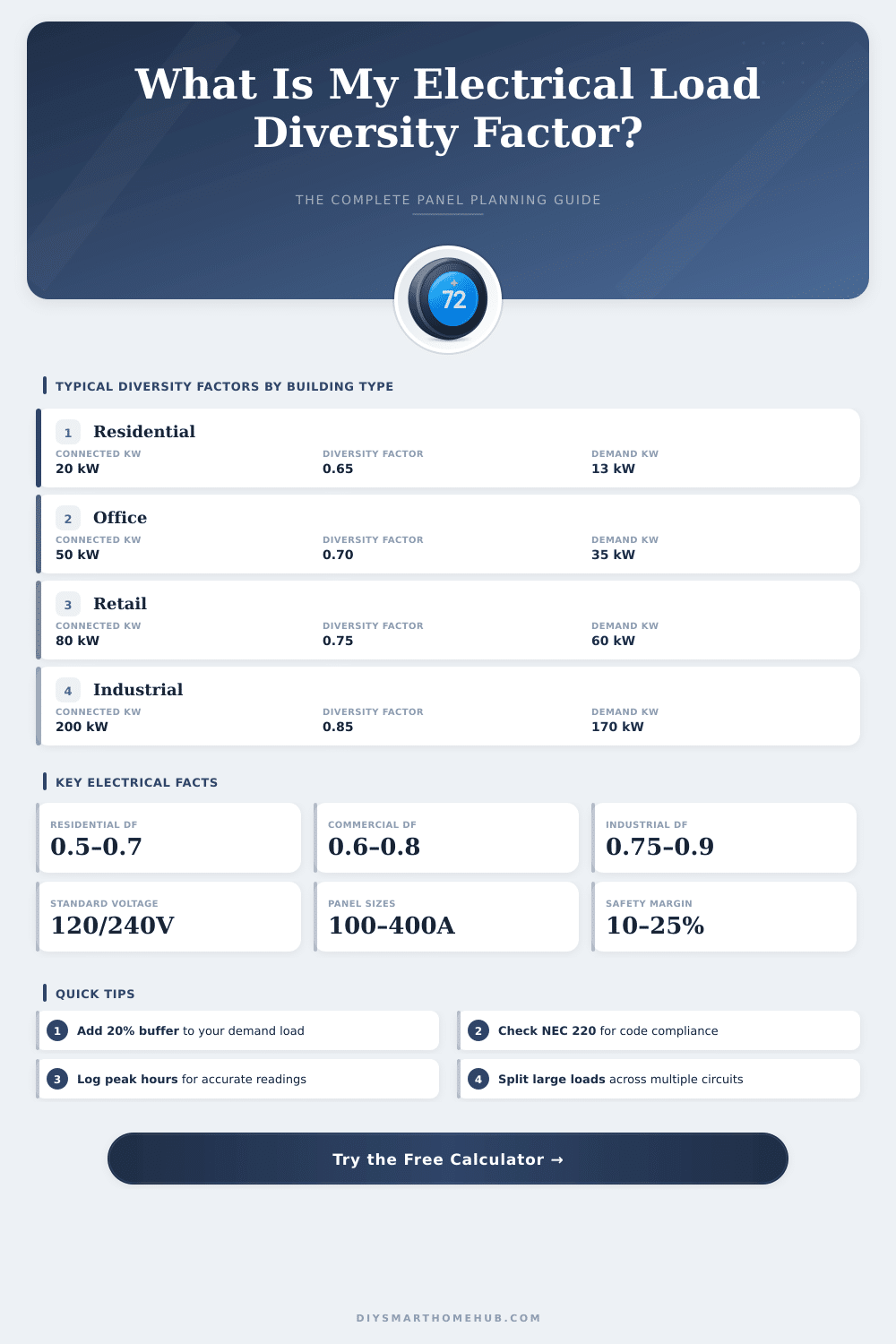
Diversity factor (DF) represents the ratio of the sum of individual maximum demands to the simultaneous maximum demand of the whole system. A DF of 0.65 means only 65% of all connected loads operate at peak simultaneously. Higher DF = less diversity = larger required panel.
Per NEC 210.20, breakers and conductors serving continuous loads (operating 3+ hours) must be sized at 125% of the load. Always add at least 20% safety margin to your demand load when sizing your service entrance, main panel, and sub-panels.
Electrical diversity of burdens matters a lot when one designs electrical installations. Here the main spot: no single device in the system uses its maximum power at the same time. Some machines operate early, others start later.
There are also devices that can not work together for instance heating and cooling, that never switch both in the same moment.
What Is Diversity Factor in Electrical Systems
The diversity factor itself simply is a ratio. One adds the maximum burdens of every element and compares that with the highest demand that the whole system truly reaches. If everything would operate at maximum at the same time, that ratio would be one.
But in the real world that almost never happens. Said, the total installed capacity commonly is four times more than what truly requires the system, so a diversity factor of four.
Imagine two buildings that have the same maximum use, but in entirely different hours. Now serve them both by means of one single line. The demand on that line drops below that, what one would get simply adding the two amounts.
Here is diversity in practice for electrical designs. The peak burden of a substation usually stays under the amount of all peak values tied to it.
Different kinds of buildings reach their peaks at various times. Offices most commonly peak around midday or at the beginning of afternoon. Housing?
Here the spikes happen between the main meal and early evening. Those differences in times matter, when one plans systems for mixed usages.
Using diversity one gets real profit. The peak demand drops, what saves money, because one does not build too much capacity for casual spikes. It also steadies the whole electrical net by means of lowering of those demand swings, what helps to escape overloads and failures.
The rules adjust, when one considers separate circuits. For lighting circuits one commonly applies diversity at around two thirds of the total flow. For other burdens?
Here is no diversity discount. Bathrooms, water heaters with thermostats and floor heaters all require full calculations of their burden. For power circuits one takes 100 percent for the first surrounding line, and later 40 percent for the rest.
After-diversity maximum demand, or ADMD, if one wants the abbreviation… Is that, what results from multiplying the connected burden by the diversity factor. That points the planned rael consumption after thought of various usages.
There are many modes that apply different factors according to type of burden and setup of circuits.
The designer of electrical installation must count the maximum demand. Before adding new devices to an already existing net, use records for control, what truly gets used. At campsites and RV-parkings the designer usually works with 65-percent diversity to estimate the total service needs.
For separate stalls however? Here commonly one does not apply diversity, because they are basic connection spots. Those homes on wheels have more circuits in their systems, although the whole consumption commonly stays steady, unlessthare are chargers for EV or warm bath in the causes.