🔋 Ring Alarm Battery Life Calculator
Estimate how long your Ring Alarm devices will run on battery power based on your setup and usage patterns
| Device Type | 5 Triggers/Day | 10 Triggers/Day | 20 Triggers/Day | 40 Triggers/Day | Battery Type |
|---|---|---|---|---|---|
| Contact Sensor Gen 2 | 4+ years | 3 years | 18 months | 9 months | CR123A |
| Motion Detector Gen 2 | 4+ years | 3 years | 18 months | 8 months | 2x AA |
| Tilt Sensor | 3+ years | 2.5 years | 14 months | 7 months | CR123A |
| Flood & Freeze Sensor | 3+ years | 3 years | 2 years | 18 months | CR123A |
| Panic Button | 3+ years | 3 years | 2 years | 18 months | CR2 |
| Smoke/CO Listener | 10 years | 10 years | 8 years | 6 years | AA x6 internal |
| Temperature Range (°F) | Temperature Range (°C) | Battery Impact | Life Multiplier | Notes |
|---|---|---|---|---|
| Below 32°F | Below 0°C | Very High Drain | 0.4x – 0.6x | Batteries fail faster; alkaline worst affected |
| 32°F – 50°F | 0°C – 10°C | High Drain | 0.65x – 0.8x | Significant reduction; lithium preferred |
| 50°F – 77°F | 10°C – 25°C | Optimal | 1.0x (baseline) | Ideal operating range for all battery types |
| 77°F – 95°F | 25°C – 35°C | Moderate Drain | 0.85x – 0.95x | Minor reduction; self-discharge increases |
| Above 95°F | Above 35°C | High Drain | 0.6x – 0.8x | Risk of battery damage; avoid direct sun exposure |
| Signal Level | RSSI Range | Impact on Battery | Life Multiplier | Recommendation |
|---|---|---|---|---|
| Excellent | > -50 dBm | Minimal | 1.05x – 1.1x | Ideal placement |
| Good / Strong | -50 to -60 dBm | Low | 1.0x (baseline) | Normal operation |
| Medium / Fair | -60 to -75 dBm | Moderate | 0.85x – 0.95x | Consider extender |
| Weak / Poor | -75 to -85 dBm | High | 0.65x – 0.8x | Add range extender |
| Very Weak | < -85 dBm | Very High | 0.4x – 0.65x | Relocate device or extender required |
| Battery Type | Capacity (mAh) | Cold Temp Performance | Shelf Life | Used In |
|---|---|---|---|---|
| CR123A Lithium | 1,500 mAh | Excellent (lithium) | 10 years | Contact sensor, tilt, flood |
| AA Alkaline | 2,700 mAh | Poor below 32°F | 5–7 years | Motion detector (Gen 1) |
| AA Lithium | 3,000 mAh | Excellent | 20 years | Motion detector (recommended upgrade) |
| CR2 Lithium | 800 mAh | Good | 10 years | Panic button |
| Internal Rechargeable | ~1,800 mAh | Moderate | N/A (rechargeable) | Keypad, range extender |
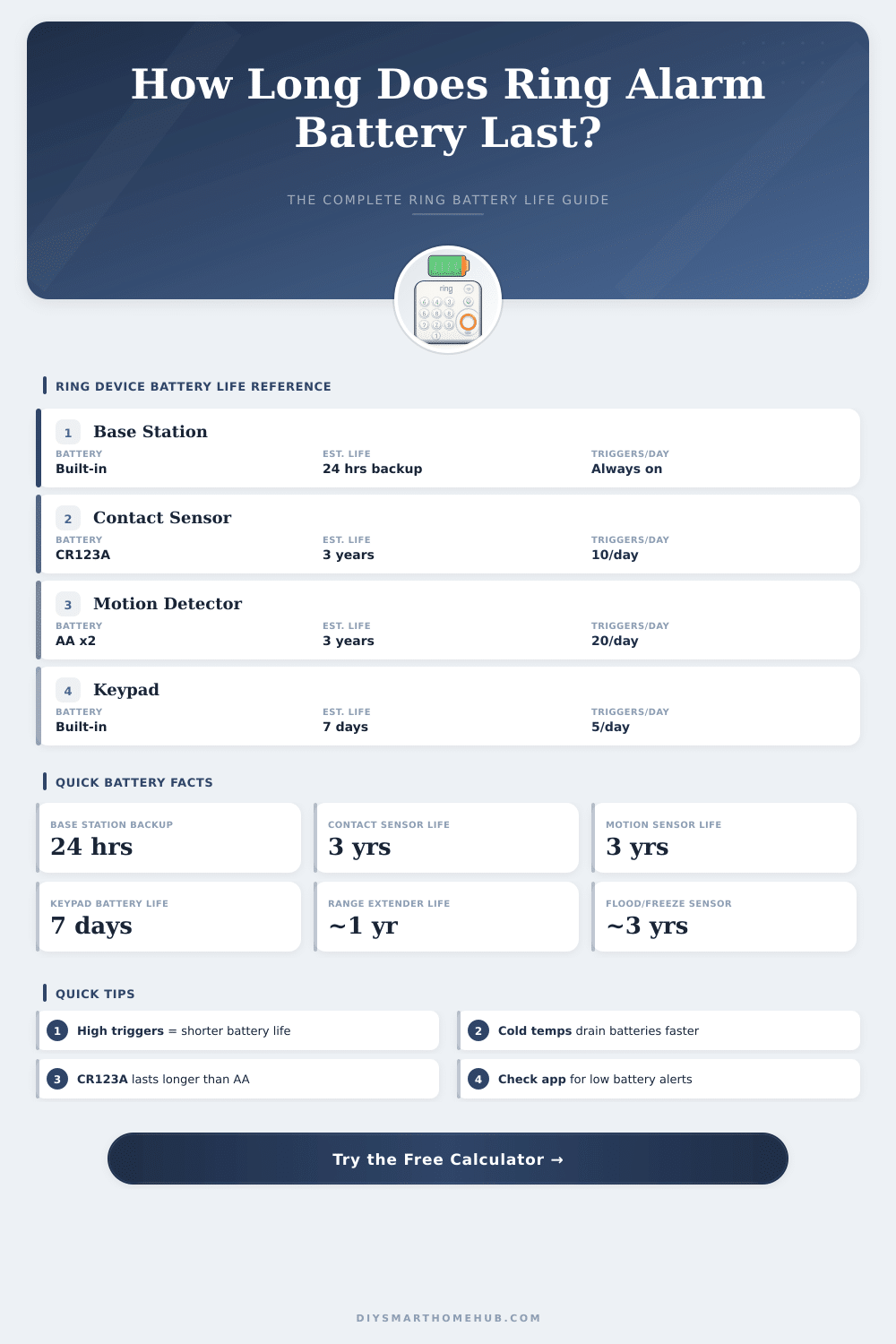
The Ring Alarm system carries an internal Battery in the base station that kicks in when the home electricity disappears. That backup source ensures around 24 hours of coverage. But some models of the first generation do not last well during long time.
One hears about old Gen 1 bases that only run 30 minutes on Battery, which does not work for near blackouts.
Ring Alarm Batteries and Backup Time
For the Ring Alarm Pro there is the called Ring Power Pack. Every such pack gives up to 8 hours of backup energy. It works with the Air 6 Extender, that one sells separately.
One can connect up to three packs to the Pro which keeps it active around 24 hours depending on the usage.
The Ring Alarm Keyboard owns its own internal Battery. It receives energy through the included USB adapter and cable, even so one can use it without cable. To charge it takes some hours, and the Battery can serve up to 7 months depending on the amount of usage.
One reaches the Battery inside and outside through a quick closing lid, while charging happens through micro-USB cable.
Different Ring Alarm devices require different batteries. The first generation Motion Detector uses one CR123A Battery. Before removing it, you need to turn off the alarm.
The Motion Detector of the second generation requires 3 V Lithium batteries, that can serve up to three years depending on the usage. Worth noting is, that rechargeable CR123A lithium batteries do not work with Ring Alarm devices. They only lite up one time and right away shut off.
Only non-rechargeable CR123A batteries work.
The second generation Ring Alarm Contact Sensors use too CR2032 batteries. Those CR2032 lithium 3V coin batteries are safe and deliver stable energy. Many other alarm door and window sensors also depend on CR2032 batteries.
While putting them in, one must match the plus and minus signs of the batteries. If one lays a Battery the wrong way, it could damage the device.
The life of batteries in Ring devices differs depending on model, usage habits and surrounding conditions. The amount of signals plays a big role. If warnings come every five minutes, the energy runs out soon.
Some batteries last only three months in common setups. There were cases, when a contact sensor stopped working because of weak Battery, but the Ring Alarm system did not warn about it. All wireless alarms need regular checking of batteries, so it is good to watch their levels.
It is possible to swap the Battery of the Ring Alarm Home Base Station through thirdparty items with 5200mAh Li-ion Battery. The internal backup source ensures only short coverage, but not for several days without energy.