⚡ Ohm's Law Calculator
Solve for Voltage, Current, Resistance, or Wattage — enter any two known values
| Device / Application | Voltage (V) | Current (A) | Power (W) | Resistance (Ω) |
|---|---|---|---|---|
| AA Battery | 1.5V | — | — | — |
| 9V Block Battery | 9V | — | — | — |
| Car / Auto Battery | 12V DC | ~2–5A | 24–60W | ~2.4Ω |
| USB 2.0 Port | 5V DC | 0.5A | 2.5W | 10Ω |
| USB-C PD (60W) | 20V DC | 3A | 60W | 6.67Ω |
| LED Indicator Light | 3.3V | 0.02A | 0.066W | 165Ω |
| LED Bulb (10W) | 120V AC | 0.083A | 10W | 1,440Ω |
| Incandescent 60W | 120V AC | 0.5A | 60W | 240Ω |
| Hair Dryer | 120V AC | 12.5A | 1,500W | 9.6Ω |
| Microwave (1000W) | 120V AC | 8.33A | 1,000W | 14.4Ω |
| Laptop Charger | 19.5V DC | 3.33A | 65W | 5.86Ω |
| Electric Kettle | 230V AC | 8.7A | 2,000W | 26.45Ω |
| Voltage (V) | Resistance (Ω) | Current (A) | Power (W) |
|---|---|---|---|
| 5V | 10Ω | 0.5A | 2.5W |
| 5V | 50Ω | 0.1A | 0.5W |
| 12V | 6Ω | 2A | 24W |
| 12V | 100Ω | 0.12A | 1.44W |
| 24V | 12Ω | 2A | 48W |
| 48V | 16Ω | 3A | 144W |
| 120V | 12Ω | 10A | 1,200W |
| 230V | 23Ω | 10A | 2,300W |
| 240V | 24Ω | 10A | 2,400W |
| Resistor Value | At 5V: Current | At 5V: Power | At 12V: Current | At 12V: Power |
|---|---|---|---|---|
| 10 Ω | 500 mA | 2.5W | 1,200 mA | 14.4W |
| 22 Ω | 227 mA | 1.14W | 545 mA | 6.5W |
| 47 Ω | 106 mA | 0.53W | 255 mA | 3.06W |
| 100 Ω | 50 mA | 0.25W | 120 mA | 1.44W |
| 220 Ω | 22.7 mA | 0.11W | 54.5 mA | 0.65W |
| 470 Ω | 10.6 mA | 53mW | 25.5 mA | 0.31W |
| 1k Ω | 5 mA | 25mW | 12 mA | 144mW |
| 10k Ω | 0.5 mA | 2.5mW | 1.2 mA | 14.4mW |
Whether you need to count voltage, flow, resistance or power? The computer based on Ohm’s Law is a free website that handles everything from that. Simply enter two known values and it will give the rest.
Truly, it works this easily, that everything seems almost too simple.
Simple Online Ohm’s Law Calculator
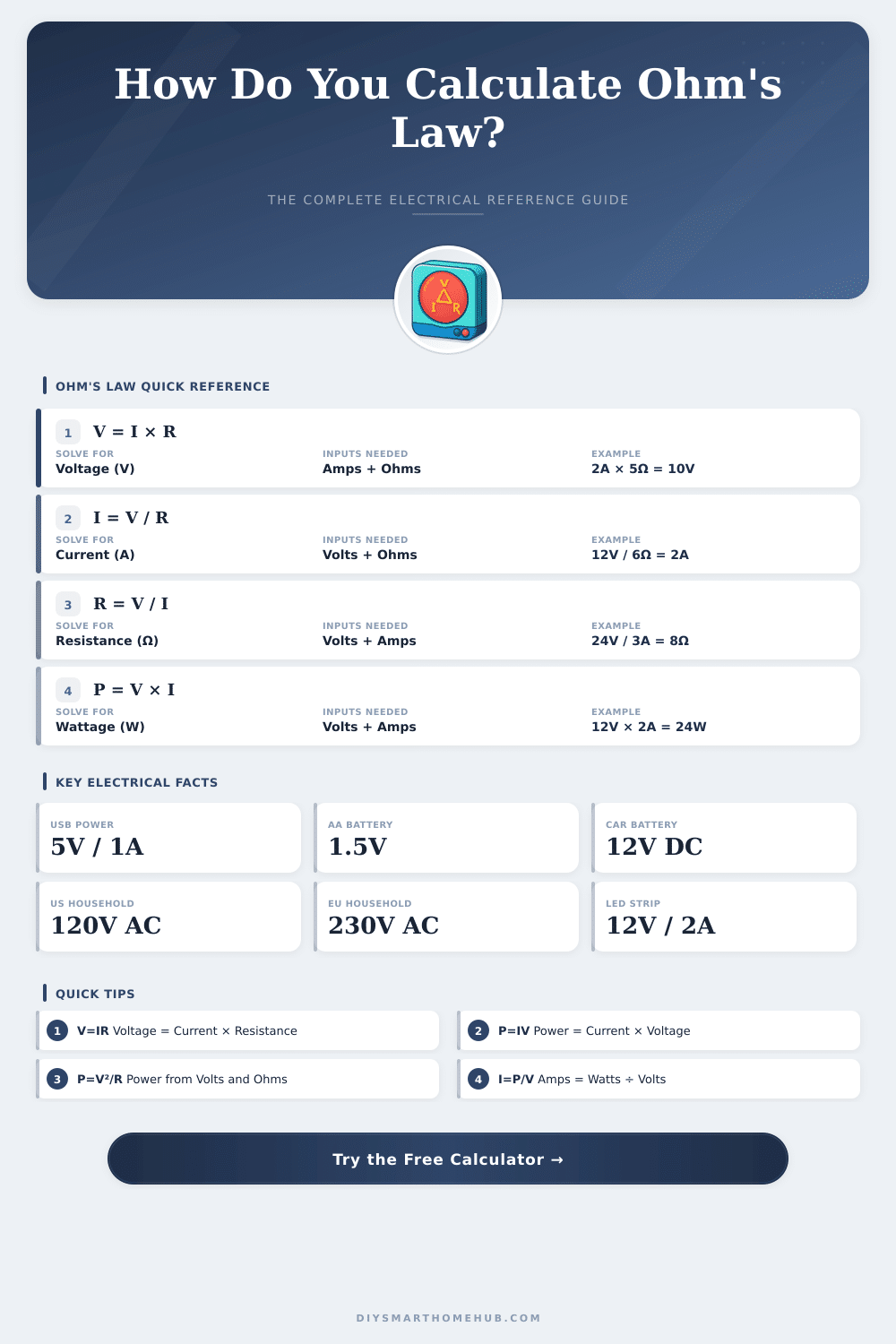
Here what happens under the surface: the values from Ohm’s Law, like power, voltage, flow and resistance, all bind together. The basic ideas are not hard. The voltage matches to flow multiplied by resistance.
To find the flow, simply divide voltage by resistance. And about resistance? It is voltage divided by flow.
For watts, you multiply volts by amps. There is another way: take the square of flow and multiply it by resistance, or square voltage and divide by resistance. Different ways, but always same result.
The link of Ohm’s Law with the Law of Joule truly gives dozens of different equations, enough to know, that two variables you use. Besides that, there is also a formula wheel, that really helps. Search the part for your need, later choose the piece, that matches wiht your two known values, and done.
Some of those computers become even more detailed. Besides the simple number work, it automatically converts units, from millivolts and volts to kilovolts, and from milliamps, amps, ohms, kilohms, megohms, milliwatts, watts and kilowatts. It leads you through the steps and shows the used right formula.
Truly helpful for checking your result is the optional rating of resistor power, that includes amounts like eighth of a watt, quarter of a watt and half of a watt. Usually there is also a little warning about risks of overload (very useful), when you work on circuit tasks home, in lab or on basic physics problems.
Georg Ohm spent time studying resistor behavior in 1825 and 1826. When he published his findings in 1827, in a book called The Galvanic Circuit Mathematically Researched (he absolutely did not know), that his work would become this available threw a simple online tool.
Ohm’s Law counts for the electrical behavior of both leads and insulators. The computer clearly shows the relation between voltage, flow and resistance. Even so, if your circuit has coils or capacitors, maybe you will have to add some extra laws and equations.
Naturally, regular computers can handle the math of Ohm’s Law, but really? A scientific or graphing computer eases it a lot. However the online version beats it, you only enter two numbers, click to count, and the other values appear right away.
It is like having a mighty computer, flow-computer, voltage-computer and resistance-computer, everything inone package. Whether you study, tinker as a hobby or work as an engineer, it removes the headache from those equations.