🔥 Radiator BTU Calculator
Calculate the exact BTU output your radiator needs to heat any room efficiently
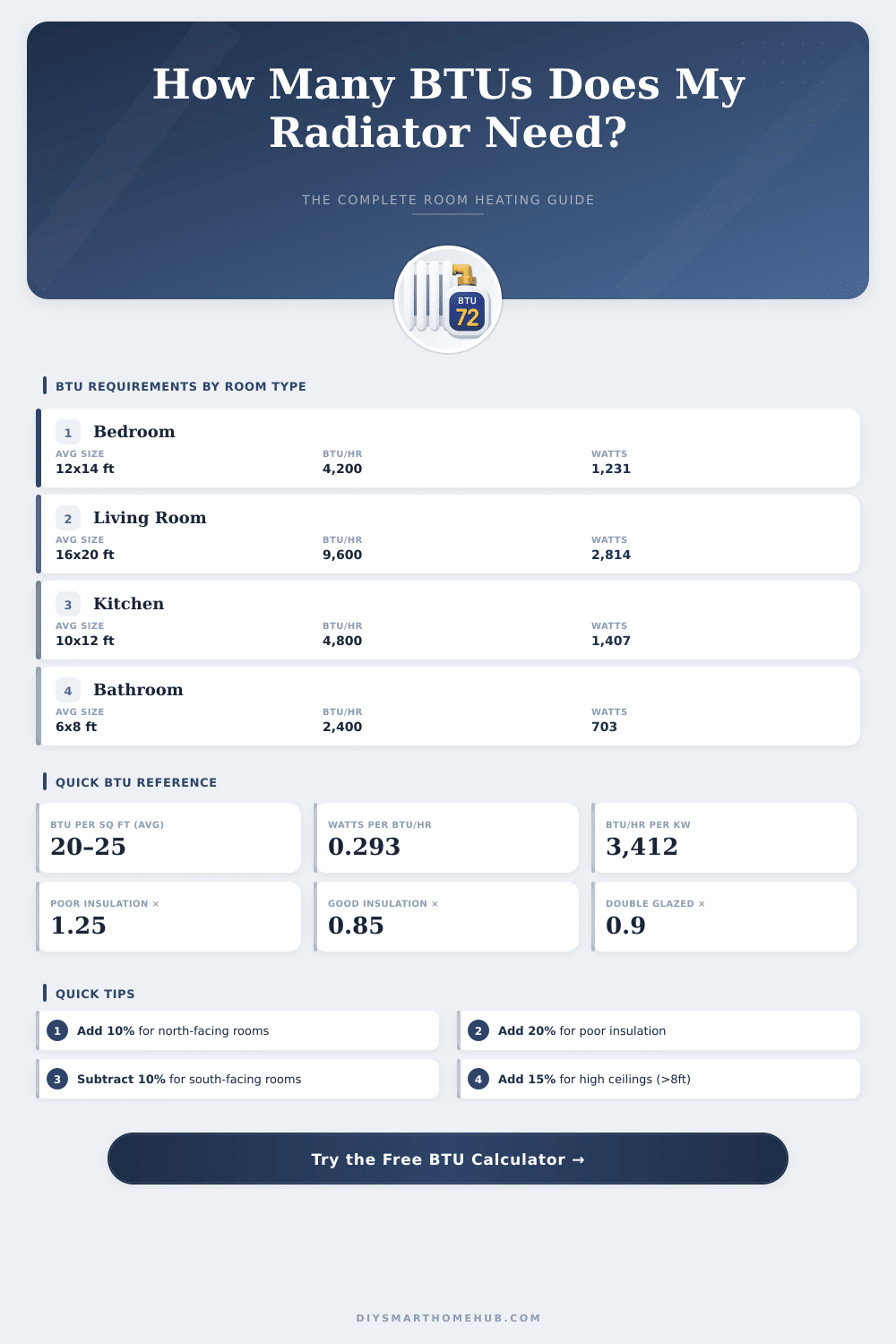
| Room Size | Area (sq ft) | Good Insulation | Average Insulation | Poor Insulation | Watts Equiv. |
|---|---|---|---|---|---|
| 10 x 10 ft | 100 | 2,000 | 2,500 | 3,250 | 585–953 W |
| 12 x 10 ft | 120 | 2,400 | 3,000 | 3,900 | 703–1,143 W |
| 12 x 14 ft | 168 | 3,360 | 4,200 | 5,460 | 985–1,600 W |
| 14 x 16 ft | 224 | 4,480 | 5,600 | 7,280 | 1,313–2,133 W |
| 16 x 20 ft | 320 | 6,400 | 8,000 | 10,400 | 1,876–3,047 W |
| 20 x 24 ft | 480 | 9,600 | 12,000 | 15,600 | 2,814–4,571 W |
| 24 x 28 ft | 672 | 13,440 | 16,800 | 21,840 | 3,939–6,400 W |
| BTU/hr | Watts (W) | Kilowatts (kW) | Typical Radiator Size |
|---|---|---|---|
| 1,000 | 293 W | 0.29 kW | Small single panel |
| 2,000 | 586 W | 0.59 kW | Small bedroom rad |
| 3,000 | 879 W | 0.88 kW | Medium single panel |
| 4,000 | 1,172 W | 1.17 kW | Medium double panel |
| 6,000 | 1,758 W | 1.76 kW | Large double panel |
| 8,000 | 2,344 W | 2.34 kW | XL double convector |
| 10,000 | 2,931 W | 2.93 kW | XXL double convector |
| 12,000 | 3,517 W | 3.52 kW | Multiple radiators |
| Factor | Condition | Multiplier | Effect on BTU |
|---|---|---|---|
| Insulation | Excellent (modern build) | × 0.85 | −15% |
| Insulation | Good (cavity walls) | × 1.00 | Baseline |
| Insulation | Average (some insulation) | × 1.20 | +20% |
| Insulation | Poor (older home) | × 1.40 | +40% |
| Glazing | Triple glazed | × 0.90 | −10% |
| Glazing | Double glazed | × 1.00 | Baseline |
| Glazing | Single glazed | × 1.15 | +15% |
| Ceiling Height | Above 9 ft | × 1.15 | +15% |
| Room Facing | North | +10% | +10% |
| Room Facing | South | −10% | −10% |
| Exterior Walls | Each additional wall | +5% | Per wall |
| Each Window | Standard size | +150 BTU | Per window |
BTU values mean the British Thermal Unit. That is the usual way one measures the heat output of a radiator. Exactly said, one BTU matches the energy that needs to warm one pound of water by one degree Fahrenheit.
For a radiator those BTU numbers tell you how much heat the device puts out during one hour. Simply, BTU helps to guess how much heat energy something sends to the area.
How to Use BTU to Choose a Radiator
When buying a radiator, the BTU guide shows how much energy is needed to properly warm a room. A calculator for BTU is a good tool for guessing the needed power of the room. A heating calculator lets you enter the size of your room and its type to get a fast result.
The output updates itself, and one can split it between several radiator units, if that requires.
Average size of rooms ranges between 2 000 and 6 000 BTU. It gives a general idea, but for a more exact picture one must think about extra details about the room. Stuff like heat loss of the house or of the room itself.
Also count the BTU for hourly output of each radiator at the water temperature that your system reaches.
Here is something that commonly confuses folks. Some companies advertise BTU ratings at delta 70, but most folks run their systems at low flow temperature, so that they do not receive the full BTU value from the radiator. Delta T50 shows the difference between the room temperature and that of the radiator.
Currently, one rates a radiator using a dT value of 20 degrees, which allows a flow temperature of 40 from the boiler or heat pump. Modern heating systems require to maintain temperature with flow of about 55 degrees, so too large a size does not really matter.
BTU ratings help you figure out whether a radiator will give enough heat for the room. If the BTU is too high, the radiator will use more energy than needed, which costs more money and grows your carbon footprint. If it is two low, the radiator will have to work harder and run longer.
One always can turn down a bigger radiator, but cannot force a smaller one to put out more heat.
The imperial unit is BTU, but an installer can use watts instead. Or one picks a radiator based on that. The conversion is that one kilowatt matches 3 412 BTU.
Most panel radiator units also have the option for a non-electric valve, that one can set for every radiator and so for every room. Like this, even if a radiator puts out more BTU than the room strictly needs, onecan easily turn it down.