🔊 Amplifier Wattage Calculator
Find the exact power your amplifier needs based on speaker sensitivity, impedance, room size, and listening level
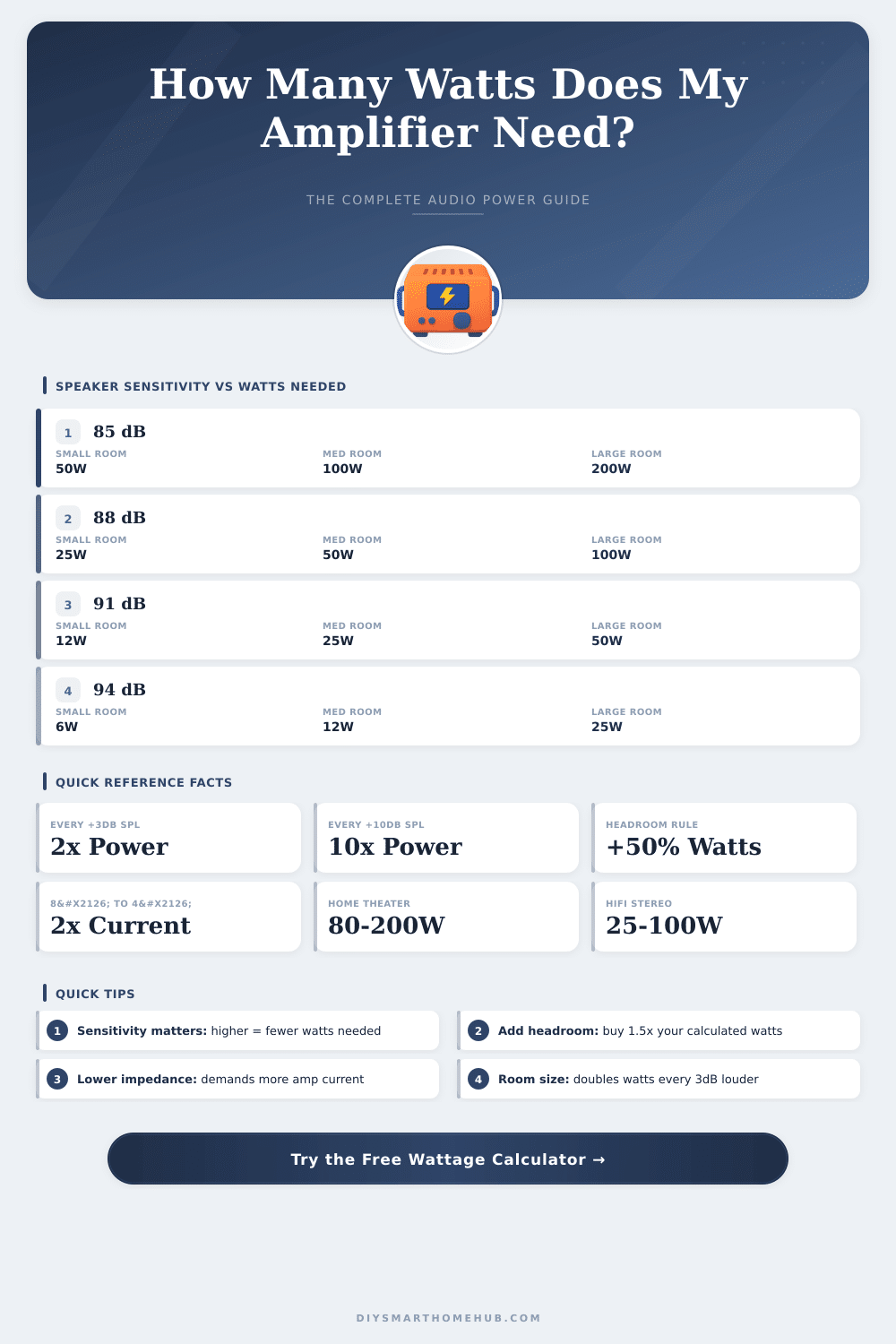
| Sensitivity (dB/W/m) | 75 dB SPL (Moderate) | 85 dB SPL (Loud) | 95 dB SPL (Very Loud) | 105 dB SPL (Concert) |
|---|---|---|---|---|
| 82 dB | ~200W | ~2000W | >20kW | — |
| 85 dB | ~63W | ~630W | ~6300W | — |
| 88 dB | ~20W | ~200W | ~2000W | — |
| 91 dB | ~8W | ~80W | ~800W | — |
| 94 dB | ~4W | ~40W | ~400W | — |
| 97 dB | ~2W | ~20W | ~200W | ~2000W |
| 100 dB | ~1W | ~10W | ~100W | ~1000W |
| 103 dB | <1W | ~5W | ~50W | ~500W |
*Values shown at 3m (10ft) listening distance. Actual power varies with room acoustics, speaker placement, and signal peaks.
| Amp Class | Efficiency | Best Use | Heat Output | Sound Character |
|---|---|---|---|---|
| Class A | 15–35% | Hi-Fi Audiophile | Very High | Warm, smooth |
| Class AB | 50–70% | Home stereo / HT | Medium | Balanced, versatile |
| Class B | ~70% | PA systems | Medium-Low | Slightly harsh |
| Class D | 85–98% | Subwoofers, car, PA | Very Low | Clean, powerful |
| Class G/H | 70–90% | Pro audio | Low | Clean, efficient |
| Class T | 85–95% | Small systems | Very Low | Clean digital |
| Impedance (Ω) | Relative Power | Current Demand | Common Application |
|---|---|---|---|
| 2 Ω | 4x (vs 8Ω) | Extremely High | Car audio, pro PA |
| 4 Ω | 2x (vs 8Ω) | High | Car audio, HT subs |
| 6 Ω | 1.33x (vs 8Ω) | Medium-High | Some home speakers |
| 8 Ω | Baseline | Standard | Most home speakers |
| 16 Ω | 0.5x (vs 8Ω) | Low | Guitar amps, PA tops |
| Application | Typical Wattage | Channels | Total System Power |
|---|---|---|---|
| Bedroom Stereo | 20–50W RMS/ch | 2 | 40–100W |
| Living Room Hi-Fi | 50–150W RMS/ch | 2 | 100–300W |
| Home Theater (5.1) | 80–200W RMS/ch | 5 | 400–1000W |
| Home Theater (7.1) | 80–200W RMS/ch | 7 | 560–1400W |
| Outdoor Patio | 50–100W RMS/ch | 2–4 | 100–400W |
| Studio Monitors | 50–150W RMS/ch | 2 | 100–300W |
| DJ / Small Venue | 500–1500W RMS/ch | 2 | 1000–3000W |
| Car Audio (sub) | 200–1000W RMS | 1 | 200–1000W |
The power of amplifier simply shows whether it can reach high sound before the solid-state circuits start breaking. Amplifiers range from low values, for instance 5 until 10 watts, until 100 or even 200 watts. Even so here comes the thrilling part, the tie between power and sound is not direct for everything.
The output of power and the sound of speakers obeys a logarithmic law not linear. Like this a 100-watt amplifier does not sound twice as loud as a 50-watt with same speakers. For double the sound level in decibels, one must increase the watts ten times.
What amplifier power means and how to match it to speakers
So a 10-watt device sounds twice as loud as a 1-watt, but only half as loud as a 100-watt. When you own 100 watts and want clear growth, you should go to 200 watts. Later from 200 to 400, and so on.
One must know two main ways to measure power. RMS-watts show the steady, long-lasting force, that an amplifier delivers without damage or distortion. It well shows the everyday use in reality.
Peak power is the highest output, that the device can give for very short time, for instance during a strong deep blow or drum hit.
Matching an amplifier with speakers commonly confuses, because makers use different words for each. The speakers are rated according to the maximum safe force, that the maker advises to use. The maker of the amplifier rates it according to what it can put out.
No real standards exist for rating watts of speakers. It mostly is only advice about the highest suggested power of the amplifier, not a guarantee for steady handling of that power. Mutual advice says, that watts of speakers bee around 1.5 times those of the amplifier.
Another view suggests, that the amplifier be between 80 and 100 percent of the rating of speakers.
The sensitivity of speakers also plays a big role. A speaker with 98 dB for one watt at one metre is really efficient. With such a sensitive model, even 10 watts reach a lot of sound.
In the 1960s big theaters filled themselves with sound using only 50 watts of amplifier power per channel with good speakers. Speakers with higher sensitivity, say 101 dB, would require only around 12 watts per channel.
For home listening, low power works well, around 1 until 20 watts for tube amplifier and 1 until 60 watts for solid-state. It depends on whether neighbours hear and if the goal is to turn the amplifier for natural distortion. Bigger watts help to move speakers and help to keep the sound pure and strong.
As long as theamplifier power stays inside the suggestions of the speaker maker, the exact number does not matter too much.