🔥 Furnace BTU Calculator
Calculate the right furnace size for your home based on square footage, climate zone, insulation, and ceiling height
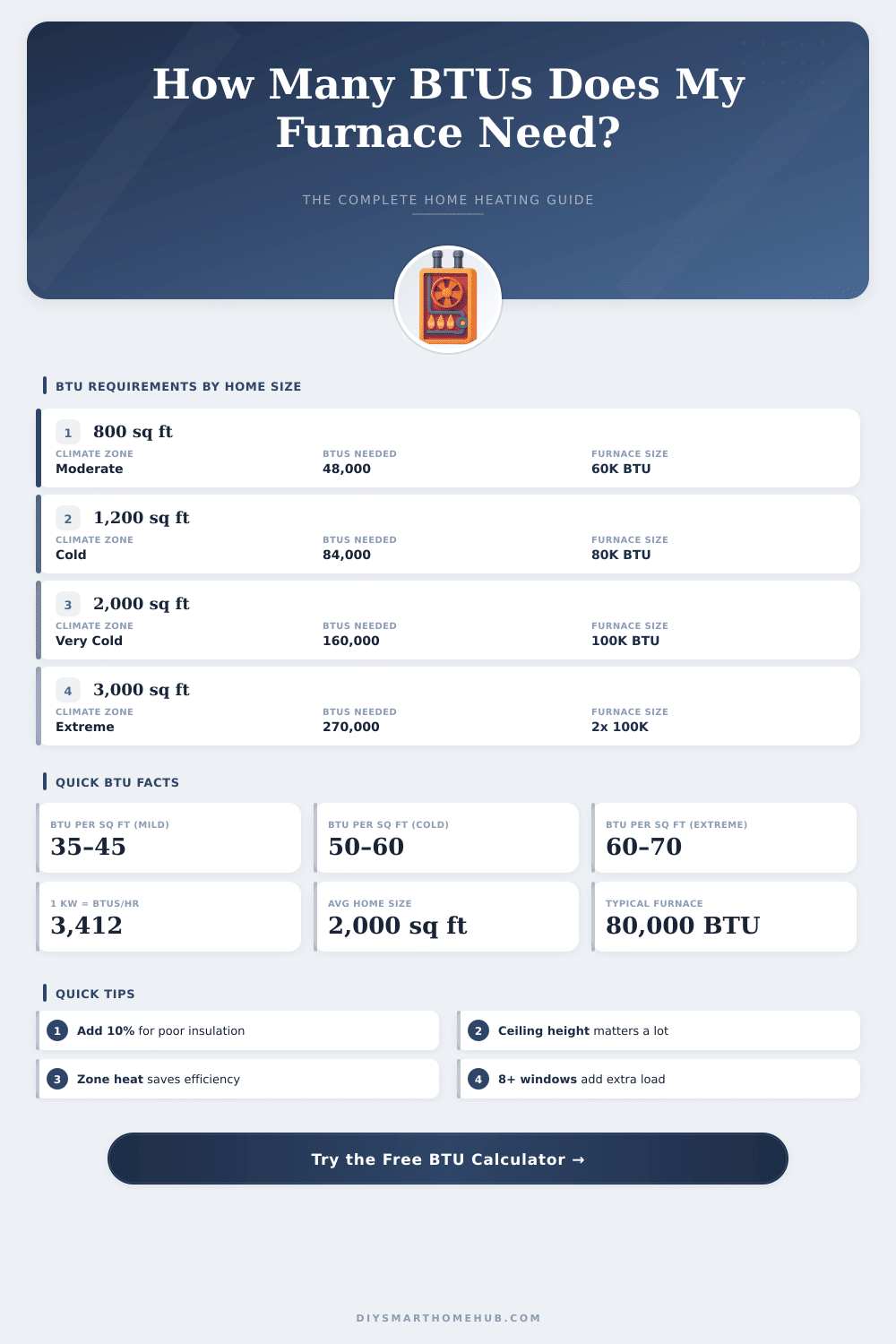
| Home Size | Mild Zone | Cold Zone | Very Cold Zone | Extreme Zone | Metric (m²) |
|---|---|---|---|---|---|
| 500 sq ft | 17,500–22,500 | 25,000–30,000 | 30,000–32,500 | 32,500–35,000 | 46 m² |
| 800 sq ft | 28,000–36,000 | 40,000–48,000 | 48,000–52,000 | 52,000–56,000 | 74 m² |
| 1,000 sq ft | 35,000–45,000 | 50,000–60,000 | 60,000–65,000 | 65,000–70,000 | 93 m² |
| 1,200 sq ft | 42,000–54,000 | 60,000–72,000 | 72,000–78,000 | 78,000–84,000 | 111 m² |
| 1,500 sq ft | 52,500–67,500 | 75,000–90,000 | 90,000–97,500 | 97,500–105,000 | 139 m² |
| 2,000 sq ft | 70,000–90,000 | 100,000–120,000 | 120,000–130,000 | 130,000–140,000 | 186 m² |
| 2,500 sq ft | 87,500–112,500 | 125,000–150,000 | 150,000–162,500 | 162,500–175,000 | 232 m² |
| 3,000 sq ft | 105,000–135,000 | 150,000–180,000 | 180,000–195,000 | 195,000–210,000 | 279 m² |
| Furnace Size | Input BTU/hr | Output BTU/hr (80%) | Output BTU/hr (96%) | Typical Home Size | kW Equivalent |
|---|---|---|---|---|---|
| 40K BTU | 40,000 | 32,000 | 38,400 | Under 800 sq ft | 11.7 kW |
| 60K BTU | 60,000 | 48,000 | 57,600 | 800–1,200 sq ft | 17.6 kW |
| 80K BTU | 80,000 | 64,000 | 76,800 | 1,200–1,800 sq ft | 23.5 kW |
| 100K BTU | 100,000 | 80,000 | 96,000 | 1,800–2,500 sq ft | 29.3 kW |
| 120K BTU | 120,000 | 96,000 | 115,200 | 2,500–3,200 sq ft | 35.2 kW |
| 140K BTU | 140,000 | 112,000 | 134,400 | 3,200–4,000 sq ft | 41.0 kW |
| Factor | Condition | BTU Adjustment | Notes |
|---|---|---|---|
| Insulation | Excellent | −10% | New construction, high R-value walls/attic |
| Insulation | Good | No change | Properly insulated existing home |
| Insulation | Average | +10% | Typical existing home |
| Insulation | Poor | +25% | Older home, drafts, single-pane windows |
| Ceiling Height | Under 8 ft | −5% | Less volume to heat |
| Ceiling Height | 8 ft (standard) | No change | Baseline assumption |
| Ceiling Height | 9–10 ft | +10% | More volume to heat |
| Ceiling Height | Over 10 ft | +20% | Vaulted/cathedral ceilings |
| Windows | Few (1–4) | −5% | Minimal heat loss through glass |
| Windows | Average (5–8) | No change | Standard window count |
| Windows | Many (9–14) | +10% | Significant heat loss |
| Windows | Lots (15+) | +15% | Maximum window heat loss |
BTU stands for British Thermal Unit. One BTU matches the amount of energy needed to warm one pound of water by one degree Fahrenheit. When one talks about the size of a furnace, one usually means BTUs per hour not simply BTUs alone.
That reading helps you understand how much heat the furnace can release during one hour.
How to Choose the Right Furnace Size
The size of a furnace is measured in BTUs and shows how much heat it can generate. Even so there is a big difference between input BTUs and output BTUs. Input BTUs measure how much fuel the furnace burner uses.
Output BTUs show the real heat that the furnace delivers to your home. For instance, an 80-percent efficient furnace with 120 000 BTU input would deliver only 96 000 BTUs of usable heat. The rest is simply lost as waste.
Efficiency plays a key role here. A furnace with 80-percent rating uses 80 percent of the made heat, while the rest goes through the chimney. Modern high-efficiency models recycle warm exhaust gases that old devices would simply send right through the roof.
That really boosts the output of BTUs. Because of that, an old furnace rated at 100 000 BTU input commonly would deliver only 60 to 70 perecnt of that as actual heating energy.
A general rule says that you need around 30 to 60 BTUs for every square foot of the home. But furnaces should not be sized only by the floor area. They should be sized by the heat loss of the house at set inside and outside temperatures.
The insulation of walls, the height of ceilings, the kind of windows and the thickness of insulation all affect the exact size calculation.
New houses need less heating. A home with 2100 square feet, built in the 2000s, maybe would do fine with a 40 000 BTU furnace, while a same-sized house from the 1960s or 1970s could need 80 000 BTUs. Simple online calculators commonly lead to too big furnaces.
For a 96-percent efficient model the right size easily reaches 40 000 to 45 000 BTUs, and probably no more then 60 000.
For a home of 1900 square feet with an 80-percent efficient furnace, a device with 90 000 BTU input that gives 72 000 BTUs of heat could be almost right. To find the rating of your furnace, open the panel up and look at the label inside. If only the input rating appears, multiply it by the efficiency; for instance 0.8 or 0.95; to get the real output.
Most companies simply swap one furnace for another, without thinking about those details. That can cause problems. The best way to choose the right furnace is towork with a heating expert who will do a professional load calculation.