⚡ EV Electricity Cost Calculator
Calculate how much electricity your electric vehicle uses and what it costs to charge — per session, per month, and per year.
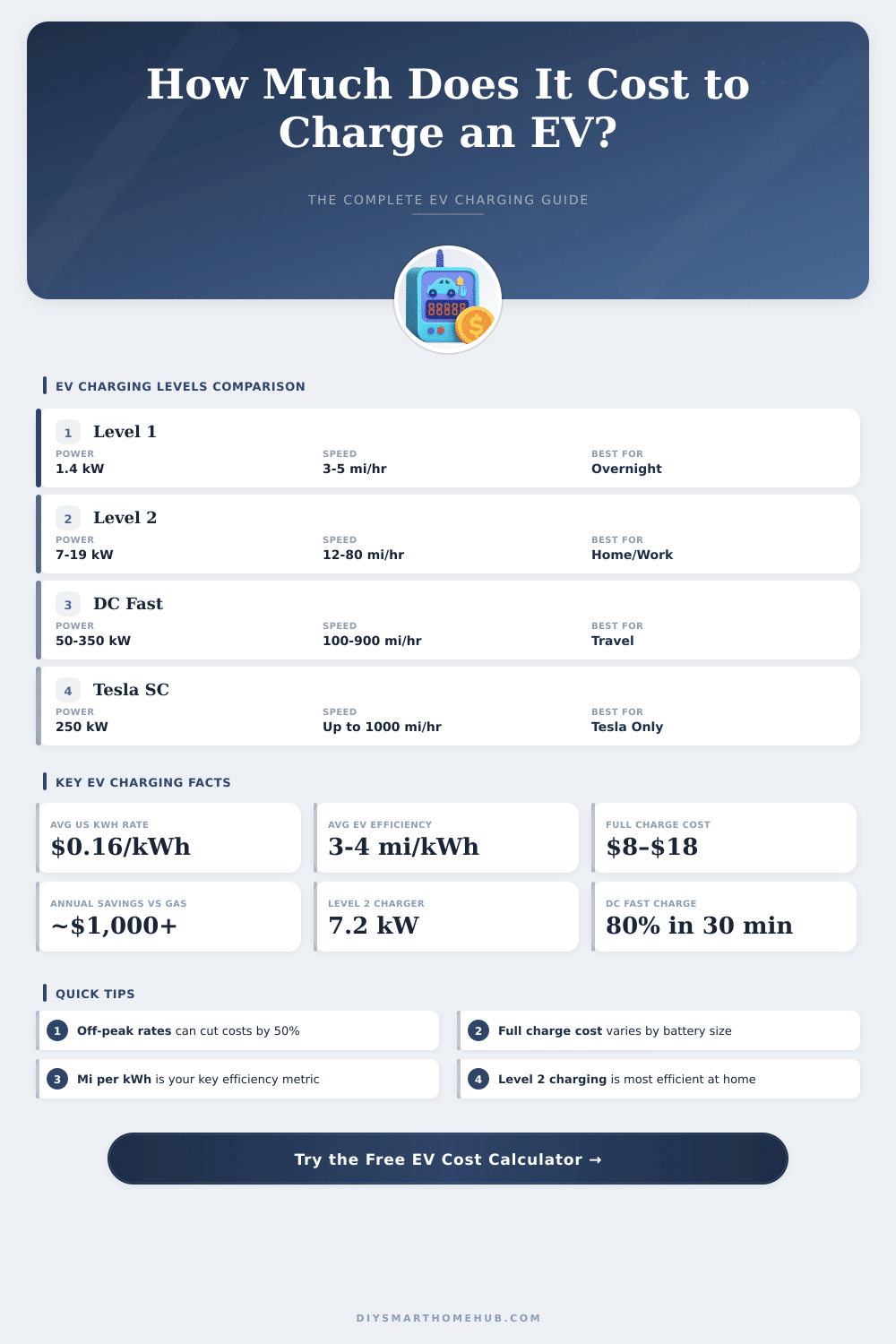
| Level | Voltage | Power | Speed (mi/hr) | Full Charge (75kWh) | Best Use |
|---|---|---|---|---|---|
| Level 1 | 120V AC | 1.4 kW | 3–5 mi/hr | ~54 hours | Emergency/travel |
| Level 2 (Home) | 240V AC | 7.2 kW | 20–30 mi/hr | ~10 hours | Overnight home |
| Level 2 (Public) | 240V AC | 11.5 kW avg | 30–50 mi/hr | ~6.5 hours | Workplace/retail |
| DC Fast (50 kW) | 400-800V DC | 50 kW | 100–200 mi/hr | ~1.5 hours | Road trips |
| Ultra-Fast DC | 800V DC | 150–350 kW | 500–1000 mi/hr | 15–30 min | Highway stops |
| Efficiency | 50 mi / 80 km | 100 mi / 161 km | 200 mi / 322 km | 300 mi / 483 km |
|---|---|---|---|---|
| 2.5 mi/kWh (4.0 km/kWh) | 20 kWh | 40 kWh | 80 kWh | 120 kWh |
| 3.0 mi/kWh (4.8 km/kWh) | 16.7 kWh | 33.3 kWh | 66.7 kWh | 100 kWh |
| 3.5 mi/kWh (5.6 km/kWh) | 14.3 kWh | 28.6 kWh | 57.1 kWh | 85.7 kWh |
| 4.0 mi/kWh (6.4 km/kWh) | 12.5 kWh | 25 kWh | 50 kWh | 75 kWh |
| 4.5 mi/kWh (7.2 km/kWh) | 11.1 kWh | 22.2 kWh | 44.4 kWh | 66.7 kWh |
| Annual Miles | ¢10/kWh | ¢14/kWh | ¢16/kWh | ¢20/kWh | ¢25/kWh |
|---|---|---|---|---|---|
| 8,000 mi | $19/mo | $27/mo | $30/mo | $38/mo | $48/mo |
| 10,000 mi | $24/mo | $33/mo | $38/mo | $48/mo | $60/mo |
| 12,000 mi | $29/mo | $40/mo | $46/mo | $57/mo | $71/mo |
| 15,000 mi | $36/mo | $50/mo | $57/mo | $71/mo | $89/mo |
| 20,000 mi | $48/mo | $67/mo | $76/mo | $95/mo | $119/mo |
* Assumes 3.5 mi/kWh average efficiency and 10% charging loss.
| Vehicle | Battery (kWh) | Range (mi) | L2 Full Charge | DC Fast (10–80%) |
|---|---|---|---|---|
| Nissan Leaf (40 kWh) | 40 kWh | 149 mi | ~7.5 hrs | ~60 min (50kW) |
| Chevy Bolt EV | 65 kWh | 259 mi | ~7 hrs | ~60 min (55kW) |
| Tesla Model 3 SR | 60 kWh | 272 mi | ~8 hrs | ~25 min (250kW) |
| Tesla Model 3 LR | 82 kWh | 358 mi | ~9 hrs | ~30 min (250kW) |
| Ford Mustang Mach-E | 91 kWh | 312 mi | ~10 hrs | ~38 min (150kW) |
| Hyundai IONIQ 6 | 77 kWh | 361 mi | ~8.5 hrs | ~18 min (350kW) |
| Rivian R1T | 135 kWh | 314 mi | ~18 hrs | ~40 min (200kW) |
| VW ID.4 | 82 kWh | 275 mi | ~7.5 hrs | ~38 min (135kW) |
Home charge electricity for autos cost much less than many folks think. The spending of electricity for one mile usually falls between 4 and 9 cents what commonly matches half, or even less, of the amount that you would pay for gasoline. For typical use of around 338 kWh monthly, that results in about 58 dollars according to the average American home rate of 17 cents each kilowatt-hour.
To fill the battery of an ev at home happens for between 8 and 26 dollars. Public stations for charging? Here one requires of you double more.
Charging an electric car at home usually costs much less than gas
Whether you truly save money, depends mainly on one thing: the local price for electricity.
The place has big influence on the whole amount. In regions with prices of around 0.07 dollars each kWh, you pay only 2 cents per mile. For instance in Arizona, where the price is about 0.12 dollars each kWh, 100 miles cost only 3 dollars.
In San Diego on the other hand electrical costs tirple the national average, so the figures change quite a lot.
Home charging seems the best and cheap way. It matches only a third of the cost for DC-fast charging during travel. Although even those fast stations stay better than paying at the pump.
Full charging of 60 kWh at home is 3.4 times cheaper than DC-fast. The best way to save? Charge during the hours outside peek, that usually goes from around 11 at night until 6 in the morning, when companies offer lower prices to push overnight use.
How well your ev uses electricity is truly important. The Hyundai Ioniq 6 uses about 24 kWh for 100 miles and costs much less than heavy cars that swallow energy. The most common ev models reach between 3 and 4 miles each kilowatt-hour.
In real life the cost falls between 2 and 5 cents per mile. Also you have little worry, much less upkeep and fuss than with gas cars.
A driver in San Francisco noticed that its monthly bill for electricity grew from 452 to 523 dollars after adding ev charging, a 16 percent increase. But here is the key: another study shows that electrical costs climbed by 100 dollars, while spending for gasoline dropped by 300. Beyond everything, your car stands fully charged in the driveway every morning, without stops at gas stations.
Some plans from companies can drop the costs of charging to match 1.90 dollars each gallon at the pump. If you addsolar panels, you basically charge almost for nothing.