💡 Grow Light Electricity Usage Calculator
Calculate daily, monthly & annual kWh consumption for any grow light setup
| Light Type | Watts | 12 hrs (kWh) | 18 hrs (kWh) | 24 hrs (kWh) | Efficiency |
|---|---|---|---|---|---|
| LED Quantum Board | 400W | 4.8 | 7.2 | 9.6 | ★★★★★ |
| HPS High Pressure Sodium | 1000W | 12.0 | 18.0 | 24.0 | ★★★ |
| CMH / LEC | 315W | 3.78 | 5.67 | 7.56 | ★★★★ |
| Metal Halide (MH) | 600W | 7.2 | 10.8 | 14.4 | ★★★ |
| T5 Fluorescent | 216W | 2.59 | 3.89 | 5.18 | ★★ |
| LED COB | 500W | 6.0 | 9.0 | 12.0 | ★★★★ |
| Induction / LEC | 200W | 2.4 | 3.6 | 4.8 | ★★★★ |
| Total Watts | Veg Coverage | Flower Coverage | PPFD Target | Light Type |
|---|---|---|---|---|
| 100W LED | 2–3 sq ft | 1–2 sq ft | 400–600 µmol | LED |
| 200W LED | 4–6 sq ft | 2–4 sq ft | 400–600 µmol | LED |
| 315W CMH | 9 sq ft | 6–7 sq ft | 500–700 µmol | CMH |
| 400W LED | 9–12 sq ft | 6–9 sq ft | 400–700 µmol | LED |
| 600W HPS | 16 sq ft | 9–12 sq ft | 500–800 µmol | HPS |
| 1000W HPS | 25 sq ft | 16 sq ft | 700–1000 µmol | HPS |
| 800W LED | 20–25 sq ft | 16–20 sq ft | 400–700 µmol | LED |
| Grow Stage | Typical Hours/Day | kWh/day (400W) | kWh/30 days (400W) | Notes |
|---|---|---|---|---|
| Seedling / Clone | 24 hrs | 9.6 | 288 | Gentle light, low intensity |
| Early Vegetative | 20 hrs | 8.0 | 240 | High blue spectrum |
| Vegetative | 18 hrs | 7.2 | 216 | Most common veg schedule |
| Pre-Flower | 14–16 hrs | 6.4 | 192 | Transition period |
| Flowering | 12 hrs | 4.8 | 144 | High red spectrum |
| Auto-Flowering | 18–20 hrs | 7.2–8.0 | 216–240 | No light cycle change needed |
Switch Grow Light entirely affect your Electricity bill, although the real blow to your wallet depends on several factors that work together. Naturally, the power of your lights matters, but so does the number of hours that you use them daily, and what you pay for one kilowatt hour where you live. The prices of Electricity range a lot across different places, anything around 11 to 14 cents per kilowatt hour in one area, while in others it can reach 40 to 63 cents.
That shows a huge difference.
How Grow Lights Affect Your Electricity Bill
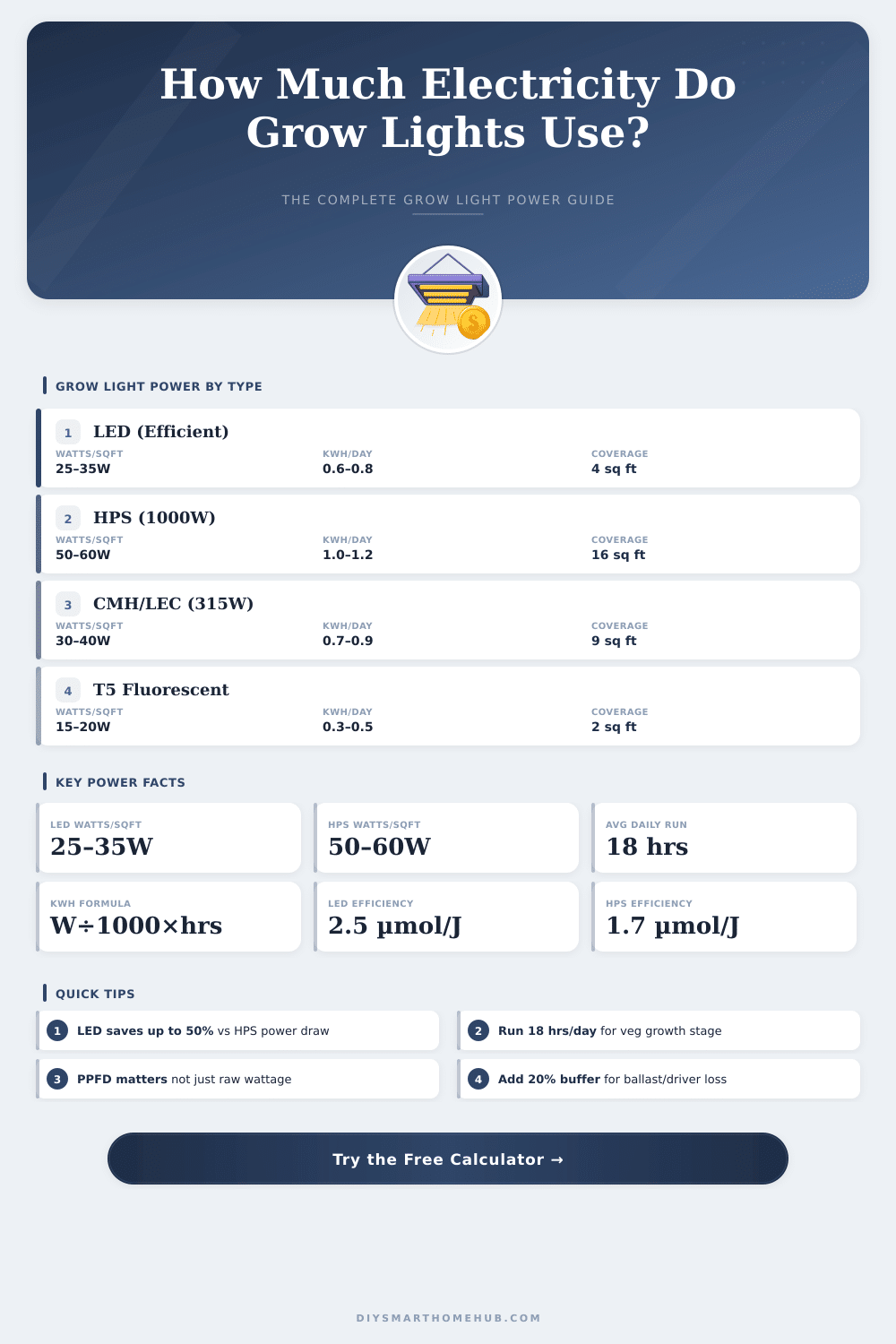
The math itself is not hard for anyone. You divide your power by 1000, then multiply by the daily hours of use, like this you find the daily kilowatt hours. Then multiply that by your local price, and you see the daily cost.
Calculators for Grow Light rooms ease this, because you simply enter the real power, the hours daily and the price of Electricity, and they give you the daily, monthly and yearly amounts in a moment.
Here is where it becomes a bit confuisng. The advertised power and the real energy that it uses are two different things. Makers can simply put label “1000 W LED” on something, but the actual use could be close to 180 to 200 watts.
This surprises many new growers and misleads their cost guesses.
Let me go through some actual numbers. A 500-watt LED in a 4×4 space, running during 15 hours daily at 17 cents per kilowatt hour, results in around 450 dollars per year. Assume a 650-watt light that runs 12 hours daily at 12 cents per kilowatt hour, that gives around 7.8 kWh a day, or almost 94 cents per day.
On the other hand, a 600-watt HID system on a 12-hour program uses around 14.4 kWh daily, which adds up too close to 432 kWh monthly.
On a smaller scale, two 30-watt lights that run 10 to 12 hours cost under 20 dollars per month and use less than 21 kWh. One mid-size LED could cost you only one or two dollars monthly. For most folks that set up small to mid-size Grow Light spaces, you will pay something in the range of 15 to 35 dollars per month, probably about as much as you would spend on a computer or game console.
LED technology has come a long way compared to older options. It is much more efficient, giving better light while it uses less energy. Older tech is already fully beaten.
Now you want full-spectrum lights in around 5400 to 5700 kelvins. Modern LEDs truly cost little to use, compared to big devices like your AC or fridge. Your AC in summer?
That really is thereal energy hog.
Two Grow Light setups will not cause a visible jump in your bill. But if you add several extras, the situation changes quickly. Someone that uses 12 multi-branch lights with 60 two-foot strips saw his Electricity bill double.
Another grower with four lights said that each cost at least 30 dollars monthly. One person set up a light in December and noticed that his bill jumped from around 100 to 160 dollars the next month.
Using your lights during the off-peak hours can help lower costs, because the prices of Electricity drop when the demand is lower. The main secret is knowing the real power use of your lights and how much you pay per kilowatt hour in your region.