⚡ Multiple Wire Gauge Calculator
Find the equivalent AWG for parallel wires, total ampacity, resistance, and voltage drop
| AWG | Diameter (in) | Area (mm²) | Circular Mils | Cu Resistance (Ω/1000ft) | Al Resistance (Ω/1000ft) | Cu Ampacity (A) |
|---|
| Base AWG | 2 Parallel | 3 Parallel | 4 Parallel | 6 Parallel |
|---|
| AWG | 25 ft | 50 ft | 100 ft | 150 ft | 200 ft |
|---|
Whether you need help to choose the right wire gauge for your wiring? These handy calculators for wire gauge help do that easily, they are free and remove the need to guess about the best cable. Whether you want to connect power to a pump in the garden, install wiring for a little cottage or bring electricity to a shed outside, those tools simplify everything.
Enter your data and one gives you ratings about length of wire, guesses about voltage drop and exact need of thickness.
How to Choose the Right Wire Size
Here where everything gets hard: different makers of wires not always agree. One store rates a certain wire gauge at 20 amps, while another insists on 25 amps for safety. That bothers truly.
So use a calculator that cuts through the confusion, allowing you to enter your own details and receive a clear, reliable result.
The most many of those calculators follow a simple steps. One enters the voltage, the flow and the distance, that the wire must cover. Later the tool points, what wire gauge to use.
The good ones consider also the percentage of voltage drop, filling of tubes and both copper and aluminium. At long runs of wire the voltage drop truly matters, if one pushes too much flow through too slim a cable or too long, bad things will happen.
For safe wiring systems it matters to choose the write wire gauge. Cables, that are too thin, will warm, will waste energy bad and maybe will trigger fire. The ability for flow depends on the diameter, the thicker the wire, the more it lasts.
Think about that as about tubes: more water through the same tube will cause a drop. In slimmer wires the resistance grows and the ability for flow drops, especially over longer ways. Truly, using a bit thicker wires, it almost never causes a problem.
If you are not sure, how much flow the circuit will need, choosing the next bigger wire gauge is a wise choice.
Some calculators are done for particular work. Some are meant for sizing of pumps for ponds, landscaping and farming. Others deal with marine wiring according to ABYC E-11 standards.
Similar tools exist for 12V-systems in camping vehicles and for general wire runs.
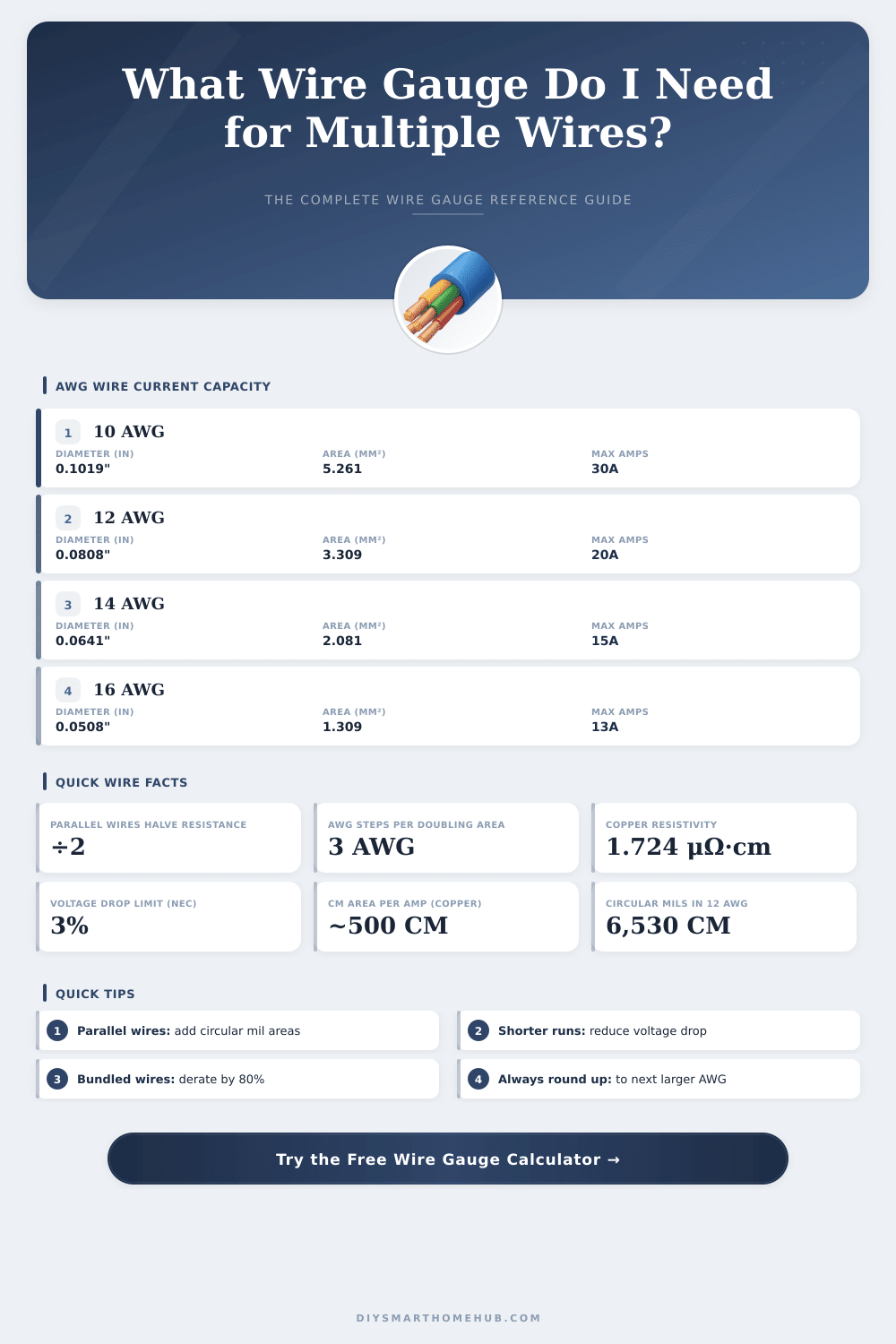
Calculators for combined wires settle another riddle: what happens, if one twists several wires together? Say, you want to make a match of 12-gauge wire from slimmer 20-gauge, you need around six of them. Temperature affects not only the wire gauge itself.
Single wires warm differently than a group. The NEC gives advice for simple setups, but for serious electrical work you need a professional license. Even if a friend did a similar setup inhis garage, your case almost always needs other specs.