⚡ 3 Phase Electrical Load Calculator
Calculate kVA, kW, amperage, and phase balance for three-phase electrical systems
| Formula | Expression | Variables | Notes |
|---|---|---|---|
| Apparent Power (kVA) | √3 × V × I ÷ 1000 | V = line V, I = amps | √3 = 1.7321 |
| Real Power (kW) | √3 × V × I × PF ÷ 1000 | PF = power factor | 0 to 1 |
| Reactive Power (kVAR) | √(kVA² − kW²) | Pythagorean theorem | Inductive loads |
| Line Current from kVA | kVA × 1000 ÷ (√3 × V) | V = line voltage | Balanced load |
| kW from HP | HP × 0.7457 ÷ Efficiency | Eff = motor eff. | Input power |
| HP from kW | kW × Efficiency ÷ 0.7457 | Shaft output | Output power |
| Phase Voltage (Wye) | Vₗᵢₙₑ ÷ √3 | √3 = 1.7321 | Line-to-neutral |
| NEC 125% Rule | FLA × 1.25 | Continuous loads | Breaker sizing |
| System Voltage | Phase Voltage | Typical Application | Common Wire Size |
|---|---|---|---|
| 208V 3Φ | 120V | Commercial / Light Industrial | #2 AWG |
| 240V 3Φ | 139V | Residential / Small Commercial | #2 AWG |
| 480V 3Φ | 277V | Industrial Standard | 250 kcmil |
| 600V 3Φ | 347V | Canada / Heavy Industrial | 350 kcmil |
| 4160V 3Φ | 2402V | Medium Voltage Distribution | Cable |
| 13.8kV 3Φ | 7967V | Utility Distribution | Cable |
| HP Rating | FLA at 460V (A) | FLA at 208V (A) | Min Breaker (A) |
|---|---|---|---|
| 1 HP | 2.1 | 4.6 | 15 |
| 2 HP | 3.4 | 7.5 | 15 |
| 3 HP | 4.8 | 10.6 | 15 |
| 5 HP | 7.6 | 16.7 | 20 |
| 7.5 HP | 11 | 24.2 | 30 |
| 10 HP | 14 | 30.8 | 40 |
| 15 HP | 21 | 46.2 | 60 |
| 20 HP | 27 | 59.4 | 70 |
| 25 HP | 34 | 74.8 | 90 |
| 30 HP | 40 | 88 | 100 |
| 50 HP | 65 | 143 | 175 |
| 75 HP | 96 | 211 | 250 |
| 100 HP | 124 | 273 | 350 |
| Load (kVA) | Amps (480V) | Suggested Wire | Conduit Size |
|---|---|---|---|
| 5 kVA | 6.0 | #12 AWG | 1/2 in |
| 10 kVA | 12.0 | #10 AWG | 1/2 in |
| 15 kVA | 18.0 | #8 AWG | 3/4 in |
| 25 kVA | 30.1 | #8 AWG | 3/4 in |
| 37.5 kVA | 45.1 | #6 AWG | 1 in |
| 50 kVA | 60.2 | #4 AWG | 1 in |
| 75 kVA | 90.2 | #3 AWG | 1.25 in |
| 100 kVA | 120.3 | #1 AWG | 1.5 in |
| 150 kVA | 180.4 | 3/0 AWG | 2 in |
| 200 kVA | 240.6 | 4/0 AWG | 2 in |
Three phase energy feeds the electrical nets through almost every land of the globe, and it became the usual standard not without reasons. The efficiency and reliability that one receives from it, are hardly beaten. It moves commercial and industrial settings, while most houses depend on single phase instead.
The whole idea twists around the skill to pull big electrical loads sharing the task between three different phases, so that nothing overloads.
How Three-Phase Power Works
A 3 Phase Electrical Load system uses three separate windings, that one can tie in delta or star form, each of them works on its own. That allows you to control the load at every winding separately. Below happen three alternating waves, that twist, reaching their peak one after the another.
Rather than require extra ways for the return, they share the current between themselves. When one phase starts to climb to its peak, the others already reach their minimum. The final result is a steady, smooth flow of energy.
Compare that with a two phase setup, where the energy drops until almost half of its maximum, roughly. A 3 Phase Electrical Load never drops like this; it stays at 85% of the paek during the whole time. Generators and engines receive much more equal load because of that.
That stability is key in practical uses. It lowers heat, reduces vibrations in machines and simplifies the tracking of electrical problems.
Balanced load in a 3 Phase Electrical Load system means distribute the need equally through all three phases. For instance with 3 kW of load, ideally every phase bears around 1 kW from it. The phases operate together, parallel one to the another.
Big devices usually keep the setup, that keeps the current low. Lamps, for example, do not require three phases, because they are only basic resistive consumers. But something like an air conditioner ore electrical boiler?
Those truly work in a three phase setup.
Big three phase engines should take energy equally from every phase, but life does not always cooperate. Imbalance and harmonics can happen, causing problems, extra shaking in the engine and loss of efficiency, that builds up soon. The lifetime of the engine drops also.
A bad state can spread and create problems for any single phase consumer in the same net.
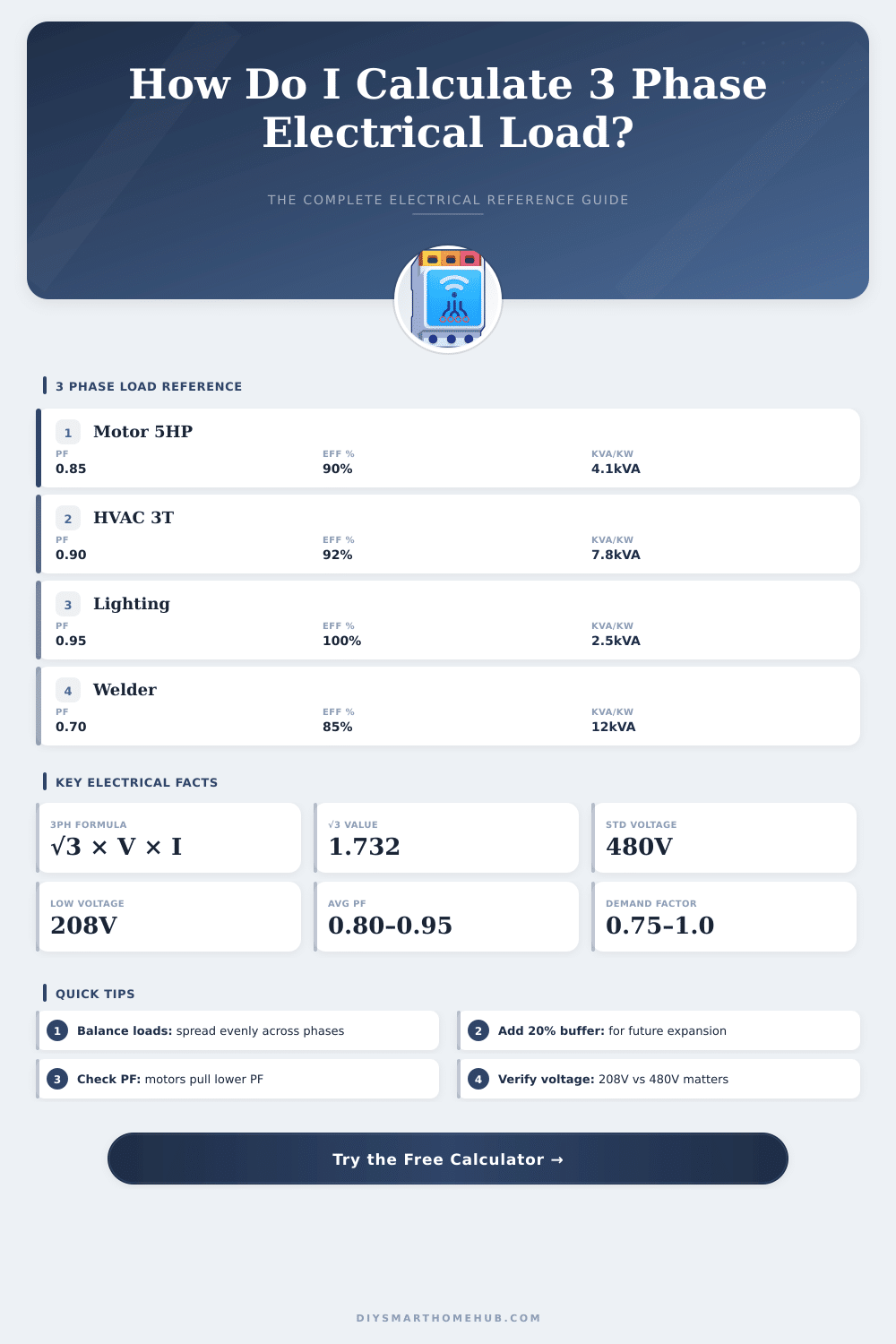
To count 3 Phase Electrical Load values, one divides the wattage of the voltage and then multiplies by 1.73. Because for purely resistive consumers, watts match 1.732 times the current times voltage. Here is an interesting twist, you truly can run three phase engines and heaters on single phase power, if you place a VFD between them.
The VFD makes a three phase wave at its output, what makes the whole thingperfect. In houses with three phase wiring, the voltage between phases jumps from 230 to 400 volts. That ends with lower cost for cables and converters, compared to handling same loads with another method.