🐟 Aquarium Lighting Calculator
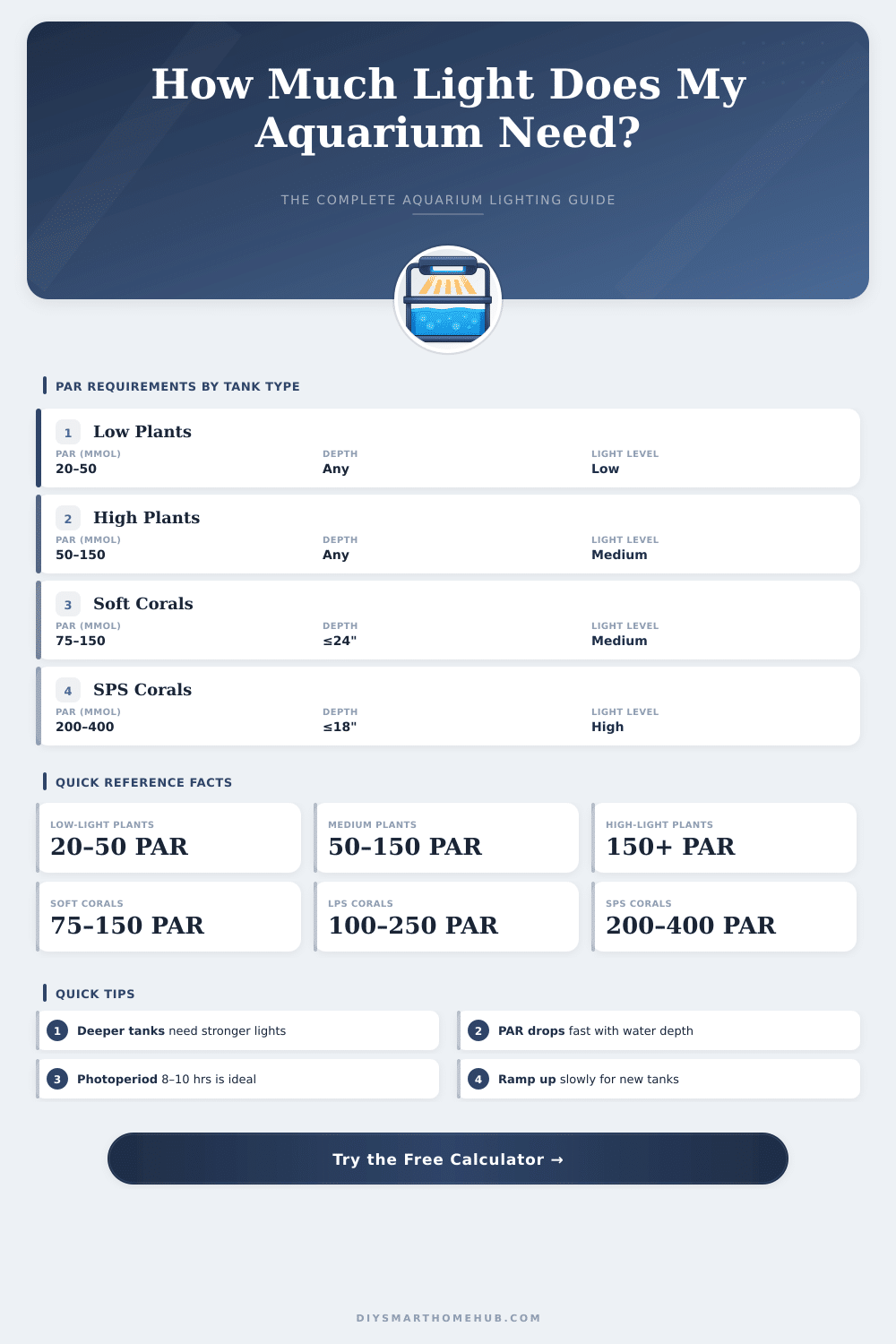
Find the ideal PAR, watts & lumens for your tank size, depth, and livestock type
| Depth | PAR Remaining (%) | Example: 300 PAR at surface | Example: 150 PAR at surface |
|---|---|---|---|
| 5 cm / 2 in | ~95% | 285 μmol | 143 μmol |
| 10 cm / 4 in | ~85% | 255 μmol | 128 μmol |
| 20 cm / 8 in | ~70% | 210 μmol | 105 μmol |
| 30 cm / 12 in | ~55% | 165 μmol | 83 μmol |
| 40 cm / 16 in | ~40% | 120 μmol | 60 μmol |
| 50 cm / 20 in | ~28% | 84 μmol | 42 μmol |
| 60 cm / 24 in | ~18% | 54 μmol | 27 μmol |
| Tank Volume | Fish Only (W) | Planted / Soft Coral (W) | SPS / High-Light (W) |
|---|---|---|---|
| 10 L / 2.6 gal | 3–5 W | 5–10 W | 10–15 W |
| 40 L / 10 gal | 6–10 W | 15–25 W | 30–45 W |
| 75 L / 20 gal | 10–18 W | 25–45 W | 50–80 W |
| 150 L / 40 gal | 20–35 W | 50–85 W | 100–150 W |
| 300 L / 80 gal | 40–60 W | 90–150 W | 180–270 W |
| 500 L / 130 gal | 60–90 W | 140–220 W | 280–400 W |
| Kelvin (K) | Color Appearance | Best For | Photosynthetic Value |
|---|---|---|---|
| 2700–3000 K | Warm White | Freshwater planted accents | Low–Moderate |
| 5000–6500 K | Neutral / Daylight | Freshwater planted tanks | High |
| 7000–10000 K | Cool White / Blue | Marine & reef tanks | High (coral pop) |
| 14000–20000 K | Deep Blue / Actinic | SPS / coral fluorescence | Moderate (PAR lower) |
The lighting for Aquarium setups changed a lot over the years. Before, people used energy-wasting types like fluorescent tubes or metal halide lamps but those already belong to the past. Now they are replaced by efficient LED lights.
The LED technology provides full-spectrum light with rich colours and good intensity for the healthy growth of water plants. It also helps to protect light-sensitive fishes, allowing them to stay active in their Aquarium tanks.
How to Choose the Right Light for Your Fish Tank
LED lamps last more in the long term than older types, so they commonly are the best choice. Currently most Aquarium tanks use LEDs. Even so, when one requires light to warm the water in a cool room, one yet can use older tubes.
Choosing light, consider three main parts: the colour spectrum, the intensity of the light and its spread. Good lighting has the right Kelvin rating for the plants and offers the right colour range, so that the plants indeed absorb the light. The visible light ranges from 400 nm (violet) to 700 nm (red).
In the visible spectrum, the blue and red parts best help the plants and seaweeds.
There are also programmed types. Some lamps arrive with set schedules for the light and changeable intensity. Functions for sunrise and sunset allow the fishes to adapt too the light before it reaches maximum, which is a nice detail.
Some models include settings like 24/7 mode, memory function, DIY mode, set timers and ratings for water quality.
About budget. Cheap lamps or similar options, like common store lights, can work just as well as some more expensive Aquarium models. A regular desk lamp does not give quite enough shine for keeping live plants, and usual tubes do not give the right spectrum for their growth.
Some grow lights use Samsung LM301 diodes, that reach more than 200 lumens per watt. Most Aquarium lamps, even the expensive ones, only reach 50 to 80 lumens per watt, which is quite a lot lower in comparison.
Most LED systems for Aquarium setups target low-tech or mid-tech setups for beginners, who want to keep some plants alive. For expert builders of planted tanks, high PAR lighting is more important. Brands like Fluval, Chihiros, Nicrew and Hygger rank very highly.
The Aqua Worx SOL is friendly to budget and provides balanced spectrum for plant growth. The AquaZen ZenGlow works well for beginners with low-care planted tanks up to 10 gallons.
For sea reef tanks, the lighting is one of the costliest parts. The used type of light decides which corals can live there. High reef light systems commonly include wireless controls and can connect with Bluetooth for use by means of phones.
Special lamps exist, that stop the growth of seaweeds andthe stress of corals.