☀️ Battery & Solar Panel Calculator
Size your solar system perfectly — panels, battery bank, and daily energy needs in one tool
| Region / Location | Avg Peak Sun Hrs | Annual kWh/m² | Best Season |
|---|---|---|---|
| Southwest USA (AZ, NV, NM) | 6.0 – 7.5 hrs | 1800 – 2200 | Year-round |
| Southeast USA (FL, TX) | 5.0 – 6.5 hrs | 1600 – 1900 | Spring/Summer |
| Midwest USA | 4.0 – 5.5 hrs | 1300 – 1600 | Summer |
| Northeast USA / Canada | 3.5 – 5.0 hrs | 1100 – 1400 | Summer |
| Pacific Northwest USA | 3.0 – 4.5 hrs | 1000 – 1300 | Summer |
| UK / Northern Europe | 2.5 – 4.0 hrs | 900 – 1200 | Summer |
| Central Europe | 3.5 – 5.0 hrs | 1100 – 1500 | Spring/Summer |
| Australia (general) | 5.5 – 7.0 hrs | 1700 – 2100 | Year-round |
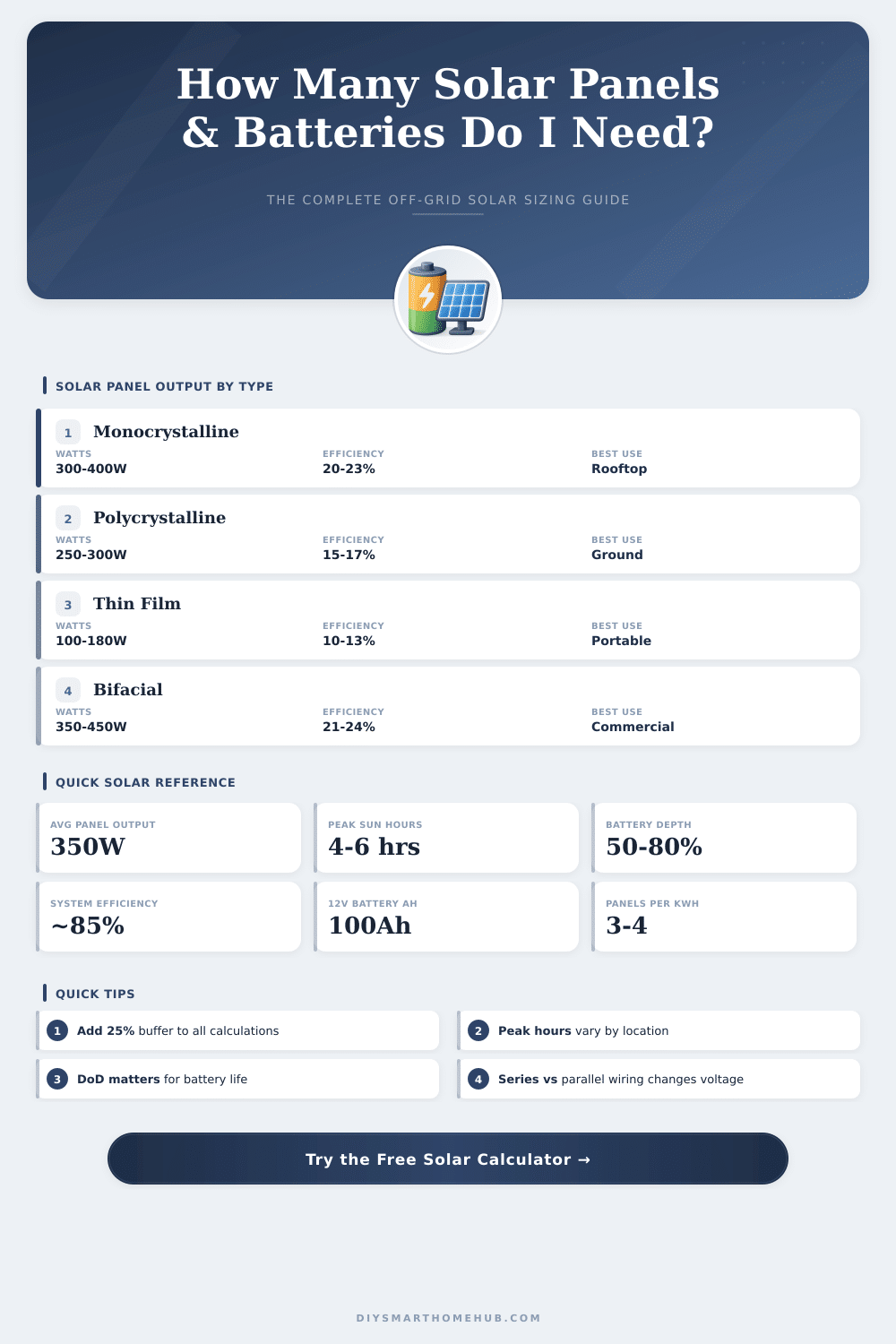
| Panel Type | Wattage Range | Efficiency | Daily Output (5 sun hrs) | Best Use Case |
|---|---|---|---|---|
| Monocrystalline | 200 – 450W | 18 – 23% | 1.0 – 2.25 kWh | Rooftop, space-limited |
| Polycrystalline | 150 – 350W | 14 – 17% | 0.75 – 1.75 kWh | Ground mount, budget |
| Bifacial Mono | 350 – 500W | 20 – 24% | 1.75 – 2.5 kWh | Ground, elevated mount |
| Thin Film (CdTe) | 80 – 180W | 10 – 13% | 0.4 – 0.9 kWh | Portable, flexible use |
| PERC Monocrystalline | 300 – 450W | 19 – 22% | 1.5 – 2.25 kWh | High-efficiency rooftop |
| Portable / Foldable | 20 – 120W | 14 – 21% | 0.1 – 0.6 kWh | Camping, RV, backup |
| Appliance | Watts | Hrs/Day Typical | Daily Wh | Daily kWh |
|---|---|---|---|---|
| LED Light Bulb | 8 – 15W | 5 hrs | 40 – 75 Wh | 0.04 – 0.075 |
| Laptop Computer | 45 – 90W | 6 hrs | 270 – 540 Wh | 0.27 – 0.54 |
| Smartphone Charge | 10 – 25W | 2 hrs | 20 – 50 Wh | 0.02 – 0.05 |
| 12V Fridge (small) | 35 – 60W | 24 hrs | 400 – 800 Wh | 0.4 – 0.8 |
| Household Fridge | 100 – 200W | 8 hrs avg | 800 – 1600 Wh | 0.8 – 1.6 |
| TV (32″ LED) | 30 – 80W | 4 hrs | 120 – 320 Wh | 0.12 – 0.32 |
| Ceiling Fan | 15 – 75W | 8 hrs | 120 – 600 Wh | 0.12 – 0.6 |
| Water Pump | 200 – 750W | 1 hr | 200 – 750 Wh | 0.2 – 0.75 |
| CPAP Machine | 30 – 60W | 8 hrs | 240 – 480 Wh | 0.24 – 0.48 |
| AC Unit (window) | 500 – 1500W | 6 hrs | 3000 – 9000 Wh | 3.0 – 9.0 |
| Daily Usage | LiFePO4 Bank (2 days) | AGM Bank (2 days) | Panels Needed (5 hrs) |
|---|---|---|---|
| 0.5 kWh/day | ~52 Ah @ 12V | ~83 Ah @ 12V | 1 x 100W panel |
| 1.0 kWh/day | ~104 Ah @ 12V | ~167 Ah @ 12V | 2 x 100W panels |
| 2.5 kWh/day | ~260 Ah @ 12V | ~417 Ah @ 12V | 2 x 300W panels |
| 5.0 kWh/day | ~520 Ah @ 12V | ~833 Ah @ 12V | 4 x 300W panels |
| 10 kWh/day | ~260 Ah @ 48V | ~417 Ah @ 48V | 8 x 300W panels |
| 20 kWh/day | ~521 Ah @ 48V | ~833 Ah @ 48V | 16 x 300W panels |
Solar panels commonly work with batteries for many users. Deep cycle battery, used for solar panel systems, are designed for long and repeated charge and discharge cycles. That battery stores energy from sources like solar panels that generate power only when the sun shines.
Without such storage a 12-volt panel can range from zero to 20 or even 30 volts in open circuit, so batteries help to keep a stable level.
Do Solar Panels Need Batteries?
Solar panels do not carry built-in batteries. They create power, that one can store in separate batteries. Some solar panel setups include storage units to preserve extra energy used overnight, when the sun is gone.
Really, the battery itself is not a separate energy source. It works best as a holder of energy. Panels deliver it only briefly, and without storage it simply disappears.
battery for home use, like the Powerwall, form joined cells that receive energy from solar panels or the grid. The stored energy then can feed devices day and overnight, during power cuts or when one leaves the grid. Many folks do not know, that if the grid goes down, solar panels do not give power to the house, unless they are bound too batteries.
Even so, one can use solar panels without any batteries for storage. Not each person needs to buy such unit right away. Prices of solar systems dropped by 70 to 90 percent during the past 10 years.
Batteries seem still cheap, so that what now costs around 15 000 dollars, could fall to 6 to 7 thousand dollars in some years, and also become more efficient. Buy good panels and inverters now and wait on batteries is a good plan.
There are setups that carry inverters to convert DC energy from solar panels to AC energy and back to the grid. In such systems, batteries allow folks to store extra energy from the day to use it overnight or in times of high demand. The IRA currently offers a 30 percent tax credit for added batteries, what helps to cut costs.
Close to camping, simpler and small systems work very well. Portable power banks with folding solar panels help to charge phones, lanterns and other tiny tools. A folding panel of 60 watts charges a smartphone in some hours or less.
A popular combo is a 100-watt panel together with a solar charger and deep cycle marine battery in a box. The main problem during camping is the limited number of sun hours per day, so enough power from panels matters. Around 600 watts from panels and two 100-amp-hour batteries form a good target for those who truly depend on such energy.
LiFePO4 batteries are seen as astrong option because they are much more safe than average lithium ion batteries.