🔊 Speaker Wire Gauge Calculator
Find the correct AWG wire gauge for your speaker run length and impedance
| Gauge (AWG) | Resistance (Ω/ft) | Resistance (Ω/m) | Max Run @ 8Ω | Max Run @ 4Ω | Max Run @ 8Ω (m) |
|---|---|---|---|---|---|
| 10 AWG | 0.00203 | 0.00666 | 320 ft | 160 ft | 97 m |
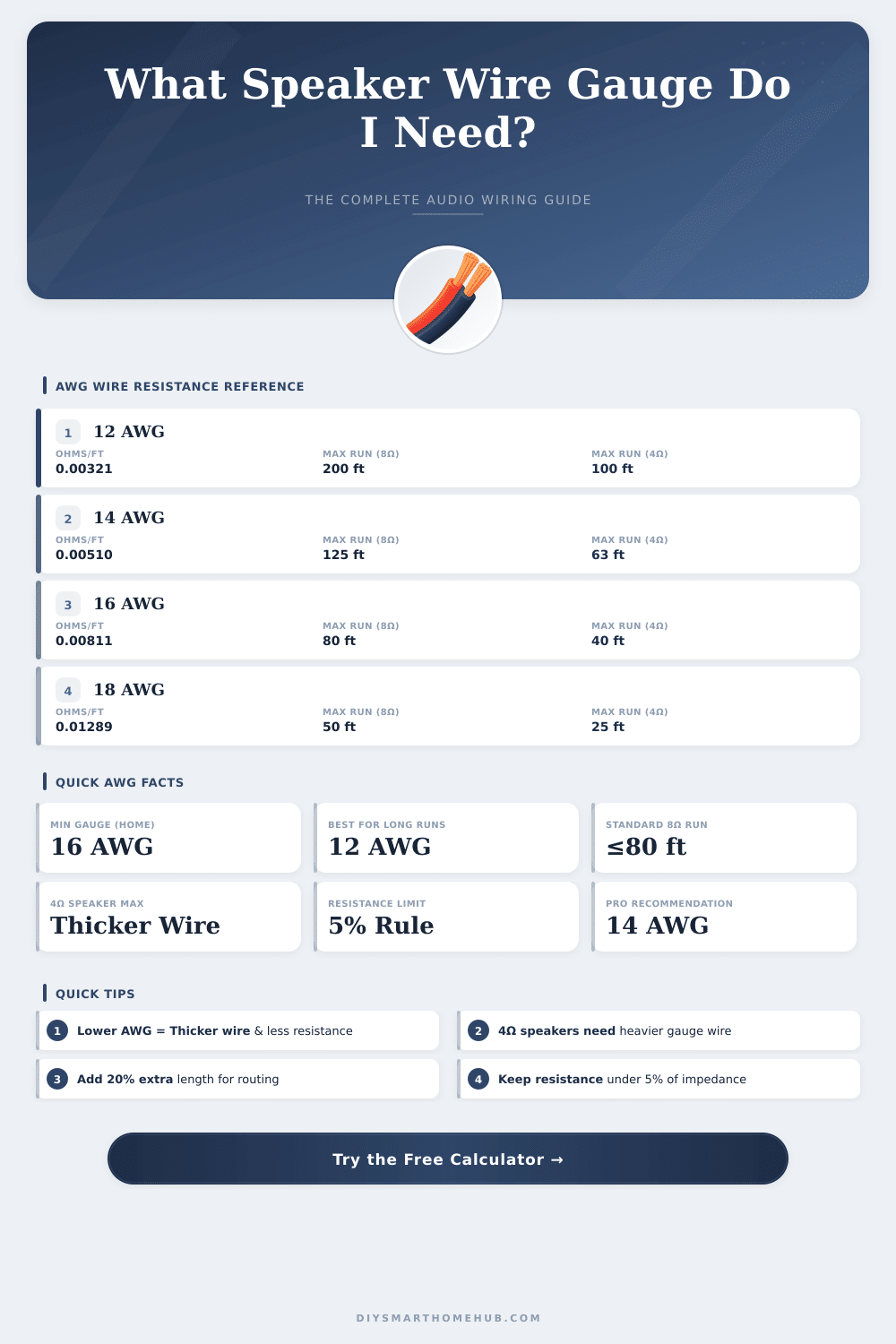
| 12 AWG | 0.00321 | 0.01053 | 200 ft | 100 ft | 61 m |
| 14 AWG | 0.00510 | 0.01673 | 125 ft | 63 ft | 38 m |
| 16 AWG | 0.00811 | 0.02661 | 80 ft | 40 ft | 24 m |
| 18 AWG | 0.01289 | 0.04228 | 50 ft | 25 ft | 15 m |
| 20 AWG | 0.02049 | 0.06720 | 31 ft | 16 ft | 9 m |
| 22 AWG | 0.03257 | 0.10682 | 20 ft | 10 ft | 6 m |
| AWG | 2Ω Speaker (ft) | 4Ω Speaker (ft) | 6Ω Speaker (ft) | 8Ω Speaker (ft) | 16Ω Speaker (ft) |
|---|---|---|---|---|---|
| 10 AWG | 80 ft | 160 ft | 240 ft | 320 ft | 640 ft |
| 12 AWG | 50 ft | 100 ft | 150 ft | 200 ft | 400 ft |
| 14 AWG | 31 ft | 63 ft | 94 ft | 125 ft | 250 ft |
| 16 AWG | 20 ft | 40 ft | 60 ft | 80 ft | 160 ft |
| 18 AWG | 12 ft | 25 ft | 37 ft | 50 ft | 100 ft |
| 20 AWG | 8 ft | 16 ft | 24 ft | 31 ft | 63 ft |
| Setup | Typical Run | Impedance | Recommended AWG | Notes |
|---|---|---|---|---|
| Bookshelf Stereo | 10–25 ft | 8Ω | 16 AWG | Plenty for short runs |
| Floorstanding Speakers | 15–40 ft | 8Ω | 14–16 AWG | 14 AWG preferred |
| In-Wall / In-Ceiling | 30–80 ft | 8Ω | 14 AWG | Use CL2/CL3 rated wire |
| Subwoofer | 10–30 ft | 4Ω | 14–16 AWG | Low impedance needs thicker |
| Outdoor Speakers | 40–100 ft | 4–8Ω | 12–14 AWG | Use UV-rated direct burial |
| Home Theater (5.1) | 15–60 ft | 8Ω | 14–16 AWG | 14 AWG for rear runs |
| PA / High Power | 50–150 ft | 4Ω | 10–12 AWG | Power loss critical |
The rating of speaker wire relates mainly to the size of the wire itself. One measures it according to the American system of wire ratings, or simply AWG. Smaller numbers point to wires with bigger thickness, while bigger numbers show wires with smaller thickness.
Like this, wire of 16 rating is less thick than that of 14 rating, which in turn is less thick than 12 rating. This maybe seems unfair but like this it works in the system.
How to Choose the Right Speaker Wire
For the most common home sound systems, speaker wire of 16 rating works entirely well. At short distances under 50 feet to a typical speaker of 8 ohms, 16 rating works very well. The resistance of copper cable of 16 rating does not affect the sound truly in runs of 50 feet or less with a normal speaker of 8 ohms.
Even 18 rating works for low-power home or car speakers, that is not subwoofers.
The situation changes when the distance becomes bigger. When speakers are more than 50 feet away from the receiver, one should switch to 14 rating. Speaker wire of 14 rating, tied to a speaker of 8 ohms, should not pass 80 feet.
Speaker wire of 12 rating with a load of 8 ohms can reach up to 120 feet with good clarity. On the other hand, very thin wire of 22 rating too a speaker of 8 ohms should not pass 12 feet.
Wire with heavier rating has less resistance. This allows more efficient sending of power from the amplifier to the speaker. At long runs with thin cable, part of the power of the amplifier is lost in the wire itself.
That simply wastes energy without reason. If one uses too thin wire for long distances, the sound can become weak or even cause damage to the devices.
For speakers of 4 ohms with low impedance or for systems of high power, one should choose 12 AWG or even thicker. The maximum fair distance for speaker wire of 16 rating with a load of 4 ohms is around 24 feet. Subwoofers and high-frequency drivers work well with 12 AWG or even 10 AWG wire.
The price gap between 16 and 14 ratings is not very big, so using a bit thicker than needed never matters.
One must know that speaker wire of 12 rating sometimes is almost too thick for some holes of binding posts and round clips. Speaker wire of 14 rating is easier to handle and quite good for short runs. For very short distances in cable setup for speakers, 18 rating does the task.
Copper without oxygen is the best choice compared to aluminum covered with copper, which costs less but is not as efficient. Shielded speaker wire of 16 rating can be more helpful thanunshielded of 14 rating, because long wire runs sometimes pick up interference like antennas.