♨️ Hot Tub Electricity Cost Calculator
Estimate your hot tub’s monthly and annual electricity usage based on tub size, heater wattage, and run time
| Temp Difference (°F) | Temp Difference (°C) | Est. Heater Duty Cycle | Energy Impact |
|---|---|---|---|
| 10°F (ambient 92°F) | 5.6°C | 10–15% | Very Low |
| 25°F (ambient 77°F) | 13.9°C | 20–30% | Low |
| 47°F (ambient 55°F) | 26.1°C | 35–50% | Moderate (typical) |
| 62°F (ambient 40°F) | 34.4°C | 50–65% | High |
| 82°F (ambient 20°F) | 45.6°C | 65–80% | Very High |
| 102°F (ambient 0°F) | 56.7°C | 80–95% | Extreme |
| Component | Typical Wattage | Duty Cycle | kWh per Day (avg) |
|---|---|---|---|
| Electric Heater (standard) | 3,000–6,000 W | 30–60% | 2.5–8.6 kWh |
| Circulation Pump | 50–250 W | 24 hrs | 1.2–6 kWh |
| Jet Pump (1-speed) | 1,000–2,500 W | 1–3 hrs use | 1–7.5 kWh |
| Jet Pump (2-speed) | 2,000–3,000 W | 1–4 hrs use | 2–12 kWh |
| LED Lighting | 10–30 W | 1–3 hrs | 0.01–0.09 kWh |
| Ozone Generator | 10–50 W | 2–4 hrs | 0.02–0.2 kWh |
| Control System | 10–50 W | 24 hrs | 0.24–1.2 kWh |
| Blower | 1,000–2,000 W | 0.5–1 hr | 0.5–2 kWh |
| Scenario | Tub Size | Avg kWh/Month | Metric Equiv. |
|---|---|---|---|
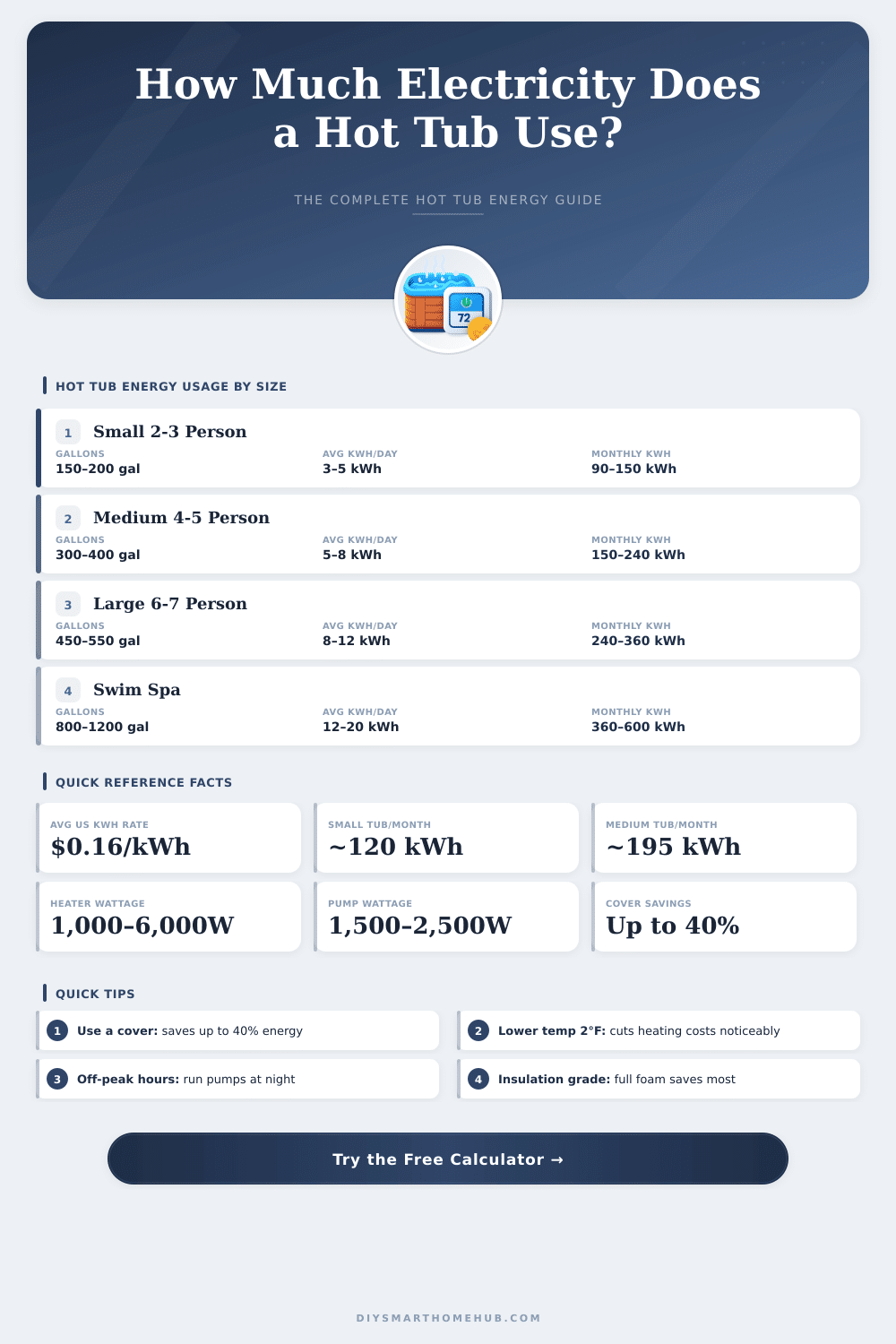
| Inflatable, light use | 150 gal (568 L) | 30–60 kWh | 108–216 MJ |
| Small tub, daily use | 250 gal (946 L) | 90–130 kWh | 324–468 MJ |
| Medium tub, moderate use | 350 gal (1,325 L) | 150–200 kWh | 540–720 MJ |
| Large tub, daily use | 500 gal (1,893 L) | 200–300 kWh | 720–1,080 MJ |
| Swim spa, daily use | 1,000 gal (3,785 L) | 350–600 kWh | 1,260–2,160 MJ |
| Large tub, cold winter | 500 gal (1,893 L) | 300–450 kWh | 1,080–1,620 MJ |
| Insulation Type | Heat Loss Factor | Energy Multiplier | Notes |
|---|---|---|---|
| Full-Foam (Excellent) | Very Low | 0.70x (30% savings) | Best efficiency |
| Partial Foam (Good) | Low–Moderate | 0.85x (15% savings) | Most newer tubs |
| Standard (Average) | Moderate | 1.00x (baseline) | Most common |
| Minimal (Poor/Inflatable) | High | 1.35x (+35% cost) | Inflatable / older |
Hot Tub needs enough electrical energy to operate. On average, electrical Hot Tub uses 1,500 to 6,000 watts, depending on the kind and the mode, as one uses them. 220-volt Hot Tub usually takes between 3,000 and 6,000 watts, and the higher voltage allows the heater to warm the water more quickly.
That fast warming motivated many folks to choose 240-volt setups instead of 120-volt.
Hot Tub Power Use and Costs
Installing a Hot Tub is not as easy as simply plugging it in. Most Hot Tub models require 240-volt wiring with 50 amps. Some require up to 60 amps, while others work with 30 or 40.
Hot Tub models normally do not have a setting for cable. One must connect them directly to the home electrical panel, similar to electrical water heatres. The wiring must follow the National Electrical Code, and many regions also have local building rules.
GFCI breakers must be at least five feet away from the Hot Tub and visible from it. Six-gauge copper cable one commonly must use for the ties.
Electrical warming reaches 100-percent efficiency, so all energy that enters becomes heat. So, whether the Hot Tub runs on 110 or 220 volts, the energy for the same temperature increase stays almost the same. On the other hand, 220-volt Hot Tub models usually are built and insulated moor well.
Here are the monthly expenses. Most home owners observe that there Hot Tub uses 90 to 600 kWh monthly, which adds around 60 to 70 dollars to the bill. Some calculations estimate the whole running cost at 30 to 100 dollars per month.
Modern Hot Tub models can cost almost one dollar a day, so around 50 dollars monthly in the worst case. Really, the costs depend on local power prices, on the climate and on how often you use it.
This is worth noting. Around 75 percent of the energy use of a Hot Tub happens when it is covered and not in use. The size, the usage time and the insulation all decide how much electricity it uses.
For instance, wet or soaked cover can really lower the efficiency. Removing old cover can save a lot of energy. Keeping the Hot Tub at lower temperature during the week and only warming it for use, one also can save.
One person managed to save 50 to 75 dollars monthly like this, although the reheating to four degrees per hour happens only then.
Inflatable Hot Tub models cost less at first, but they can raise the power bill by more than 100 dollars monthly. One commonly sees them as a trial step, to estimate whether a real Hot Tub deserves the investment. Soft-sided models keep the heat well, even so, andsmaller ones warm up quite quickly.