💡 Lumens Calculator — Room Size & Lighting
Find exactly how many lumens and bulbs your room needs for perfect lighting
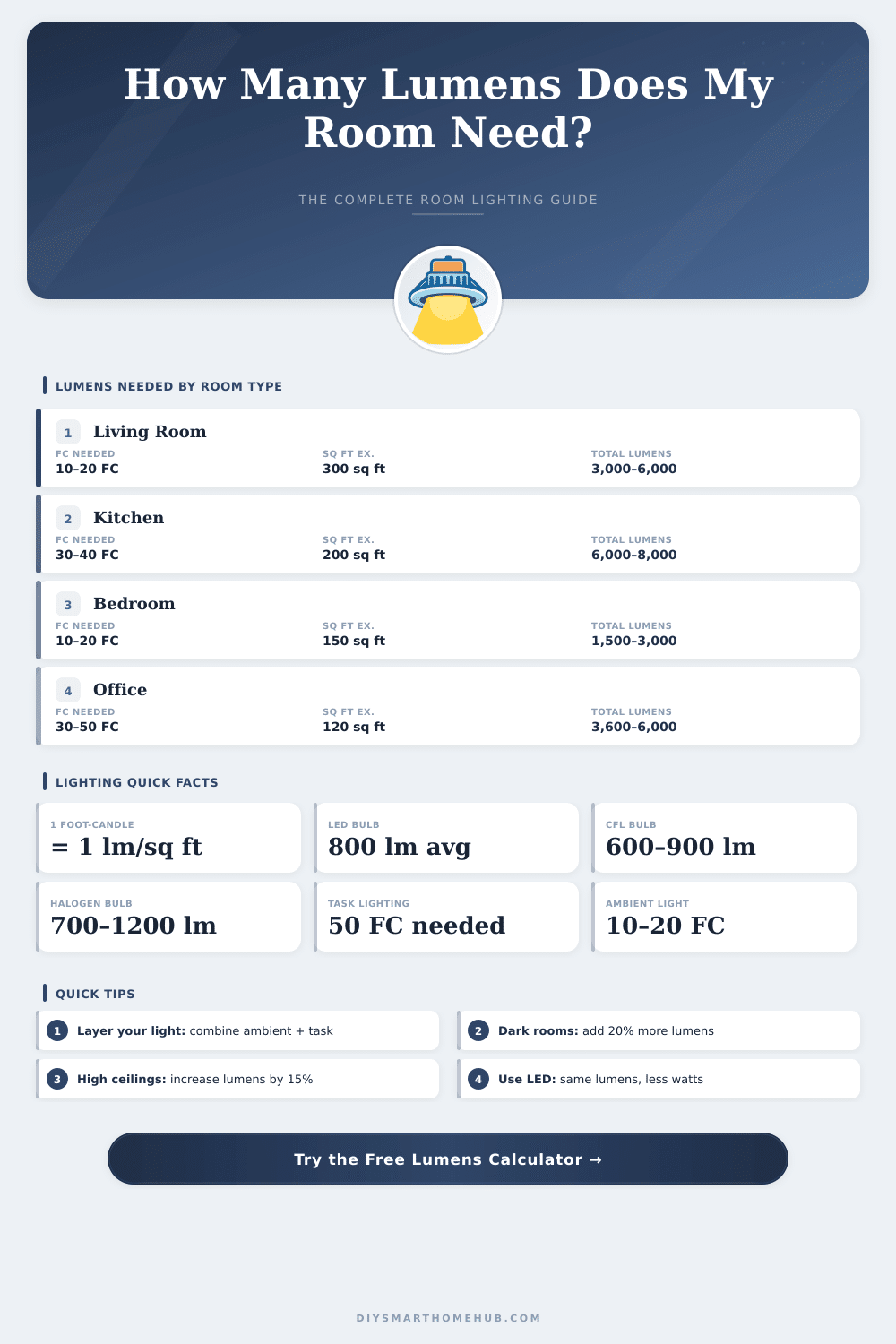
| Room Size | Sq Ft | Min Lumens | Max Lumens | Sq Meters |
|---|---|---|---|---|
| Small Bedroom | 100 | 1,000 | 2,000 | 9.3 m² |
| Average Bedroom | 150 | 1,500 | 3,000 | 13.9 m² |
| Master Bedroom | 225 | 2,250 | 4,500 | 20.9 m² |
| Small Kitchen | 100 | 3,000 | 4,000 | 9.3 m² |
| Average Kitchen | 175 | 5,250 | 7,000 | 16.3 m² |
| Living Room | 250 | 2,500 | 5,000 | 23.2 m² |
| Large Living Room | 400 | 4,000 | 8,000 | 37.2 m² |
| Home Office | 100 | 3,000 | 5,000 | 9.3 m² |
| Bulb Type | Wattage | Lumens Output | Lumens/Watt |
|---|---|---|---|
| LED A19 | 8–10W | 800 lm | 80–100 |
| LED A21 | 14–16W | 1,600 lm | 100–114 |
| LED PAR38 | 15–20W | 1,200–1,400 lm | 70–80 |
| CFL Spiral | 13–15W | 800–900 lm | 60–70 |
| CFL Globe | 20–23W | 1,200 lm | 52–60 |
| Halogen A19 | 43W | 620 lm | 14–16 |
| Incandescent 60W | 60W | 800 lm | 13–14 |
| High-Output LED | 25–30W | 3,000 lm | 100–120 |
| Foot-Candles (FC) | 100 sq ft | 200 sq ft | 300 sq ft | 500 sq ft |
|---|---|---|---|---|
| 5 FC (Accent) | 500 lm | 1,000 lm | 1,500 lm | 2,500 lm |
| 10 FC (Ambient) | 1,000 lm | 2,000 lm | 3,000 lm | 5,000 lm |
| 20 FC (General) | 2,000 lm | 4,000 lm | 6,000 lm | 10,000 lm |
| 30 FC (Task) | 3,000 lm | 6,000 lm | 9,000 lm | 15,000 lm |
| 50 FC (Work) | 5,000 lm | 10,000 lm | 15,000 lm | 25,000 lm |
| 70 FC (Bright) | 7,000 lm | 14,000 lm | 21,000 lm | 35,000 lm |
Figuring out how many lumens your room truly needs is not difficult… A calculator for lumens helps you with the main work. Those simple programs remove the casual guesses by means of computing the perfect light level according to the size of your room and some extra elements.
Simply point the type of space that you have, enter the dimensions and height, and say how much glow you want for the objects. Later the tool shows exactly how many lumens and watts you must consider for that main area.
How to Use a Lumen Calculator
The most many of those calculators need only basic data: the square surface of your room or its dimensions in feet, inches or metres. Beyond that, some go more carefully; they ask about the height of the ceiling, the tone of your walls, the layout of furniture and whether natural light flows in during the day. The colour of walls matters more than one commonly thinks, because the reflection of light changes a lot between dark and bright surfaces.
When you enter everything, the program offers ideas about lamps or fixtures that fit best.
You will find calculators that cover almost every kind of room that you can imagine. Rooms for sleep, kitchens, workspaces, schools, canteens, stockrooms, retail stores, meeting rooms, everything is available. It matters to mention that different places require totally different levels of light, hence the advice adapts according to your choice.
Except only lumens, some tools also convert between other measures of light. Lux is one of them, it shows one lumen scattered over a square metre. When light goes more far, it spreads over bigger space, hence distance plays a role.
Foot-candles commonly appear in old specifications. On the other hand is the metric version: candela per square metre, that sometimes one calls nit. Foot-Lambert measures lumens per square foot and works as the imperial match.
Another useful kind of calculator allows to convert watts directly to lumens. Enter the power of your lamp and the efficiency in lumens per watt, press the button and done. Assume that you have a 10-watt LED that gives 100 lumens per watt; that results in 1000 lumens totally.
Like this one can well light work areas without too much energy use.
Here we walk through a sample with a kitchen space, to sea how that works in reality. Picture a rectangular kitchen of 4 metres long and 2.5 metres wide, first you find the whole area. Then choose the type of lamps.
An average bulb gives about 800 lumens, while single LED lights can deliver 200 lumens each or more. From here the calculator helps to find the right number of bulbs.
When you set the surface and the type of room, the math is simple. The hard step is choosing the right level of glow, then picking lights that allow to dim for various moods. Those calculators help also to match the total lumens with online products, for example a particular LED ceiling lamp…
So buyingbecomes much more simple.